


The link building tool landscape has been transformed by AI in ways that have fundamentally changed how teams prospect for opportunities, manage outreach campaigns, and track the performance of their link building efforts.
What once required six or seven separate tools, each handling a narrow slice of the workflow, can now be accomplished with three or four well-chosen platforms that leverage AI to connect prospecting, outreach, and analysis into unified workflows.
The result is that link building has become both more accessible to smaller teams and more demanding in terms of quality expectations.
AI tools have lowered the barrier to entry for prospecting and outreach, which means more outreach emails are hitting editors’ inboxes than ever before.
This increased volume has simultaneously raised the bar for what gets responses.
Choosing the right targets, crafting genuinely compelling pitches, and managing editorial relationships has become more important than ever.
According to a 2025 survey of 518 SEO professionals, 82% of SEOs rely on dedicated backlink analysis tools like Ahrefs and Semrush as a core part of their link building workflow, cementing these platforms as the non-negotiable foundation of any modern link building stack.
Prospecting and Research Tools
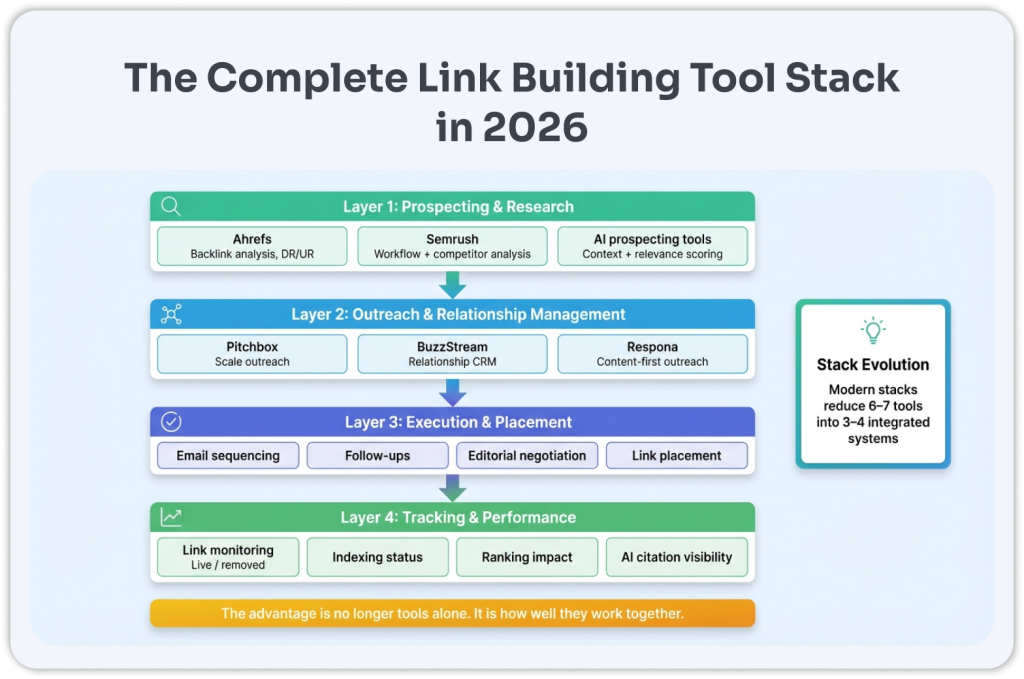
Ahrefs and Semrush remain the two dominant platforms for backlink analysis and competitor research in 2026, and any serious link building operation needs access to at least one of them.
Ahrefs’ Site Explorer provides the most comprehensive backlink index available, with its database having grown to over 27.2 trillion indexed backlinks as of early 2025, a 112.5% increase since 2017.
Semrush’s Link Building Tool offers stronger workflow integration for managing outreach campaigns directly from prospect identification through to placement tracking.
When it comes to which platform SEO professionals actually prefer for authority metrics, 64.1% of SEO specialists surveyed in 2025 use Ahrefs’ DR and UR as their primary domain authority metrics, making it the clear industry standard for evaluating link placement quality.
AI-native prospecting tools have emerged as a significant new category that goes beyond traditional backlink databases.
These tools use large language models to analyse not just domain metrics but content relevance, editorial quality, audience alignment, and predicted outreach success rates.
They can identify link opportunities that traditional tools miss because they evaluate contextual fit rather than just numerical authority scores.
For teams that prefer a software-driven approach over manual prospecting and outreach management, dedicated link building software platforms provide end-to-end campaign management from prospect identification through outreach sequencing to placement verification and reporting.
Outreach and Relationship Management
Email outreach tools have evolved significantly in 2026 compared to even two years ago.
Platforms like Pitchbox, BuzzStream, and Respona now offer AI-powered email personalisation that goes well beyond traditional mail merge variables.
These tools analyse the target site’s recent content, identify specific articles relevant to your pitch, extract key themes and talking points, and generate outreach emails that reference the prospect’s work in contextually appropriate ways.
The shift toward AI-assisted outreach has created a paradoxical challenge.
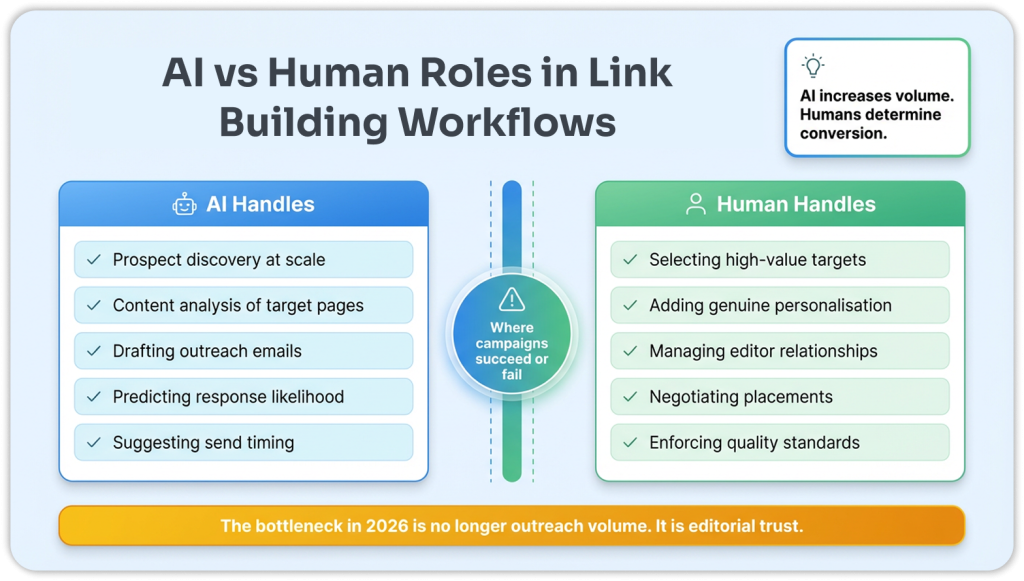
Because AI makes it easier to send personalised-seeming emails at scale, editors receive more apparently personalised pitches than ever, making it harder for any individual pitch to stand out.
The tools that deliver the best response rates in 2026 are those that use AI for research and initial drafting while making it easy and fast for human operators to add genuine personalisation, specific observations, and authentic enthusiasm before any email is sent.
According to industry data, 65% of SEOs now use AI tools specifically for automated prospecting and outreach personalisation, and 83% of link building platforms have integrated AI for advanced link quality assessment.
Relationship management features have become increasingly important as agencies and in-house teams recognise that long-term editorial relationships deliver far better conversion rates than cold outreach.
The best tools now include CRM-like features that track your history with each contact, note their preferences and editorial interests, schedule follow-ups, and flag when contacts change roles or publications.
Performance Tracking and Reporting
Tracking link building performance in 2026 requires significantly more sophistication than simply counting new referring domains each month.
The best tracking tools now monitor link persistence over time, checking whether placed links remain live at daily or weekly intervals and alerting you when links are removed or modified.
They also measure the indexing status of each placed link, because a link that Google has not crawled and indexed provides zero SEO value regardless of how impressive the hosting domain’s metrics look.
Advanced tracking tools now also measure the indirect impact of link building on AI search visibility.
They track whether your brand appears more frequently in AI-generated search results as your link profile grows.
While the correlation between links and AI citations is not as directly measurable as traditional ranking impacts, the trend data provides valuable strategic insight.
Research shows that 52% of digital marketers now use AI-based predictive analytics to prioritise which link targets will generate the greatest SEO impact, based on competitor and real-time SERP analysis, marking a significant shift from purely retrospective reporting to forward-looking performance forecasting.
For agencies and businesses evaluating the return on their link building investment, understanding current link building pricing benchmarks helps contextualise whether your combined tool and campaign costs are delivering competitive ROI compared to industry averages.
The most effective link building technology stacks integrate seamlessly with broader SEO platforms and reporting tools.
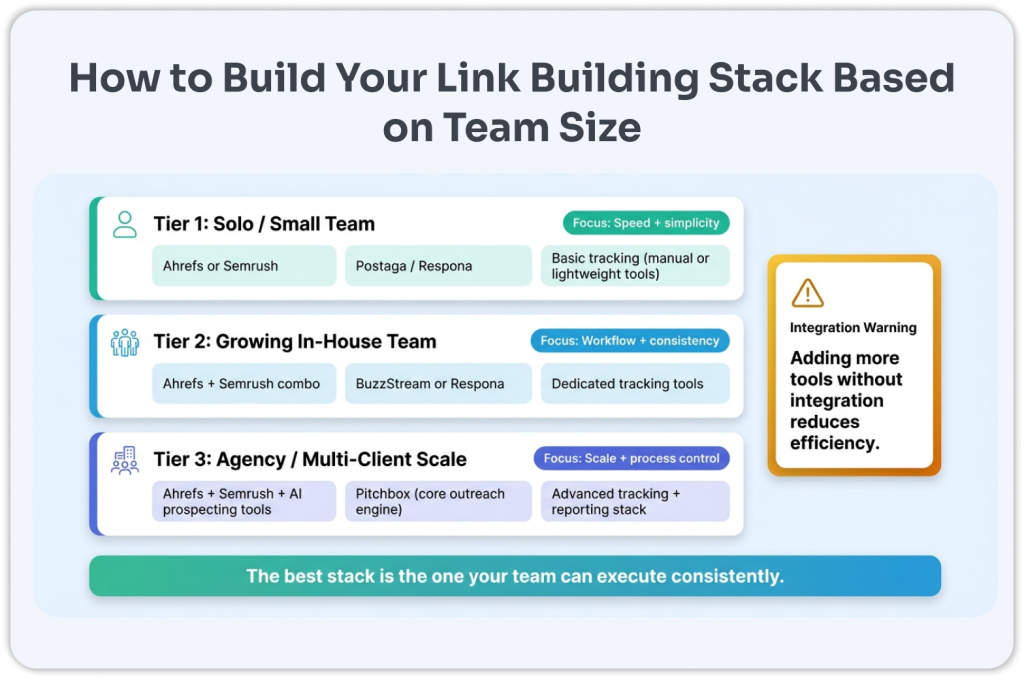
If you are assembling your stack, consider how each tool connects with your existing backlink acquisition workflow to avoid creating data silos that force manual data reconciliation and duplicate reporting effort.
The AI Search Factor in 2026
AI tools and market dynamics have created complex new pricing tensions in the backlink acquisition market that buyers and providers are still learning to navigate.
AI-powered prospecting, content creation assistance, and outreach personalisation have reduced the operational cost of link building by an estimated 20 to 30 percent across the industry.
This has theoretically allowed providers to offer lower prices while maintaining margins.
On the other hand, the dramatically increased strategic importance of quality backlinks for AI search visibility has driven up demand for premium placements.
Links directly influence whether brands are cited in ChatGPT, Perplexity, and Google AI Overview responses.
This matters particularly for high-authority placements from publications that most heavily influence LLM citation patterns.
The data confirms this shift in priorities: 73.2% of SEO professionals surveyed in 2025 now believe backlinks directly influence the probability of appearing in AI search results, up from far lower awareness in previous years.
The net effect is that mid-tier link placements in the DR 40 to 60 range have remained relatively price-stable.
Premium placements on DR 70 plus publications have become meaningfully more expensive as more companies compete for a limited supply of high-authority editorial opportunities.
Practical Implementation Guidance
Before committing budget to any link acquisition provider or establishing an ongoing programme, invest the time to establish comprehensive baseline metrics for your website’s current authority position.
Document your current domain rating, total number of referring domains and their quality distribution, organic traffic levels for your target keywords and pages, and current rankings for your priority keyword set.
Record any existing AI citation visibility data you can gather as well.
Record these metrics in a standardised format so you can measure the incremental impact of your link building investment over time with precision rather than relying on subjective impressions.
Set realistic expectations for timeline to results.
Meaningful and measurable ranking improvements from link building typically require three to six months of sustained effort to materialise.
The full compounding impact often is not fully visible until twelve months or more into a consistent programme.
Strategic Context and Market Positioning
The market for professional backlink acquisition services has matured substantially since the early days of bulk directory submissions, blog comment spam, and indiscriminate link buying from anonymous sellers.
In 2026, professional link building operates with a level of sophistication comparable to media buying or public relations.
There are established pricing models based on transparent quality metrics, comprehensive performance tracking and attribution systems, and industry standards for quality and ethical practice.
This professionalisation has raised both the quality floor, making truly terrible links less common from established providers, and the quality ceiling.
The best agencies can now deliver placements previously inaccessible to all but the largest brands with dedicated PR teams.
Understanding the total cost of ownership for backlinks requires a comprehensive financial analysis that looks well beyond the initial per-link acquisition price.
Factor in the expected lifespan of each link, as higher-quality editorial placements typically persist for three to five years or longer.
Cheap placements on low-quality sites may be removed within three to six months as the hosting site is abandoned, sold, or penalised.
Consider the opportunity cost of the time your team spends managing the acquisition process versus outsourcing to specialists with established relationships and optimised processes.
Account for the risk premium associated with different quality levels.
A single algorithmic penalty triggered by low-quality links can cost more in lost revenue and recovery expenses than years of investment in quality-focused link building.
Companies that pause or stop their link building while competitors continue to invest create a widening authority gap.
That gap becomes exponentially more expensive to close over time.
This competitive reality makes sustained monthly link building programmes significantly more cost-effective than sporadic campaigns, even though the total annual investment is larger.
Looking Ahead: Key Takeaways for 2026 and Beyond
The link building landscape continues to evolve at an accelerating pace, driven by advances in AI technology, changes in search engine algorithms, and shifting user behaviour.
User behaviour increasingly includes AI-mediated information discovery alongside traditional search.
Companies that invest in sustainable, quality-focused approaches today are building competitive advantages that compound over time.
These advantages become more valuable and more difficult for competitors to replicate with each passing quarter of consistent investment.
The strategic decisions you make about link building in 2026 will shape your organic visibility, AI citation profile, and competitive positioning for years to come.
Browse the full range of Blue Tree Digital case studies to see how clients across SaaS, fintech, cybersecurity, and ecommerce have grown their organic visibility through quality-focused link building programmes.




 Start the conversation