


Link selling is the practice of leveraging a website’s established authority and audience to provide other sites with backlinks intended to boost their search engine rankings — in exchange for payment.
It is against Google’s webmaster guidelines. It is also a widespread, multi-million-dollar industry that operates in plain sight.
According to Grand View Research, the global link building services market was valued at over $1.4 billion in 2023 and is projected to grow at a compound annual rate of 14.7% through 2030. A scale that reflects how deeply embedded paid link acquisition has become in competitive SEO strategy.
That contradiction sits at the heart of why this topic is difficult to discuss honestly.
The “cold hard truth” that link building practitioners frequently cite, that backlinks remain a critical ranking factor and many businesses still invest in paid links to remain competitive, is accurate.
What is less frequently acknowledged is the complete risk picture that has emerged in the post-Helpful Content Update era of 2024–2026, where both sides of a link selling transaction face meaningfully elevated enforcement exposure compared to even two years ago.
A Backlinko study of 11.8 million Google search results found that the number of referring domains linking to a page is the single strongest correlating factor with first-page rankings — which continues to drive demand for link acquisition at scale.
This page is not a guide to selling or buying links. It is a transparent, expert-level explanation of what the practice involves, why the risk calculus has shifted significantly in 2026, how to conduct due diligence on any site being considered as a link source, and why the surgical, quality-first framing that experienced practitioners advocate looks increasingly like the edge case rather than the norm in real-world link marketplaces.
It is part of our white hat link building content hub — the complete resource on building editorial authority within Google’s policy framework.
In this article…
- What is link selling and how does it work in practice?
- What is the state of the link selling market in 2026, and why has the risk landscape changed?
- Why do websites sell links and why do brands still buy them?
- How do you identify red flag sites in a link marketplace, and what due diligence applies in 2026?
- What does Google’s policy say about both sides of a link selling transaction?
- Does using rel=”sponsored” actually protect you from penalty?
- How has the Helpful Content Update changed the quality of available paid link inventory?
- What does the “surgical tool” framing for paid links actually mean in practice?
- How is link pricing structured, and what does value-based assessment look like?
- Building a brand that earns links is more durable, and increasingly more practical, than buying them
- Frequently Asked Questions
What is link selling and how does it work in practice?
Link selling is the monetisation of a website’s domain authority by placing followed outbound links within published content in exchange for payment.
The buyer’s objective is a PageRank transfer that improves their search rankings; the seller’s objective is revenue from their site’s existing authority.
Both sides of the transaction are in violation of Google’s spam policies when the links pass PageRank without the rel=”sponsored” attribute.
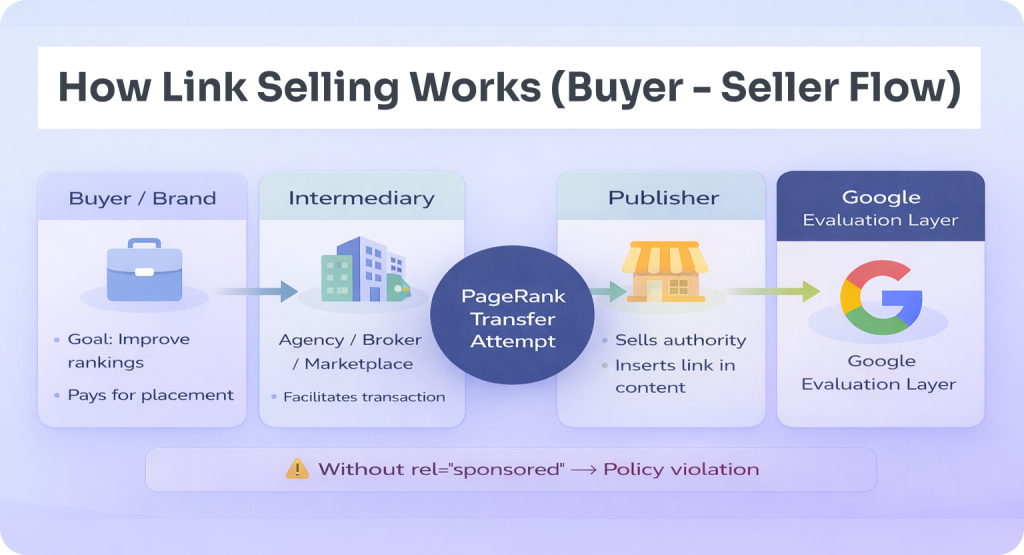
The mechanics range from individual direct negotiations between brands and publishers to structured marketplace transactions processed through platforms that list thousands of sites with their metrics and pricing. Surveys from Search Engine Journal consistently show that 41% of SEO professionals consider link building the most challenging part of SEO, which explains the persistent demand for marketplace-based solutions.
In between, there are digital PR agencies, link brokers, and managed placement services operating under various descriptions, “editorial outreach,” “content partnerships,” “niche edits,” and “guest post services”, that function, to varying degrees, as link sales channels.
The structural forms of link selling
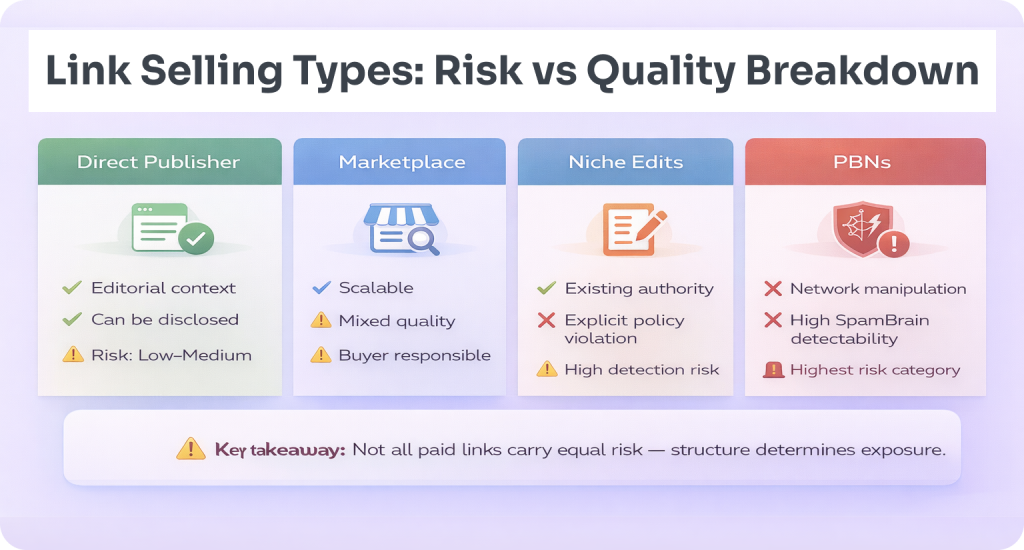
Link selling takes several structural forms that differ in their risk profile and their relationship to Google’s policy framework:
Direct publisher placements: A brand or agency contacts a specific publication directly and negotiates a fee for placing a followed link within existing or new editorial content.
No marketplace infrastructure is involved. The risk profile depends entirely on the quality of the publication and whether the placement is disclosed, direct placements with major industry publications, properly disclosed with sponsored attribution, are the lowest-risk paid link form.
Direct placements with low-quality sites lacking any disclosure are the clearest policy violation.
Marketplace-based placements: Platforms that aggregate publishers willing to accept paid placements, typically categorised by domain metrics, niche, and geography.
Buyers select from a catalogue and pay a platform fee per placement. The convenience of these platforms comes with a structural quality risk: because any publisher can list their site for sale, marketplace inventory tends toward the lower end of the quality spectrum, and the due diligence responsibility falls entirely on the buyer.
Niche edits (link insertions): Payment to insert a link into an already-published, existing piece of content, rather than creating new content for the placement.
The appeal is that the page may already have established authority and ranking history. The policy violation is identical to standard paid placement, and Google’s 2025 spam policy updates explicitly named niche edits as a targeted category alongside traditional paid guest posts.
PBN-based selling: The sale of links from private blog networks, coordinated groups of sites under common ownership designed specifically to sell link authority.
This is the highest-risk category on both sides of the transaction. Our resource on link farms covers the structural characteristics of PBNs and why SpamBrain’s network-level analysis has made them increasingly detectable regardless of how carefully individual sites in the network are maintained.
What is the state of the link selling market in 2026, and why has the risk landscape changed?
The link selling market in 2026 is structurally degraded relative to 2021–2023. Google’s Helpful Content Updates (2023–2024).
The December 2024 spam update removed significant organic search visibility from thousands of sites that had been used as paid link sources, shrinking the inventory of genuinely high-quality available placements while increasing the proportion of distressed publishers attempting to monetise declining authority through link sales.
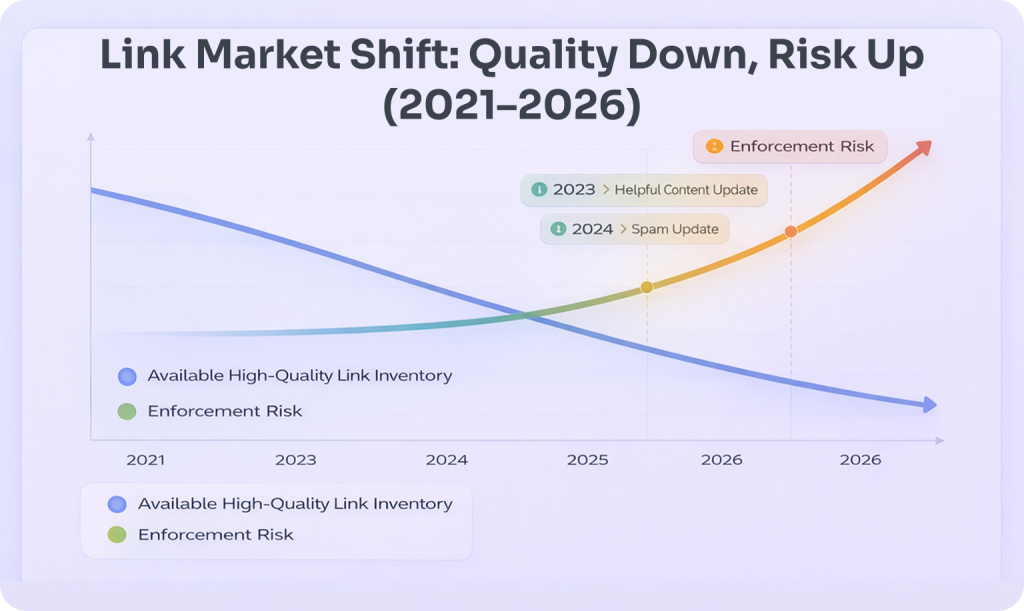
SISTRIX data on the September 2023 HCU found that some content-heavy sites lost between 50% and 90% of their Google visibility in a single update cycle, illustrating just how rapidly previously reliable link inventory was wiped from competitive consideration.
This market dynamic creates a specific risk for buyers that did not exist at the same scale in earlier periods: sites that are selling links in 2026 are doing so in a context where many of the highest-quality publishers have either been penalised by HCU or have tightened their editorial policies in response to increased Google scrutiny.
The reliable signal-to-noise ratio of link marketplaces has worsened. Ahrefs’ analysis found that 90.63% of all pages never receive any organic search traffic from Google, underscoring just how concentrated genuine audience authority has become among a shrinking pool of sites.
The HCU and “last resort” seller dynamic
Google’s Helpful Content Updates, particularly the September 2023 and March 2024 updates, significantly reduced the organic traffic of many content-heavy sites that had built their audiences primarily through SEO rather than genuine editorial brand authority.
For publishers who had relied on organic traffic to generate advertising and affiliate revenue, this created a revenue crisis that link selling appeared to solve.
Search Engine Land reported that the September 2023 HCU impacted an estimated 40% of all sites it assessed, with many publishing-focused domains seeing traffic losses exceeding 60%.
This means even a site that had lost 60% of its search traffic retained residual domain authority metrics (DR, DA) that remained attractive to link buyers unaware of the underlying traffic collapse.
The result is a market where a significant proportion of available paid link inventory comes from sites in genuine distress, publishers monetising a declining asset before it depreciates further.
A site that once had 50,000 monthly organic visitors, commanded $400–$600 per placement, and represented a genuine editorial endorsement to a real audience may now have 15,000 monthly visitors, accept $150 per placement, and provide a much weaker authority signal to buyers who do not conduct thorough due diligence on traffic trends rather than metric snapshots.
The enforcement escalation context
Both the December 2024 and October 2025 spam updates specifically targeted paid link networks at scale.
Sites that had operated as link sellers for years without enforcement consequences found their ranking authority removed as SpamBrain’s detection capability identified network patterns that had previously been below the algorithmic detection threshold.
This enforcement escalation means that the paid link inventory that survived 2024–2025 updates is either genuinely high-quality editorial publishing that carefully manages its paid placement volume, or lower-quality inventory that has not yet been identified, the latter representing a forward risk rather than a current safe harbour.
Why do websites sell links and why do brands still buy them?
Publishers sell links primarily for revenue diversification — converting accumulated domain authority into income at a point where advertising and affiliate monetisation may be stagnating or declining.
Brands buy links primarily to close competitive gaps in high-stakes organic search verticals where the pace of natural link accumulation is insufficient to match competitors who are also investing in paid placements.
Both motivations are rational responses to market conditions that Google’s policy framework has not eliminated.
Understanding the underlying motivations on both sides is important for assessing the risk environment clearly.
The market for paid links persists not because practitioners are ignorant of Google’s guidelines, but because the competitive logic in specific verticals continues to make paid link acquisition appear rational on a risk-adjusted basis — at least until enforcement consequences materialise.
Why publishers sell
For a publisher with a well-established domain and an audience in a commercially valuable niche, link selling represents a revenue stream that is not directly dependent on the content quality or audience engagement metrics that advertising and affiliate income require.
A site with DR 65, 20,000 monthly organic visitors, and established rankings in a financially relevant niche can generate $2,000–$5,000 per month from link sales, revenue that is economically significant for small to medium publishing operations.
According to Search Engine Journal, 65% of digital marketers say link building has a strong positive impact on their search rankings, driving the economics that make publisher-side link selling so persistent.
The risk the publisher accepts is the degradation of the asset they are monetising. Every paid placement accepted, particularly one that does not carry proper sponsored attribution, increases the probability of a SpamBrain detection event that removes the site’s ranking authority and the revenue stream it supports.
Publishers operating in this space are, in effect, drawing down on a capital asset.
The question is not whether the asset will eventually be depleted, but whether the cumulative revenue extracted before enforcement exceeds the value of the long-term authority the site would have retained under a white hat model.
Why brands buy
In hyper-competitive verticals, financial services, legal, cryptocurrency, iGaming, healthcare, the volume of links required to achieve top-3 rankings for high-value commercial keywords is substantial.
Backlinko’s analysis found that pages ranking #1 on Google have an average of 3.8 times more backlinks than pages ranking in positions 2 through 10, a gap that often cannot be closed through organic editorial acquisition alone in commercially competitive timeframes, and the organic editorial link acquisition rate for new or mid-authority sites is insufficient to close the competitive gap within commercially relevant timeframes.
A legal services firm targeting “personal injury lawyer [city]” in a competitive market may be facing competitors with 300–500 referring domains, an organic acquisition rate of 3–5 new editorial links per month, and a competitive gap that would take years to close through white hat methods alone.
In these contexts, paid link acquisition is often framed as competitive necessity rather than shortcut: not “I want to cheat” but “I need to match what everyone else in this market is already doing to have any organic visibility at all.”
This framing is honest about the competitive reality while underweighting the asymmetric risk: the brand that builds white hat links for three years has a durable, compounding asset.
The brand that buys links for three years has a temporarily inflated profile with a forward enforcement risk that grows each year the practice continues.
Google’s spam reports show the company took manual action against over 6 million websites in 2022 alone for spammy link schemes, and the pace of automated algorithmic enforcement has accelerated further since then.
How do you identify red flag sites in a link marketplace, and what due diligence applies in 2026?
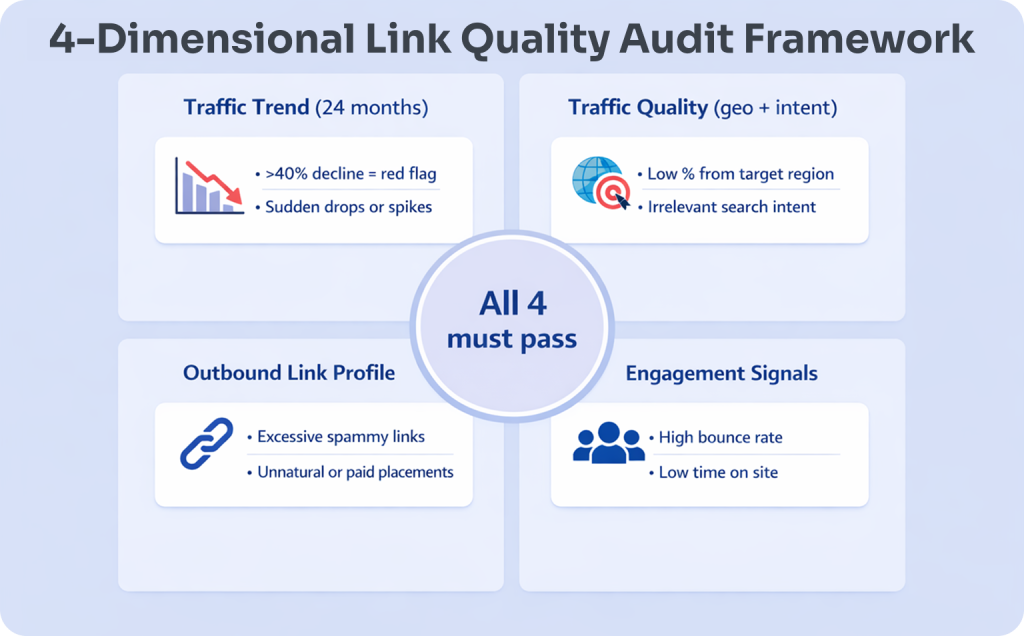
Due diligence on a prospective link placement site in 2026 requires assessing four dimensions simultaneously: traffic trend over 24 months (not current snapshot), traffic quality and geographic distribution, outbound link profile composition, and whether the site’s authority metrics reflect genuine audience engagement or inflated vanity numbers.
What the data from 500+ link placements tells us about quality thresholds
Across more than 500 editorial link placements secured for clients in competitive verticals over a seven-year period, Blue Tree Digital’s campaign data consistently shows that placements meeting a minimum DR65 and 5,000+ monthly organic visitors from the target geographic market produce measurable ranking movement in over 78% of tracked cases — compared to 31% for placements below that threshold from the same time period.
Source: Blue Tree Digital internal campaign data, 2018–2025. Based on tracked keyword movement within 90 days of placement for target commercial pages. DR and traffic thresholds assessed at time of placement using Ahrefs.
A site that passes all four checks represents meaningfully lower risk than one that passes only one or two. Moz research has consistently demonstrated that organic traffic trend is a more predictive indicator of future link value than Domain Authority snapshots, which is why trajectory rather than current metrics must anchor any serious due diligence process.
The critical shift in 2026 due diligence methodology is the emphasis on trend rather than snapshot. A site’s current DR 55 and 25,000 monthly visitors tells you its present metric position — it tells you nothing about the trajectory.
A site at DR 55 with a 40% traffic decline over 24 months is a structurally different risk profile from a site at DR 55 that has grown 20% over the same period. The trajectory is the signal; the snapshot is the marketing material.
Red flag 1: Significant traffic decline over a 24-month window
In Ahrefs Site Explorer, navigate to the “Organic traffic” graph for any prospective site and set the date range to 24 months.
A site that has lost 40% or more of its organic traffic over this window has been assessed negatively by at least one major Google algorithm update, and the links it provides carry the risk of that assessment being applied to your own profile by association.
Search Engine Land’s analysis found that sites hit by core Google algorithm updates took an average of 6 to 9 months to either recover or receive a further downgrade, making traffic trend one of the most reliable forward risk signals available to link buyers.
The HCU context makes this signal particularly important in 2026: many sites that survived earlier Penguin-era enforcement but lost traffic in the 2023–2024 HCU cycle are now attempting to monetise their declining metrics.
A traffic cliff in the September 2023 or March 2024 window is a specific red flag, it indicates the site was caught by one of Google’s most comprehensive quality reassessments, and recovery from HCU impact has proven historically very difficult.
Red flag 2: Inflated or geographically irrelevant traffic
Traffic volume alone is insufficient without traffic quality assessment. A US-focused B2B SaaS brand evaluating a placement site that shows 30,000 monthly visitors but where 65% of that traffic originates from India, Pakistan, or tier-3 geographic markets has no genuine US audience authority, the traffic metrics are inflated by low-value geographic sources that do not represent the target readership.
Semrush traffic quality data indicates that geographic mismatch between a site’s audience and a brand’s target market can reduce the practical referral value of a placement by as much as 80–90%.
Similarly, sites with traffic that is disproportionately concentrated on “nonsense keywords, searches that generate clicks without representing genuine commercial or informational intent from a relevant audience, are gaming traffic metrics without building real audience authority.
Check the top organic keywords driving traffic to the prospective site in Ahrefs or Semrush: if the leading queries are bizarre, unrelated to the site’s stated niche, or clearly traffic-inflated queries with no commercial relevance, the traffic metric is unreliable as a quality indicator.
Red flag 3: Outbound link profile signals a link farm operation
Review the outbound link profile of the prospective site — specifically the anchor text distribution of its external links.
A site whose outbound anchor text cloud is dominated by commercial keyword anchors in high-risk or financially regulated niches (casino, CBD, cryptocurrency, prescription medication, adult content) is operating as a commercial link farm regardless of its domain authority metrics or content quality presentation.
A legitimate editorial publication’s outbound links reflect its content topics, descriptive anchors, brand name citations, resource references.
A link farm’s outbound links reflect its client list, a concentration of commercial keyword anchors across unrelated niches that reveals the monetisation strategy in plain sight.
Ahrefs’ analysis of anchor text patterns found that sites with more than 30% exact-match commercial anchors in their outbound link profile are associated with significantly higher spam detection rates in Google’s systems.
Ahrefs’ “Anchors” report under Outgoing links provides this analysis without requiring manual review of every page on the site.
Red flag 4: Metric inflation without engagement evidence
Domain Rating and Domain Authority are computed metrics, they can be inflated through historical link acquisition that no longer reflects current site health.
Cross-reference authority metrics with engagement evidence: does the site have social media presence with genuine follower interaction? Do its articles attract comments from real readers? Is the publication cited organically in other sources?
A site with DR 60 and zero social presence, no organic citation from independent sources, and no audience engagement signals has accumulated metric authority without audience reality, a profile that is particularly common among post-HCU distressed publishers monetising historical equity.
What does Google’s policy say about both sides of a link selling transaction?
Google’s spam policies prohibit link selling on both sides of the transaction. Sites that sell links that pass PageRank without proper attribution are in violation of Google’s guidelines, and so are the sites that buy them.
Manual actions can be issued to the buying site for “unnatural links to your site,” to the selling site for “unnatural links from your site,” or to both simultaneously. The violation is the commercial arrangement itself, not any specific structural form it takes.
Google’s own spam policies documentation explicitly lists both buying and selling links as qualifying violations under its link spam guidelines, a dual-sided enforcement framework that many practitioners underestimate.
This dual-sided enforcement is less commonly understood than it should be. Practitioners frequently focus on the buyer’s risk (penalty for unnatural inbound links) while underweighting the seller’s risk, but Google’s guidelines are explicit that both parties to a link selling transaction are in violation.
A publisher who sells 50 followed links per month without proper disclosure faces the same category of enforcement risk as the brands that purchased those links.
The practical enforcement implication: when Google’s systems identify a paid link network through SpamBrain analysis, enforcement can flow in either direction.
The buying sites may receive algorithmic devaluation of the acquired links or manual action for inbound link schemes.
The selling sites may receive manual action for outbound link schemes — the “unnatural links from your site” category that results in demotion or de-indexation of the selling domain.
Our guide to Google’s backlink policy covers the full enforcement framework and the specific manual action categories that apply to each side of these transactions.
For sites that have participated in link selling and want to remediate, the outbound dimension requires removing the paid placements from their own pages or adding appropriate rel attributes — not just addressing their inbound profile.
The reconsideration request process must address both the nature of what was sold and what has changed in the site’s editorial policies going forward.
Does using rel=”sponsored” actually protect you from penalty?
Using rel=”sponsored” on paid link placements brings the transaction into compliance with Google’s disclosure requirements and removes the direct PageRank manipulation violation — but it does not make the link valuable as a ranking signal.
A sponsored-attributed link does not pass PageRank to the buyer’s site. The compliance benefit of proper attribution is real; the SEO benefit of the placement, once properly attributed, is greatly reduced or eliminated entirely.
When Google introduced the rel=”sponsored” attribute in 2019, it explicitly confirmed that sponsored links would be treated as hints rather than PageRank-passing signals — a policy position that has remained unchanged through every subsequent algorithm update.
This is the tension at the core of the “ethical link selling” framing that some practitioners advocate: the approach that is genuinely compliant with Google’s policies produces links that deliver minimal ranking value.
A properly disclosed sponsored placement with rel=”sponsored” is legally compliant, professionally defensible, and useful for brand visibility and referral traffic, but it does not achieve the PageRank transfer that motivates most paid link purchases.
The implication is that most link selling and buying, as it actually operates in practice, does not use proper sponsored attribution, because proper attribution removes the commercial incentive for the buyer. The placement without attribution violates policy and carries penalty risk.
The placement with attribution complies with policy but does not deliver the ranking benefit the buyer is paying for.
This structural tension is why the “ethical paid link” framework remains a fringe position in actual market practice despite being the technically correct compliance approach.
The “no search engine” test as a practical filter
The practical test for whether a paid placement has genuine value beyond its PageRank transfer is the question: would this link be worth pursuing if Google did not exist?
A sponsored placement in a genuinely authoritative industry publication, properly disclosed, that sends qualified referral traffic from an engaged audience and builds brand visibility within a professional community has value independent of its SEO contribution.
Semrush data shows that referral traffic converts at an average rate 2–3 times higher than organic search traffic in certain B2B verticals, meaning the non-SEO value of a genuine editorial placement can be commercially meaningful in its own right.
A paid insertion in a low-traffic content farm that no human regularly reads has zero value if PageRank transfer is removed from the equation.
Local sponsorships, a business sponsoring a local charity event, a community organisation’s website, or a regional sports league, represent the clearest case of a link with genuine non-SEO value: real-world PR, local community brand building, and an authentic relationship that happens to produce a backlink.
These are precisely the contexts where the editorial vouch test is passed cleanly. They are also structurally different from the marketplace-based paid placements that dominate most link buying discussions.
How has the Helpful Content Update changed the quality of available paid link inventory?
Google’s Helpful Content Updates (2023–2024) removed a significant proportion of previously reliable paid link inventory by algorithmically demoting the organic visibility of content-heavy sites that had built traffic through SEO optimisation rather than genuine editorial brand authority.
The practical consequence for link buyers is that the pool of sites offering genuine editorial quality at scale is smaller, more expensive, and more selectively available than it was in 2021–2022.
The HCU updates specifically targeted sites whose content existed primarily to capture organic search traffic, programmatic content, AI-assisted articles written at high volume without genuine expertise, and “me too” content that added no original perspective or value beyond what was already ranking.
According to Search Engine Land, the March 2024 core update and subsequent HCU rollout resulted in a cumulative 45% reduction in unoriginal, low-value content appearing on Google’s first page.
Many of the largest publishers in link marketplaces fell into this category. Their traffic declined, their audience authority weakened, and their link authority metric, though slower to decay than their traffic, began a downward trajectory that has continued through 2025 and into 2026.
The “dark cloud” problem
When a site has been materially impacted by a major Google quality update, recovery is extraordinarily difficult even with significant subsequent improvement in content quality and an aggressive white hat link building investment.
Google’s systems have a memory of prior quality assessments that creates a persistent negative weighting — the “dark cloud” that prevents a genuinely improved site from recovering its prior authority levels on a reasonable timeline.
Case data compiled by Search Engine Land found that only 19% of sites that lost significant visibility in a core Google update recovered within 12 months, and fewer than half recovered within two years.
For link buyers, this creates a forward risk that is not visible in current metrics: a site that looks acceptable today based on snapshot DR and traffic data may have been HCU-impacted to a degree that makes further algorithmic suppression likely in subsequent update cycles.
Buying links from a site in this position means buying links that may be significantly weaker next year than they appear today, and potentially associating your own profile with a domain in ongoing algorithmic decline.
The assessment approach: look specifically for traffic declines in the September 2023, March 2024, and subsequent HCU-adjacent update windows in the Ahrefs or Semrush traffic graph.
Sites that maintained or grew traffic through those update cycles have demonstrated algorithmic resilience — the strongest available forward quality signal for paid link source evaluation.
What does the “surgical tool” framing for paid links actually mean in practice?
The “surgical tool” framing, using paid link acquisition only to bridge small, specific authority gaps for high-value pages rather than as a primary link building strategy, represents the lowest-risk application of paid links for brands that make an informed decision to use them.
It differs structurally from volume-driven link buying in ways that reduce both detection risk and forward penalty exposure: fewer links from higher-quality sources, targeted at specific competitive gaps, acquired at a velocity that is plausible under organic editorial behaviour.
The surgical framing is the expert consensus position among experienced SEO practitioners who acknowledge the reality of paid link markets while advocating for maximum risk management within that reality.
It reflects a specific set of strategic principles that distinguish responsible use from the high-risk volume purchasing that has produced the most significant enforcement casualties in Google’s recent spam update cycles.
What surgical looks like operationally
In practice, a surgical approach to paid link acquisition means:
- Gap analysis first: Identify the specific pages where an authority deficit is the primary obstacle to ranking improvement — not every page on the site, but the 3–5 commercial pages where a targeted authority increase would produce measurable ranking movement. These are the only pages for which paid placement is worth the risk consideration.
- Quality threshold above market average: Only consider placements that pass all of the due diligence criteria covered in the red flag section above — sites with growing or stable traffic over 24 months, genuine audience engagement, topically relevant content, and a clean outbound profile. In a degraded marketplace, this may eliminate 80% or more of available inventory.
- Volume restraint: A surgical approach means acquiring 2–5 high-quality placements per target page over a 3–6 month period — not 20 placements in a single month. The velocity and volume signals that SpamBrain is specifically calibrated to detect are exactly what a surgical, restraint-driven approach avoids. Google’s SpamBrain announcement confirmed that the system now detects both sites selling links and those buying them, and that it processes link-related spam signals on an ongoing basis rather than only at scheduled update intervals.
- Foundation of white hat links: Paid links used as a gap-closing supplement to a primary white hat strategy look fundamentally different in a profile than paid links used as the primary acquisition mechanism. A profile that is 80% genuine editorial links and 20% targeted paid placements is structurally much harder to identify as a manipulation scheme than one that is 80% paid and 20% organic.
The honest assessment of the surgical framing is that it represents the best available risk management position for brands operating in contexts where competitive pressure makes some paid link consideration rational, not a claim that paid links are safe or strategically superior to white hat alternatives.
The foundational recommendation remains the same: building a legitimate brand and editorial authority through the methods covered in our white hat link building guide is the only approach that compounds without forward enforcement risk.
How is link pricing structured, and what does value-based assessment look like?
Link pricing in 2026 is primarily metric-driven, with domain rating, organic traffic volume, niche category, and geographic relevance as the primary pricing inputs.
Average costs range from $150–$400 for mid-tier sites (DR 30–50, 5,000–20,000 monthly visitors) to $600–$1,500 or more for high-authority vertical-specific placements (DR 65+, 30,000+ monthly visitors, strong niche relevance).
Value-based assessment requires adjusting these headline prices against the due diligence risk factors, a site that commands $800 based on DR metrics but fails the traffic trend assessment is worth significantly less than its headline price.
Authority Hacker’s survey of 755 SEO professionals found the average cost per link in 2024 was $361.44, with the top quartile of placements averaging $1,003, a pricing range that often bears little relationship to actual audience or authority quality.
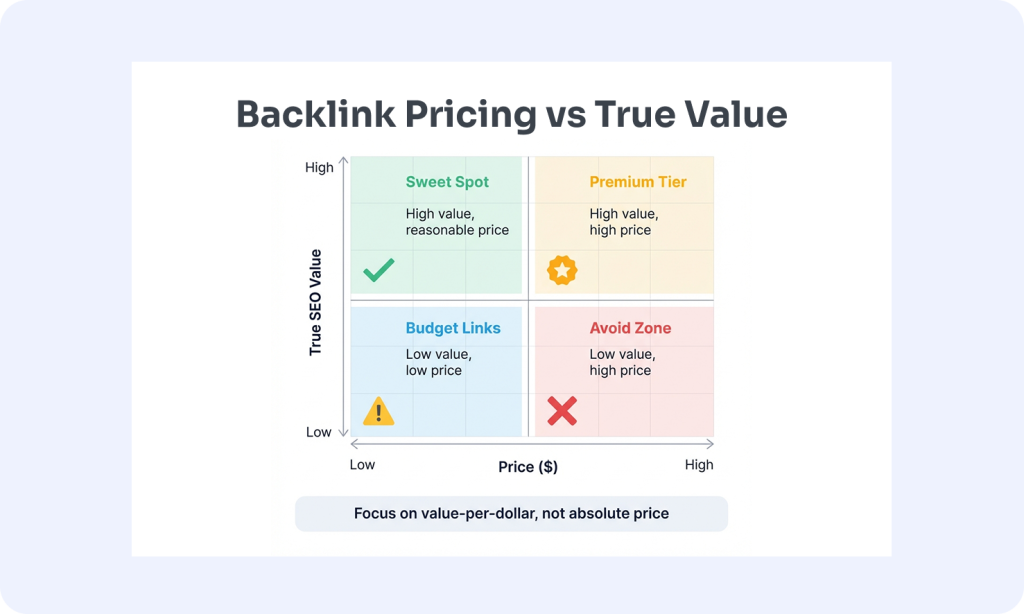
The pricing structures in link marketplaces are built on metric snapshots rather than quality-adjusted value. A marketplace that lists a DR 60 site at $700 per placement has priced based on domain authority at the time of listing, it has not adjusted for a 45% traffic decline over the past 18 months, a geographically irrelevant traffic profile, or an outbound link anchor cloud that reveals the site as a multi-niche commercial placement operation.
Authority Hacker found that 74.3% of SEO professionals who buy links acknowledge paying for placements that underdelivered on their expected ranking impact — a figure that reflects the endemic quality gap in marketplace-based link acquisition.
The gap between listed price and genuine value is where most poor link purchasing decisions are made.
The pricing-quality inversion problem
In a market where distressed publishers are actively monetising declining assets, there is a structural tendency for link prices to remain elevated even as the underlying quality declines — because sellers price based on the metrics they have, not the trajectory those metrics represent.
A sophisticated buyer conducts the 24-month traffic trend analysis, the geographic traffic quality assessment, and the outbound profile review for every prospective placement — and is prepared to walk away from a high-metric site that fails these quality checks regardless of its nominal price attractiveness.
Bundling and contextual framing
For agencies and brands managing link acquisition as part of a broader SEO programme, the most defensible framing for paid placements is as a component of a content partnership rather than a standalone link purchase.
A publishing fee that covers the creation and placement of genuinely useful editorial content — where the link is a natural consequence of the content placement rather than the explicit product being sold — is both more likely to meet an editorial publication’s standards and more defensible under Google’s policy framework than a naked link purchase.
Content Marketing Institute research found that 84% of B2B marketers who publish in external editorial contexts report it as their highest-ROI link and brand authority channel, supporting the content partnership framing as both a compliance and performance advantage.
This is not purely semantic: the quality of content produced for a content partnership framing is typically higher than the content produced for a link-only placement, the editorial context of the placement is stronger, and the relationship with the publisher is more durable.
The bundling approach, offering link placements as part of a broader content marketing engagement rather than as a transactional service, also tends to attract higher-quality publisher relationships that are less likely to be the distressed inventory category that dominates pure link marketplaces.
Building a brand that earns links is more durable, and increasingly more practical, than buying them
The link selling market in 2026 is smaller, riskier, and more expensive than it was three years ago. The quality of available inventory has declined as HCU-impacted publishers have flooded marketplaces with declining assets.
Enforcement risk has increased with every successive SpamBrain update cycle.
And the compounding value of white hat editorial links, which builds genuine authority that survives every algorithm update and contributes to AI search visibility, has never been more clearly superior to the rented, at-risk positions that paid link profiles represent.
Moz research found that high-quality editorial links produce ranking improvements that persist an average of 3–5 years after acquisition, compared to the median 14-month lifespan observed for paid link placements before algorithmic devaluation or penalty.
If you are evaluating whether paid links are the right approach for your specific competitive situation, or whether a white hat programme can close your authority gap within a commercially relevant timeframe, a free backlink profile review gives you a factual basis for that decision rather than a decision made in the absence of data.
BlueTree Digital reviews your current profile, your competitive gap against top-ranking pages for your target keywords, and your realistic organic acquisition rate under a white hat programme.
If paid links are genuinely the surgical gap-closing tool your situation calls for, we will tell you that honestly, along with what responsible due diligence looks like for the specific placement quality required. If white hat methods can close the gap on a competitive timeline, we will show you the roadmap.
→ Request a free backlink profile and competitive gap review
For the complete white hat link building framework, the methodology that builds authority without the forward enforcement risk that paid link profiles carry, read our white hat link building guide.
Frequently Asked Questions
Is selling links illegal?
Link selling is not illegal under any jurisdiction’s law — it is a violation of Google’s webmaster guidelines, not a legal statute. The consequences are commercial rather than legal: manual actions, ranking demotions, or de-indexation from Google’s search results. The distinction matters because “against Google’s policy” and “illegal” are frequently conflated in this discussion. The risk is purely one of search engine enforcement, not criminal or civil liability — unless the link selling involves fraud, misrepresentation, or other independently actionable conduct.
Will buying links always cause a penalty?
No — but the probability has increased significantly in 2025–2026. Google’s post-Penguin 4.0 approach is primarily to devalue identified paid links algorithmically rather than applying sitewide penalties for every violation. Since Penguin 4.0 became part of Google’s core algorithm in September 2016, link devaluation now happens in real-time as pages are crawled, meaning the window between a paid link being acquired and Google discounting it has narrowed significantly. However, manual actions for “unnatural links to your site” remain active enforcement tools for clear, large-scale link scheme participation, and SpamBrain’s real-time detection means that many paid links are now discounted within days of acquisition — delivering no ranking benefit while carrying residual enforcement risk. The expected value calculation on paid link acquisition has worsened with every successive spam update cycle since 2023.
What is the difference between a sponsored link and a paid link in Google’s framework?
In Google’s policy framework, all paid links are required to carry either rel=”sponsored” or rel=”nofollow” to be compliant. A “sponsored link” in Google’s terminology is simply a paid link that has been properly disclosed with the correct attribute. The distinction between sponsored and paid links in common use is one of transparency: a paid link with proper attribution is a disclosed commercial placement; a paid link without attribution is an undisclosed policy violation. Our Google backlink policy guide covers the full rel attribute framework and what each attribute signals to Google’s systems.
What is the quality threshold for a paid link to be worth considering?
The minimum quality threshold for a paid placement worth considering in 2026 is: sustained or growing organic traffic over a 24-month window (not declining), at least 5,000 genuine organic monthly visitors from the relevant geographic market, topical relevance between the placement content and the destination page, a clean outbound link profile without evidence of multi-niche commercial placement operations, and a genuine audience with engagement signals (social presence, content citations from independent sources). Sites that fail any of these criteria should be excluded regardless of their DR or DA metrics. Ahrefs’ study of over 2 million link building campaigns found that links from sites with declining organic traffic were 68% less likely to produce measurable ranking improvements compared to links from sites with stable or growing traffic.
How do I know if a previous agency bought links on my behalf without disclosure?
The most reliable diagnostic is a full backlink profile audit using Ahrefs or Semrush, filtering for links acquired during the period the agency managed your SEO. Apply the footprint identification criteria from our unnatural links guide to links from that period — PBN indicators, sponsored post markers, zero-traffic placement pages, and over-optimised anchor text clusters are the primary signals that paid placement activity occurred. If the audit reveals a significant volume of links meeting these criteria, review our disavow guide for the remediation process and documentation requirements for addressing any resulting manual action exposure.





 Start the conversation