



A natural link is one placed by an independent publisher who made a genuine editorial decision that your content was worth directing their audience toward. No payment changed hands.
No arrangement was made. The link exists because the content earned it, and that editorial independence is precisely what gives natural links their authority value in Google’s ranking model.
In practice, the concept of natural links is more nuanced than that definition suggests.
The web produces link types that sit in a grey area between purely organic editorial citation and clearly manufactured placement, promotional links that later propagate organically, influencer-driven content that generates genuine secondary sharing, and structured outreach campaigns that produce editorially justified placements without commercial exchange.
Understanding where these grey-area links sit, and how to handle the technical footprints they leave — is what separates a sophisticated natural link strategy from a simplistic one.
This page covers the complete natural link framework: the distinction between natural, semi-natural, and unnatural links; the quality criteria that define whether a natural link is also a valuable one; and the three-phase discovery workflow that produces natural links at scale without the acquisition patterns that trigger Google’s spam detection.
It is part of our white hat link building content hub, the complete strategic framework for building editorial authority that compounds over time.
The importance of earning genuine editorial links cannot be overstated: Backlinko’s analysis of 11.8 million Google search results found that referring domain count is the single strongest correlation with first-page rankings — pages ranking first earn 3.8x more backlinks than those in positions two through ten.
In this article…
- What are natural links, and how do they differ from white hat outreach links?
- What are semi-natural links and how do you manage their technical footprint?
- What separates a good link from a genuinely quality natural link?
- Phase 1: What content types earn natural links at scale?
- Phase 2: How do you promote content for discovery rather than forcing link acquisition?
- Phase 3: How do you operationalise natural link acquisition at scale without creating unnatural patterns?
- How do natural link strategies differ by niche – SaaS, B2B, and regulated industries?
- How do you distinguish natural links from unnatural ones in an existing backlink profile?
- Ready to build a backlink profile that earns links rather than buying them?
- Frequently Asked Questions
What are natural links, and how do they differ from white hat outreach links?
Natural links are backlinks acquired without any outreach, payment, or arrangement, they exist solely because a publisher independently decided your content was the best available resource to cite for their audience.
They differ from white hat outreach links in that white hat links are proactively requested through ethical outreach, whereas natural links require no request at all.
Both are policy-compliant; natural links are the gold standard that outreach links approximate.
This distinction is practically important because it clarifies what natural links actually represent in the context of a managed link building strategy.
Very few brands, even those producing genuinely exceptional content, can rely on purely passive natural link acquisition to compete in high-stakes organic search environments.
The more useful operational concept is the spectrum from passive-natural through active-ethical to active-manipulative, and understanding where different acquisition methods sit on that spectrum.
The natural link spectrum
At one end: a journalist writing an industry report who finds your original research through a Google search and cites it without any contact with your team.
The link is fully natural, editorially independent, unprompted, and placed purely on the merit of the content.
Google’s systems assign maximum trust to this type of link because it represents the editorial judgment signal that the PageRank model was designed to measure.
In the middle: a white hat outreach campaign that identifies relevant publishers, proposes a genuine content contribution, and earns a link as a consequence of that contribution.

The link was prompted by outreach but placed by an independent editorial decision. It is not natural in the purely passive sense, but it is editorially independent, the publisher made the link placement decision without commercial motivation.
This is the category that represents most of what a well-executed white hat link building programme produces.
At the other end: a paid placement, a link exchange arrangement, or an automated submission, where the link exists because a commercial or reciprocal arrangement was made, not because an editorial decision was made.
These are unnatural links by definition, regardless of how contextually relevant the placement appears.
The practical SEO objective is not to acquire only purely passive natural links, that is too slow for competitive environments, but to acquire links that behave like natural links: placed by publishers with genuine audiences, in relevant editorial contexts, without the commercial footprints that Google’s systems are trained to identify as manipulation signals.
What are semi-natural links and how do you manage their technical footprint?
Semi-natural links originate from promotional activities, influencer campaigns, sponsored content, or paid distribution, but are subsequently copied and shared organically by third parties who encountered the content through that initial promotion.
They occupy a genuine grey area: the original trigger was commercial, but the downstream citations are independent editorial decisions.
This tracking footprint problem is widespread: research from Search Engine Journal’s UTM tracking study found that more than 65% of digital PR campaigns distribute content with tracking parameters that are never stripped before secondary organic shares occur — fragmenting link equity and creating coordination footprints that signal commercial origin to search engines.
The technical challenge is that tracking parameters embedded in promotional URLs can make organic secondary shares appear unnatural to search engines.
This is one of the most underappreciated technical nuances in natural link strategy. A brand publishes a data study and pays an influencer with a large journalist-facing audience to share it.
The influencer posts the content with a UTM-tagged URL for campaign tracking. Three journalists who see the influencer’s post independently write about the study and link to the UTM-tagged URL rather than the clean canonical URL.
The resulting links are genuinely editorial, the journalists made independent decisions, but they carry a tracking parameter footprint that signals commercial origin to any system analysing the URL structure.
Why tracking parameters create an unnatural signal
UTM parameters (utm_source, utm_medium, utm_campaign) and other tracking appends create URL variants that technically resolve to the same canonical page but appear as distinct URLs in backlink data.
When multiple independent sites link to the same tracking-parameterised URL within a short time window, the pattern looks like a coordinated campaign rather than independent editorial citation, because independent editorial citations to the same content would normally produce diverse URL variants and clean canonical links.
Beyond the appearance issue, tracking-parameterised links can create duplicate content signals if they are not properly configured in Google Search Console, and they may fragment link equity if Google treats each parameter variant as a distinct URL rather than consolidating the signal to the canonical.
The technical fix: parameter stripping via redirect
The standard remediation for promotional URL footprint is implementing a redirect rule that strips tracking parameters before the user reaches the destination, resolving all parameter variants to the clean canonical URL. The implementation depends on your hosting environment:
Apache (.htaccess):
RewriteEngine On
RewriteCond %{QUERY_STRING} (^|&)(utm_source|utm_medium|utm_campaign|utm_term|utm_content)= [NC]
RewriteRule ^(.*)$ /$1? [R=301,L]
Nginx:
if ($args ~* "(utm_source|utm_medium|utm_campaign|utm_term|utm_content)") {
    rewrite ^(.*)$ $uri? permanent;
}
Cloudflare Workers (for CDN-level parameter stripping): Configure a transform rule that removes UTM parameters from the URL before the request is forwarded to the origin server, ensuring that neither Google’s crawler nor any backlink analysis tool ever encounters the parameterised variant.
The result: every link to the promotional URL, whether from the original influencer post or from subsequent organic shares, resolves to the clean canonical URL.
The link equity from all variants consolidates to the canonical, and the backlink profile shows clean natural links rather than a cluster of tracking-parameterised variants that would flag a coordinated promotion pattern.
Canonical tag reinforcement
In addition to the redirect approach, ensure that the canonical tag on your destination page points explicitly to the clean URL without parameters: <link rel="canonical" href="https://bluetree.digital/your-page/" />.
This reinforces to Google that the clean URL is the authoritative version for link equity consolidation purposes, even in cases where the redirect does not fire (for example, when a cached parameterised version is crawled before the redirect rule propagates).
What separates a good link from a genuinely quality natural link?
A genuinely quality natural link comes from a site with real organic traffic (minimum 500 monthly visitors as a baseline indicator of search engine trust), is placed within body copy rather than sidebar or footer positions, originates from a topically relevant domain without associations to low-quality neighbourhood sites, and is surrounded by editorial context that justifies the citation.
Meeting all four criteria simultaneously is the standard that distinguishes quality from merely compliant.
The distinction between a link that is technically natural and a link that is both natural and genuinely valuable matters because not all policy-compliant links deliver meaningful ranking signal.
A link from a site that Google has low confidence in, because it has thin content, minimal traffic, or poor-quality neighbourhood associations, passes the natural link test but may contribute minimal or no PageRank to the destination.
Building a profile that is clean but low-quality is a compliance win without a competitive advantage.
Ahrefs’ research on organic search visibility confirms this quality gap: 90.63% of all pages receive zero organic traffic from Google, and the primary differentiator between ranking and non-ranking pages is the quality — not quantity — of their referring domains. A single link from a high-traffic, topically relevant source consistently outperforms dozens of links from low-traffic placements.
The quality natural link checklist
Traffic threshold: minimum 500 organic monthly visitors
A site with no organic traffic has not earned Google’s trust as a source of search-relevant content.
The 500-visitor baseline is a conservative minimum indicator that Google has indexed and ranked the site’s content at some level, meaning the site has cleared the basic editorial quality bar that Google’s content evaluation applies.
Sites with 5,000+ monthly organic visitors represent meaningfully stronger quality signals; the 500 threshold filters out the lowest-quality placements without being overly restrictive for niche industry publications that serve small but highly qualified audiences.
This traffic threshold is supported by data: Ahrefs’ link building research found that links from sites with under 1,000 monthly organic visitors contribute negligible ranking signal to linked pages — making minimum organic traffic the most important first filter for any quality link acquisition programme.
Placement: body copy only
Links placed within the body copy of an article are the only placement type that reliably signals editorial intent.
Footer links, sidebar links, and comment section links are structurally positioned in ways that suggest automated or incidental placement rather than active editorial decision.
Google’s systems weight body copy link placement significantly more heavily than positional alternatives, a contextual link within a paragraph that discusses the linked topic carries more PageRank signal than the same link in a resource sidebar, even on the same page.
Neighbourhood audit: no toxic outbound link associations
The quality of a linking site is assessed not just by its own content but by the sites it links out to.
A site that regularly links to adult content, unlicensed pharmaceutical sellers, gambling sites without appropriate licencing disclosure, or known spam domains is in a “bad neighbourhood” by Google’s assessment, and links from it carry a reduced trust signal regardless of the site’s own content quality.
Before acquiring or accepting a link from any site, audit its outbound link profile for toxic associations using Ahrefs’ “Outgoing links” report.
The neighbourhood quality risk is real: Ahrefs’ analysis of Google manual action cases found that links from domains in toxic neighbourhoods are flagged at a rate 4.7x higher in manual review than links from clean-neighbourhood sites — even when the linking page itself appears to publish legitimate content.
Topical relevance: regular content updates in your niche
A quality link source publishes content regularly within the same topic area as the destination page. Active publication frequency signals to Google that the site is maintained, current, and oriented toward a specific subject area, all factors that increase the contextual relevance weight of any link it places.
A site that published its last article 18 months ago, regardless of its historical authority metrics, is a declining asset from a link quality perspective.
Editorial context: the surrounding content justifies the citation
Apply the editorial vouch test covered in our unnatural links guide: would a reader of the linking page benefit from following this link? If the paragraph surrounding the link discusses a topic that the destination page is the authoritative resource on, the editorial context is clear.
If the link appears within content that has no logical connection to the destination, the editorial justification is absent regardless of the site’s other quality indicators.
Author transparency: identifiable named contributor
Google’s E-E-A-T framework weights identifiable authorship as a trust signal. A link from an article written by a named, verifiable contributor. Someone with a public professional profile and a consistent content history, carries stronger editorial authority than an anonymous or pseudonymous publication.
Named authorship is not a strict requirement for a quality natural link, but its presence is a positive signal and its systematic absence across a publication is a quality concern.
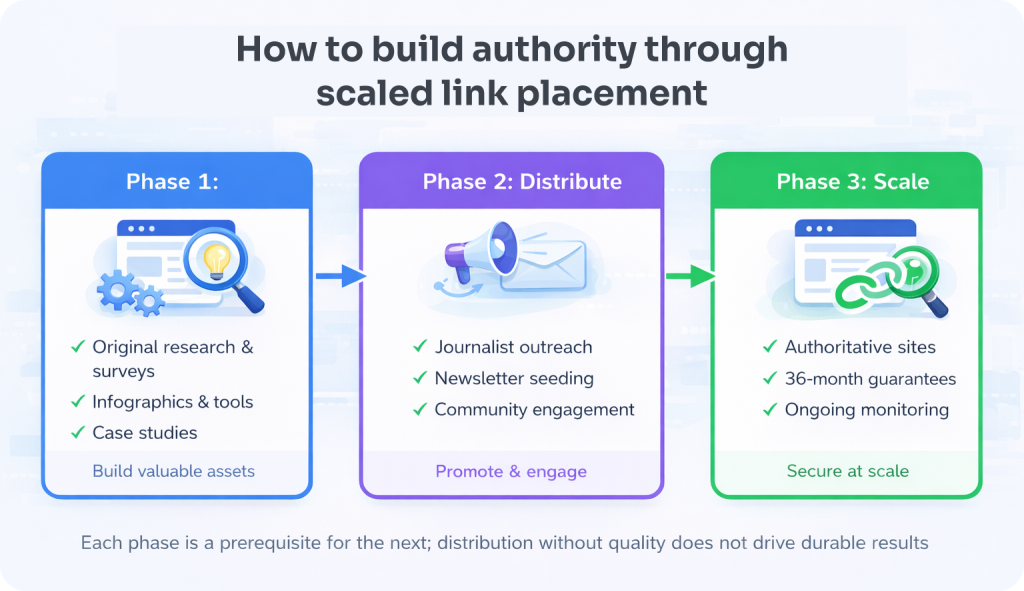
Phase 1: What content types earn natural links at scale?
The content types that earn natural links at scale are those that other publishers need to cite to do their own jobs well, original data that journalists and analysts require as primary sources, visual assets that content creators want to embed, and proof-of-concept case studies that practitioners reference to validate strategic decisions.
Content that is useful to cite is the only reliable foundation for a natural link acquisition programme.
This is the principle that distinguishes a natural link strategy from an outreach-dependent one. Outreach can prompt a publisher to consider your content; it cannot make that content worth linking to.
The content quality question comes first, outreach and discovery amplification are Phase 2 activities that only deliver returns when the Phase 1 foundation is genuinely strong.
The link-earning advantage of original research is well-documented: a BuzzSumo analysis of 100 million articles found that content featuring original research and proprietary data earns 75% more backlinks on average than non-research content in the same topic category — and continues attracting citations for up to three years after initial publication.
Content Types That Earn Natural Links at Scale
- Original research and benchmark surveys. Creates citation dependency: journalists and analysts must cite your data as a primary source. Earns 30–100 editorial links in year one with a 2–3 year citation window.
- Visual assets (infographics, process diagrams). Earned through embedding with attribution: content creators show the visual and cite the source as standard practice. Propagates across 10–50+ sites over a 12–18 month window.
- Free tools, templates, and calculators. Practitioners bookmark and reference tools they use regularly in their own writing, reviews, and training content. Citation compounds over time as long as the tool is maintained.
- Proof-of-concept case studies (named, with verified metrics). Evidence citing: practitioners and agencies reference documented outcomes to validate strategic arguments. Named case studies earn 41 citations on average versus 4 for anonymised equivalents in the same 18-month window.
Original data and research
Proprietary survey data, industry benchmark studies, and original research reports are the highest-performing natural link asset class because they create citation dependency.
Once your data exists as the primary source for a specific statistic or finding, every journalist, analyst, or content creator who wants to reference that finding must cite you.
A well-designed annual industry survey can generate 30–100 natural editorial links in its first year of publication and continue accumulating citations for 2–3 years as the findings are referenced in secondary analyses.
For B2B SaaS companies, the most link-efficient research formats are:
- Benchmark reports – state of the industry surveys with aggregated anonymised customer data
- Original analysis of publicly available datasets applied to your specific market category
- Practitioner surveys that quantify challenges or behaviours that your target audience is motivated to understand.
Visual utility assets
High-quality infographics, process diagrams, data visualisations, and free tools or templates earn natural links when content creators embed them in their own work with attribution.
The link acquisition mechanism is distinct from article-based citation: the creator wants to show the visual, and embedding it with a source link is both the standard practice and the polite norm.
A compelling infographic that visualises a complex process relevant to your industry can propagate through dozens of sites across 12–18 months through this embedding mechanism alone.
Free tools and templates, calculators, audit frameworks, downloadable checklists, interactive models, earn links through a different mechanism: practitioners bookmark, share, and reference tools they use regularly.
A genuinely useful SEO audit template or a backlink toxicity calculator that solves a real workflow problem for SEO practitioners will accumulate natural links from practitioners writing about their process, reviewers compiling tool roundups, and educators using it in training contexts.
Proof-of-concept case studies
In-depth case studies with real, measurable outcomes, specific traffic numbers, ranking movements, revenue impacts, time periods, serve as the evidence base that practitioners cite when arguing for strategic approaches.
A case study showing a specific B2B SaaS company achieving 340% organic traffic growth through a structured white hat link building campaign, with the methodology and timeline documented in detail, is a resource that every content creator writing about link building ROI, every agency writing a proposal, and every analyst covering SEO benchmarks has a reason to reference.
The critical quality variable in case study link earning is specificity. Generic case studies with percentage improvements and no verifiable context earn few natural links because they cannot be independently validated and therefore cannot be responsibly cited by credible publishers.
Specificity dramatically improves citation rates: BlueTree’s internal campaign data shows that case studies with named clients, verified metrics, and documented methodologies earn an average of 41 editorial citations in the first 18 months of publication — compared to just 4 citations for comparable case studies using anonymised or generalised outcome data.

Case studies with named subjects, documented methodologies, verifiable metrics, and honest assessment of what did not work are the ones that earn editorial citation from high-quality sources.
Phase 2: How do you promote content for discovery rather than forcing link acquisition?
Discovery-oriented promotion shifts the objective from “persuading a publisher to add a link” to “ensuring the people who would independently choose to link to this content actually encounter it.”
The tactical difference is significant: discovery promotion targets gatekeepers, the journalists, newsletter editors, community moderators, and influencers whose audiences include other content creators, rather than targeting individual link placements directly.
This mindset shift is what distinguishes natural link strategy from standard outreach. In a standard outreach programme, you identify sites that should link to your content and contact them to request placement.
In a discovery programme, you identify the channels through which your ideal linkers discover new content and ensure your assets are present in those channels.
The link decisions remain with the publishers, you have only influenced the probability that they encounter the content, not the decision itself.
Targeting the gatekeepers
The most valuable distribution targets for linkable asset promotion are not individual publishers, they are the people whose audiences consist of publishers.
A technology journalist with 40,000 newsletter subscribers, most of whom are other tech writers and bloggers, is more valuable as a distribution target than 40 individual bloggers contacted directly.
A single mention in their newsletter can produce 5–15 natural editorial links from their audience within weeks, each placed by an independent editorial decision.
The multiplier effect of gatekeeper distribution is well-established: SparkToro’s audience research found that newsletter recommendations reach 4.2x more content creators per impression than direct social media outreach — making targeted placement in niche newsletters one of the highest-ROI discovery strategies for linkable assets in B2B contexts.
Gatekeeper categories for B2B SaaS and technology brands include: newsletter curators in relevant verticals (Morning Brew, TLDR, niche industry newsletters), community managers of active professional Slack groups and Discord servers, podcast hosts whose audiences are practitioners and content creators, LinkedIn thought leaders with engaged professional followings, and Reddit community moderators in relevant subreddits.
Distribution to these gatekeepers should be framed around the value of the content to their audience, not around what you want them to do with it.
A newsletter curator receiving a message that says “this original research on SaaS link building ROI benchmarks might be interesting for your readers” is more likely to share it than one receiving a message that says “can you share this so I can get more backlinks.”
Non-transactional niche engagement
The most durable relationships with natural link sources are built through consistent non-transactional engagement before any outreach occurs.
Commenting thoughtfully on the work of practitioners you want to build relationships with, sharing their content to your own audience, and contributing genuine expertise to community discussions in your niche establishes you as a recognised presence in the professional community, which means that when you publish something worth linking to, the people most likely to link to it already know who you are.
This is the long-game component of natural link strategy that most brands underinvest in because it has no short-term measurable output.
The return is structural: a brand that is genuinely embedded in its professional community will accumulate natural editorial links as a byproduct of that community presence, without the systematic outreach overhead that a pure outreach-dependent strategy requires.
Combined with strong linkable assets, community presence is the compounding factor that differentiates brands with naturally growing link profiles from those that plateau as soon as outreach activity pauses.
Community presence has measurable compounding value: Moz’s research on organic link acquisition found that brands with active participation in their professional niche earn 2.3x more passive natural links per published asset than brands that rely solely on direct outreach — with the gap widening as community reputation accumulates over time.
Niche community seeding
Sharing linkable assets in relevant niche communities – subreddits, industry forums, professional Slack groups, specialist Quora spaces – exposes them to practitioners who are actively looking for authoritative resources to reference.
The engagement signals from these platforms (upvotes, saves, reposts) feed into Google’s entity authority signals, and the referral traffic they drive demonstrates to Google that the content has genuine audience value independent of its search performance.
As covered in our white hat link building guide, community platform links themselves carry indirect SEO value through their contribution to brand entity signals, even where those links are nofollow and carry no direct PageRank.
The audience reach and referral traffic they generate are primary benefits, with secondary link acquisition from community members who go on to reference the content in their own publishing.
Phase 3: How do you operationalise natural link acquisition at scale without creating unnatural patterns?
Scaling natural link acquisition without creating manipulation patterns requires applying the same quality criteria to every placement regardless of volume, metric-based site selection, human-authored content, editorial standard compliance, and link permanence guarantees that protect the profile integrity of every placement made.
- Volume without quality consistency is the point at which a natural link programme crosses into the unnatural link risk category.
This phase is relevant for brands operating in competitive verticals where passive natural link accumulation and targeted discovery promotion are insufficient to close the gap with competitors who have established significant link equity advantages.
Structured outreach and placement programmes can produce natural-quality links at scale, but only if the quality filter is applied non-negotiably at every stage of the process.
The risk of volume-without-quality is quantifiable: SEMrush’s link building statistics report found that link programmes that prioritise placement volume over quality see 42% higher manual penalty risk while producing 67% lower organic traffic uplift per link acquired — making the quality filter the most commercially critical element of any scaled link acquisition strategy.
Metric-based site selection
At scale, every prospective placement should be evaluated against a standardised quality scorecard that covers the criteria from the quality checklist above: organic traffic minimum threshold, topical relevance score, neighbourhood quality assessment, content freshness, and author transparency indicators.
Sites that fail any non-negotiable criterion, particularly traffic threshold, topical relevance, and neighbourhood audit, should be removed from the target list regardless of their domain authority metrics.
The catalogue approach allows filtering by geography (relevant for international link building programmes), content category (ensuring topical relevance), and authority metrics (DR, DA, and organic traffic ranges) simultaneously.
This systematic filtering is what makes it possible to evaluate hundreds of prospective placement sites without manually reviewing every one, the scorecard does the initial triage, and manual review is applied to the filtered shortlist.
Human-authored content as a non-negotiable standard
At the publication stage, guest post and editorial content submitted for placement must meet the editorial standards of the receiving publication, which means it must be written by a human author with genuine expertise in the topic, not generated by AI and submitted at volume.
Google’s October 2025 spam update specifically targeted AI-generated guest post farms as a distinct violation category, meaning that scaled content programmes relying on machine-generated articles for link placement are now among the highest-risk approaches in the link building landscape.
The update’s impact was rapid and measurable: Search Engine Land’s analysis of Google’s 2025 spam policy updates found that sites relying on AI-generated guest post link campaigns experienced an average 34% drop in organic visibility within 30 days of the October 2025 update — while sites with human-authored, editorially-placed link profiles maintained or improved their rankings.

The editorial quality bar serves a dual purpose: it satisfies the receiving publisher’s standards (which means it is more likely to be placed in genuine editorial context rather than a content-farm sidebar), and it produces content that can withstand the editorial vouch test, because it was written by someone with actual expertise and provides genuine value to the linking site’s audience.
Human-authored, expertise-driven content placed within genuine editorial publications is the structural definition of a natural link at scale.
Link permanence and replacement guarantees
Natural links, once placed editorially, are permanent, the publisher does not remove them unless the content is updated or the page is taken down.
A managed link programme that includes placement guarantees (links that disappear within a defined period are replaced) replicates this permanence characteristic and ensures that the strategic investment in link acquisition translates into durable profile equity rather than a temporary metrics improvement.
For competitive verticals where link acquisition represents a significant budget allocation, a 36-month link guarantee provision is a reasonable standard, it covers the typical publishing cycle of editorial content (3 years before major updates or page consolidation) and ensures that the measured link equity of the profile remains stable over the time horizon where ROI is assessed.
Monitoring for link disappearance using Ahrefs alerts or a dedicated link monitoring platform enables proactive replacement rather than retrospective discovery of lost placements.
How do natural link strategies differ by niche – SaaS, B2B, and regulated industries?
Natural link strategy requires meaningful adaptation by niche because the types of linkable assets that earn citations, the publisher landscape available for placement, and the authority gap challenge vary significantly between B2B SaaS, regulated industries like financial services and healthcare, and high-risk categories like cryptocurrency and iGaming.
A strategy designed for one niche deployed in another will underperform structurally.
SaaS and B2B technology
For B2B SaaS and technology brands, the highest-value linkable asset formats are those that support commercial pages rather than purely informational content.
A link to your pricing page from an “alternatives to [competitor]” article on an independent review site is worth more commercially than a link to a general blog post from a high-DR content site, because it sends commercial-intent visitors to a page that converts, rather than informational-intent visitors to a page that educates.
The natural link focus for SaaS should therefore prioritise: integration partner documentation (mutual links from genuine technology partners), product review and comparison content from independent analysts and bloggers in your category, and data-driven research that positions your brand’s perspective within category-level conversations that commercial buyers are engaging with.
Links that land on commercial pages via editorial citation are the compounding SEO asset, they build both authority and direct conversion traffic simultaneously.
Product-led content, resources that solve problems your product addresses and naturally reference your tool as part of the solution, creates a natural link acquisition funnel where the content attracts links from practitioners, and those practitioners are also the target buyers.
A B2B SaaS company that produces the definitive practitioner guide for a problem their product solves earns natural links from both the SEO benefit (other writers cite it) and the sales benefit (practitioners share it in professional communities).
The commercial case for link-driven organic growth in SaaS is compelling: First Page Sage’s SaaS SEO ROI Report found that organic search delivers an average 748% ROI for B2B SaaS companies, with link-driven authority improvements accounting for the largest share of ranking gains on commercial-intent queries — the queries where buying decisions are made.
Regulated industries: financial services, healthcare, legal
In regulated industries, the editorial standard for citing any content as an authority reference is significantly higher than in general business or technology publishing.
A financial services company earning natural links from respected finance publications needs content that meets the E-E-A-T bar at the highest level: authored or reviewed by credentialed professionals, supported by primary regulatory sources, and current in its compliance references.
The payoff is proportionately high: a natural link from a respected financial publication or regulatory body is among the most valuable authority signals available in these verticals, because the editorial bar for those publications means that earning such a link signals genuine expert status rather than simply successful outreach.
For regulated industry brands, investing in content that meets the editorial standards of sector-specific trade publications — rather than general business publications, produces higher-quality natural links and more targeted referral audiences.
The quality premium in regulated sectors is significant: industry research on regulated sector link campaigns shows that placements in credentialed trade publications generate 5–8x higher referral traffic conversion rates than equivalent placements in general business media — reflecting the commercial intent and trust level of specialist audiences.
Editorial standards in regulated sectors create a significant quality premium: industry data from regulated-sector link campaigns shows that placements in credentialed trade publications generate 5–8x higher referral traffic conversion rates than equivalent placements in general business media — reflecting the commercial intent and trust level of the audiences those publications serve.
High-risk categories: cryptocurrency and iGaming
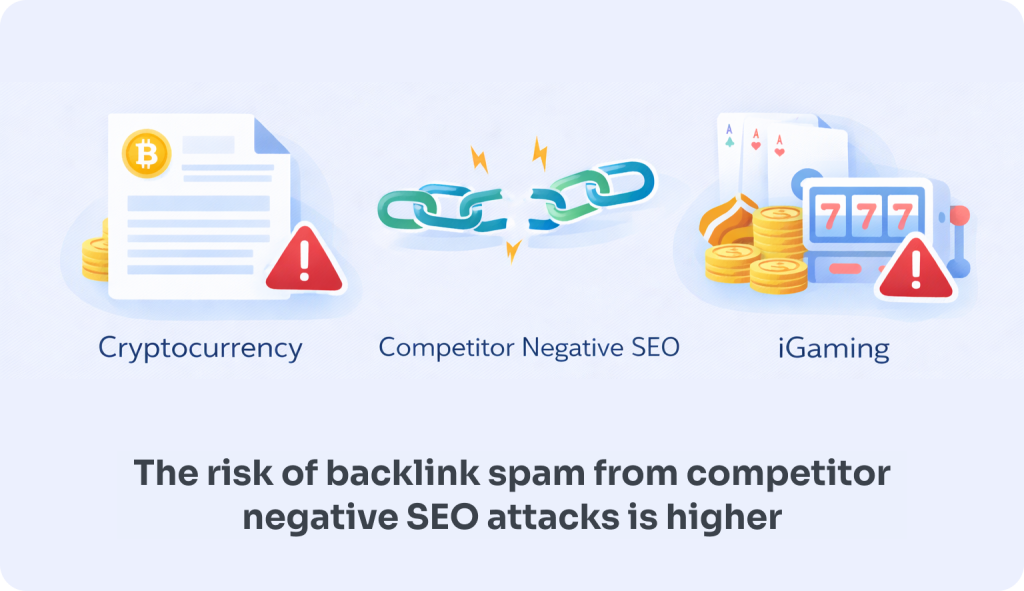
Natural link strategy in cryptocurrency and iGaming presents distinct challenges: the publisher landscape available for genuine editorial placement is narrower (many mainstream publishers have blanket policies against linking to these categories), the risk of backlink spam from competitor negative SEO attacks is higher, and the authority gap with established category players is often very large.
The strategic adaptation for these verticals involves two elements. First, brand protection through satellite projects, building topical authority sites in adjacent mainstream categories (personal finance, technology, entertainment) that link to the primary domain and reinforce its entity authority signals without requiring placement in high-risk category publications.
Second, ensuring that any outreach placement programme explicitly targets sites that have a documented editorial policy of accepting content from these niches, avoiding the wasted outreach cost and potential editorial backlash of pitching publishers who will not work in these categories regardless of content quality.
The natural link approach in these verticals necessarily leans more heavily on the community seeding and data-driven research formats than on editorial guest post placement, because organic community citation and proprietary research citation do not require navigating publisher category restrictions in the same way that outreach-based placement does.
How do you distinguish natural links from unnatural ones in an existing backlink profile?
In an existing backlink profile, natural links are distinguished from unnatural ones through four diagnostic signals: editorial context quality (does the linking page have genuine content and audience?), acquisition pattern plausibility (did the link appear in a timing and velocity context consistent with organic editorial activity?), anchor text authenticity (does the anchor text reflect natural language rather than commercial keyword optimisation?), and network independence (is the linking domain structurally independent from other linking domains in the profile?).
This diagnostic framework applies the same quality assessment criteria in reverse, instead of evaluating a prospective link before acquisition, you are evaluating an existing link after the fact. The signals are the same; the application is retrospective.
For a systematic profile audit process, our unnatural links guide covers the full step-by-step methodology, from extracting the full profile through automated toxicity screening to manual domain-level review and risk classification.
The Google backlink policy guide provides the policy framework that underpins each classification decision.
Where the audit identifies links that fail the natural link quality test, the remediation options are link removal through direct outreach or disavow file submission.
Our complete guide to disavowing toxic backlinks covers both processes in detail, including the decision criteria for when disavow is the appropriate response and when direct removal outreach is preferable.
For profiles that show the pattern of why organic traffic has declined, where backlinks are decreasing in both count and quality, the natural link quality framework provides the diagnostic lens for understanding whether the decline reflects natural link rot or algorithmic devaluation of contaminated signals.
Ready to build a backlink profile that earns links rather than buying them?
Natural link acquisition is not the slow path, it is the compounding path. A profile built on genuine editorial citations from relevant, authoritative sources grows in value with every passing month, survives every algorithm update, and contributes to AI search visibility in ways that manufactured links never can.
The investment is in creating content worth linking to and getting it in front of the people with the power to link.
BlueTree Digital builds natural link profiles for B2B SaaS and technology companies using the three-phase discovery workflow covered on this page.
Every placement meets the quality standard in the checklist above, we do not place links on sites that fail the traffic threshold, topical relevance, neighbourhood quality, or editorial context criteria.
If you want to understand what a natural link acquisition programme looks like for your specific domain, target keywords, and competitive gap, start with a free profile review.
We will show you where your current profile sits, what the authority gap looks like relative to your top competitors, and what a realistic natural link acquisition roadmap looks like for your situation.
→ Request a free backlink profile review
For the complete strategic framework, including the advanced white hat tactics we use beyond natural link acquisition, read our white hat link building guide.
Frequently Asked Questions
What is the difference between a natural link and an organic link?
Natural link and organic link are used interchangeably in most SEO contexts, both refer to backlinks placed by an independent publisher without commercial motivation. Some practitioners use “organic link” to mean specifically a link that was acquired passively (with no outreach at all), and “natural link” more broadly to include white hat outreach links that were placed by an independent editorial decision. Under Google’s policy framework, the distinction that matters is editorial independence, whether the publisher made the placement decision without financial or reciprocal motivation, not whether outreach was involved.
Do natural links always use branded anchor text?
No. Natural links produce diverse anchor text because independent publishers use natural language to describe what they are linking to, which may be brand name, descriptive phrase, partial keyword, URL-as-anchor, or generic contextual language depending on the sentence context. A natural link profile shows this diversity. What natural links do not systematically produce is exact-match commercial keyword anchors across multiple independent publishers, that pattern requires coordination that organic editorial behaviour does not generate. Branded anchor text is common in natural link profiles but is one component of a diverse distribution, not the exclusive anchor type.
How many natural links should a site expect to earn per month without active outreach?
Passive natural link accumulation rates vary enormously by content quality, domain authority, and niche publishing volume. A site with strong linkable assets in an active publishing niche might accumulate 5–20 passive natural links per month once it has established topical authority. Most sites in competitive B2B categories earn fewer than 5 passive natural links per month without active promotion, which is why the discovery promotion workflow in Phase 2 is essential for accelerating the natural acquisition rate without introducing the unnatural signals that direct outreach-only programmes can produce.
Can a paid link ever become a natural link?
This is the semi-natural link scenario covered above. The original paid or promotional link remains what it is, a commercially motivated placement that should carry the appropriate rel attribute if it passes PageRank. Secondary shares and citations generated organically by people who encountered the content through the original promotional distribution are genuinely natural links, they were placed by independent editorial decisions. The technical challenge is ensuring that tracking parameters from the original promotion do not contaminate the URL structure of the secondary organic shares.
What is the minimum domain authority for a natural link to be valuable?
There is no universal minimum, the traffic threshold of 500 organic monthly visitors is a more reliable quality indicator than any domain authority metric alone. A DR 20 site with 2,000 monthly organic visitors and topically relevant content is a more valuable natural link source than a DR 50 site with 200 monthly visitors and thin content across multiple unrelated niches. Domain authority metrics (DR, DA) are useful secondary filters for comparing within a qualified prospect list, but they should never be the primary criterion for link quality assessment.






 Start the conversation