


Digital marketing agencies face a persistent operational tension: clients expect link building as a core component of any full-service SEO offering, but building an in-house link acquisition team is expensive, slow to ramp up, and operationally complex in ways that most agency founders underestimate.
Hiring link builders, training them on quality standards, purchasing prospecting and outreach tools, and building the editorial relationships needed for consistent placements requires twelve to eighteen months and significant capital investment before the team becomes truly productive.
In this article…
In 2026, the smartest agencies solve this gap by partnering with specialist link building providers who handle execution while the agency retains client strategy, relationship management, and brand positioning.
This is a strategic decision rooted in the principle of comparative advantage, not a compromise or a shortcut.
The agencies generating the highest margins on SEO retainers are those that focus their internal resources on strategy, content, and client communication while outsourcing the labour-intensive, relationship-dependent work of prospecting, outreach, and placement to partners who do nothing else.
Agency benchmark: Agency Analytics’ 2025 Marketing Agency Benchmarks Report found that 70% of agency leaders say client reporting is critical for retention. Agencies cite client acquisition as their top operational challenge.
Margin compression remains a concern, particularly for agencies without specialised service delivery.
The Business Case for White Label Partnerships
The economics of white label link building are compelling by any measure.
A senior link builder in the UK or US commands a salary of $50,000 to $80,000 depending on experience and location.
Add the cost of tools like Ahrefs, Pitchbox, and email infrastructure, plus management overhead, training time, and the inevitable recruitment failures, and your fully loaded cost per link builder exceeds $100,000 annually.
A white label link building partnership delivers the same or better output at a fraction of this cost, with the added benefit of eliminating recruitment risk, reducing operational complexity, and providing immediate access to capabilities that take years to build internally.
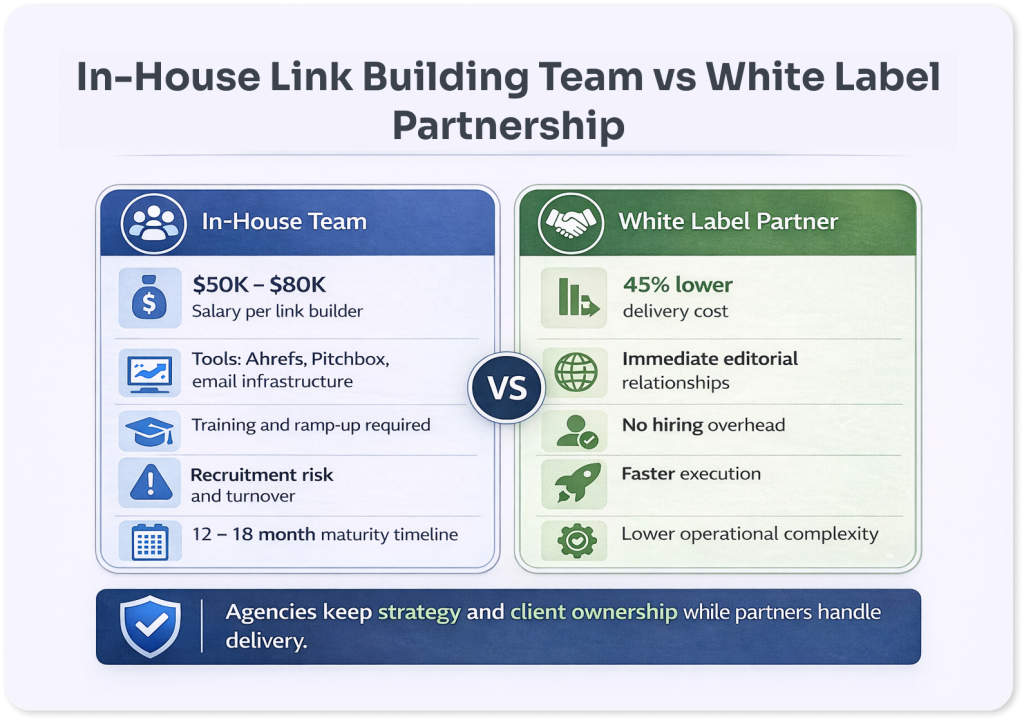
Cost efficiency data: According to white label SEO industry analysis, a fully staffed in-house link building team typically costs $350,000 to $600,000 annually.
A white label arrangement covering the same scope costs $72,000 to $216,000 per year. This creates a structural cost advantage before the first client result is delivered.
More importantly, white label partnerships give agencies instant access to established editorial relationships that represent the single biggest competitive moat in link building.
A specialist provider has spent years, sometimes decades, building connections with editors, webmasters, and publication managers across hundreds of sites.
Those relationships cannot be replicated overnight by hiring one or two link builders, and they are the primary factor that determines link placement quality, consistency, and conversion rates.
The margin opportunity is significant.
Most agencies mark up white label link building services by 50 to 150 percent, meaning a link that costs $300 from the provider is sold to the client for $450 to $750 as part of a broader SEO retainer.
At scale, this markup creates a highly profitable service line with minimal operational overhead.
How AI Is Reshaping Agency Link Building in 2026
AI has created both opportunities and challenges for agencies offering link building services, and understanding both sides is essential for positioning your agency correctly in the market.
On the opportunity side, AI tools can now handle much of the prospecting work that previously consumed hours of manual research.
Identifying relevant target sites, extracting and verifying contact information, analysing content for contextual fit, and even drafting initial outreach emails can all be augmented by AI, reducing the cost of link acquisition by an estimated 20 to 30 percent across the industry.
Client retention insight: Agency Analytics’ 2025 report found that 70% of agency leaders say client reporting is critical for retention. Clients with visible, measurable progress stay longer.
Reporting on link building creates exactly that kind of tangible proof of investment.
The challenge is that clients are increasingly aware of AI capabilities and some may question why they should pay agency rates for work that appears automatable.
This is a positioning problem, not a delivery problem.
Agencies need to clearly articulate the value they add beyond what AI can mechanically produce: strategic link target selection based on competitive analysis and ranking priorities, quality control against nuanced editorial standards that AI cannot evaluate, relationship management with publishers that ensures consistent access to high-quality placements, and integration of link building with broader SEO and content strategies.
Agencies looking to scale their link building service efficiently should explore bulk link building packages from white label providers.
These packages allow agencies to purchase links at volume pricing with guaranteed quality thresholds, then resell with healthy margins while maintaining the editorial standards that clients expect.
Positioning Link Building Within Your Service Stack
The most successful agencies in 2026 position link building not as an isolated deliverable but as an integrated component of a broader visibility strategy.
This means connecting link acquisition to content marketing, digital PR, technical SEO, and increasingly, GEO or Generative Engine Optimisation.
When link building is presented as part of a strategic system rather than a standalone line item, it becomes harder for clients to commoditise or price shop.
When onboarding new clients, frame link building alongside metrics like AI citation frequency, brand mention velocity, topical authority scores, and competitive link gap analysis.
This positions your agency as forward-thinking and demonstrates strategic depth that justifies premium pricing.
For agencies just getting started with white label partnerships, a reseller link building programme provides the infrastructure, support, and branded reporting needed to launch quickly without building any technology or processes from scratch.
Organic search dominance: Research on B2B demand generation strategies shows organic SEO is cited by 67% of marketers as one of their most effective demand generation tactics. It ranks behind only content marketing.
For SaaS companies, domain authority building is among the most defensible long-term investments an agency can deliver.
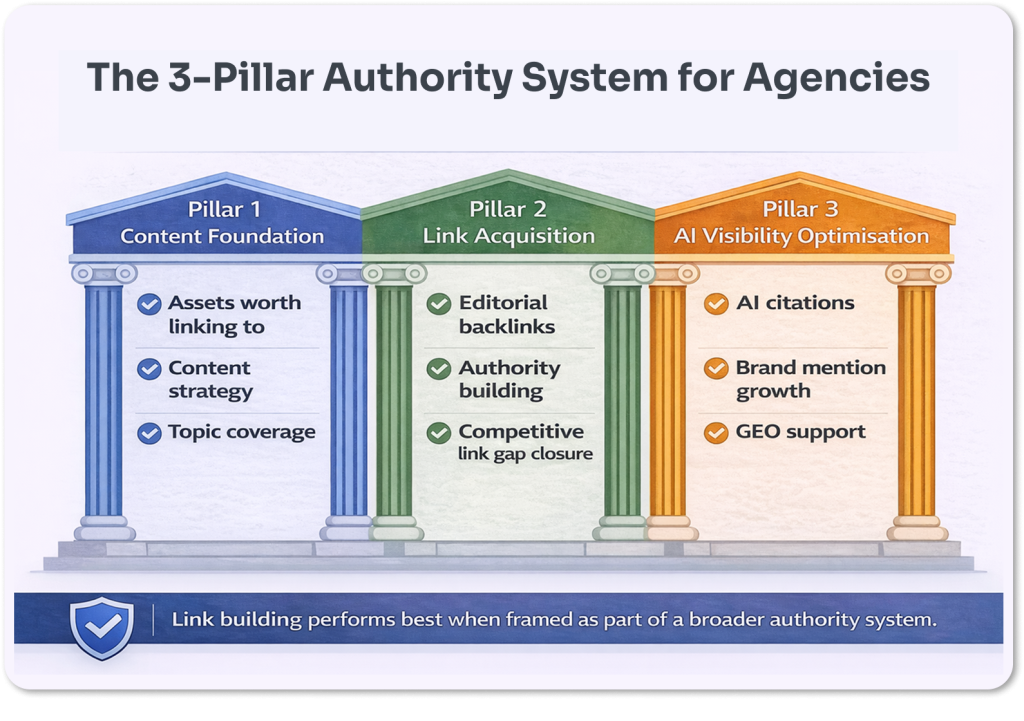
Position link building within your agency retainer as part of a three-pillar authority system:
- Content foundation, creating the assets worth linking to
- Link acquisition, building the authority signals that search engines and AI systems use to determine credibility
- AI visibility optimisation, ensuring your client is cited in AI-generated answers. This framing elevates link building from a tactical line item to a strategic growth system.
Position link building within your agency retainer as part of a three-pillar authority system:
- Content foundation: creating the assets worth linking to
- Link acquisition: building the authority signals that search engines and AI systems use to determine credibility
- AI visibility optimisation: ensuring your client is cited in AI-generated answers
This framing elevates link building from a tactical line item to a strategic growth system.
Common Mistakes Agencies Make With Link Building
The most common mistake agencies make is treating link building as an afterthought rather than a strategic priority.
Many agencies sell comprehensive SEO retainers but allocate minimal budget to link acquisition, hoping that technical optimisation and content alone will drive results.
In competitive markets, this approach fails because competitors with active link building programmes build authority faster.
Another common error is choosing white label partners based primarily on price rather than quality.
The cheapest provider almost always delivers the lowest-quality links, which can damage client sites and, by extension, your agency’s reputation.
Invest in a provider whose quality standards match or exceed your clients’ expectations, even if it means smaller margins per link.
Finally, many agencies fail to integrate link building data into their client reporting in a meaningful way.
Links should be reported alongside ranking changes, traffic growth, and competitive positioning, not as an isolated line item in a separate tab.
When clients see the direct connection between link acquisition and business results, they are far more likely to increase their investment over time.
How to Price and Package White Label Link Building for Your Clients
Pricing white label link building within an agency retainer is one of the most important commercial decisions you will make in building a profitable SEO service line.
Most agencies get it wrong in one of two ways.
One error is pricing too low: passing through white label costs with a thin margin to stay competitive.
This leaves the agency exposed to any cost increase from the provider.
It also fails to account for the coordination, reporting, and strategic work the agency adds on top of raw link delivery.
A second error is pricing link building as a standalone line item rather than embedding it within a broader authority and visibility retainer.
When clients see a per-link price, they instinctively compare it to cheap alternatives without understanding the quality and strategic differences.
Bundling link building within a monthly authority investment that includes content strategy, competitive analysis, and AI visibility planning makes the value proposition more defensible.
It also shifts the pricing conversation from cost to ROI.
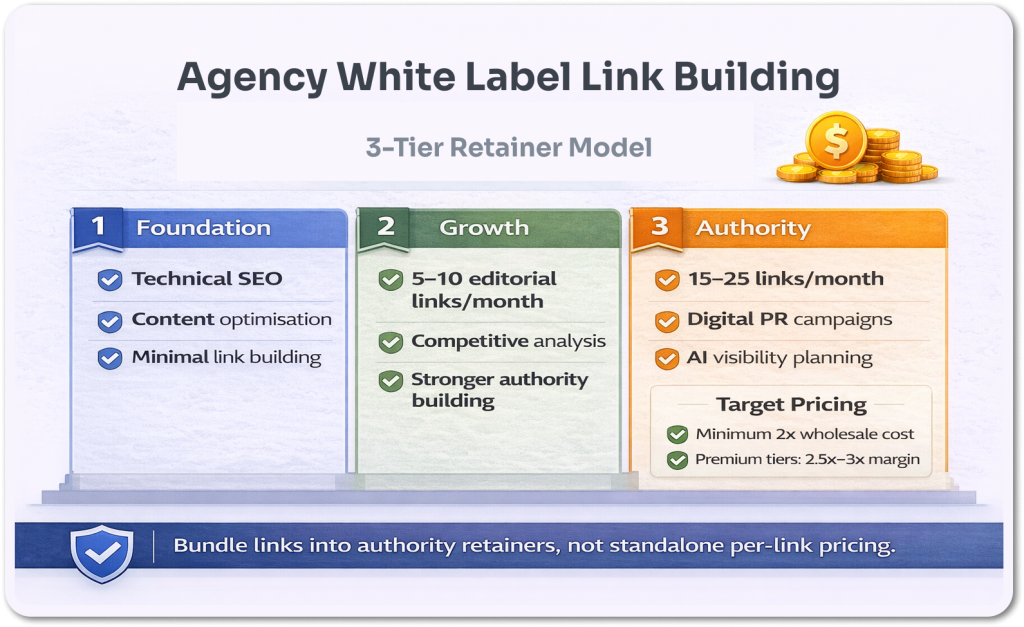
The most profitable agency model in 2026 is a three-tier authority retainer.
An entry tier covers technical SEO and content optimisation with minimal link building, positioning agencies to demonstrate early wins before upselling into the middle tier.
A middle tier adds five to ten editorial links per month.
A premium tier includes fifteen to twenty-five links monthly, digital PR campaigns, and regular competitor backlink gap analysis.
Each tier should be priced at a minimum of 2x the wholesale cost, with premium tiers targeting 2.5x to 3x margins to account for the additional strategic overhead.
Communicating link building ROI to clients requires a simple model they can follow without a technical background.
Connecting link acquisition directly to organic traffic value is the most effective framing: estimate what the expected ranking improvements would cost in paid search, then show that the link building investment delivers equivalent or greater traffic at a fraction of the cost.
Ranking on page one for a keyword with 1,000 monthly searches and a $15 cost-per-click represents approximately $15,000 in monthly paid search value.
Against that benchmark, a $2,000 monthly link investment appears not just reasonable but dramatically underpriced.
Client retention on link building retainers is substantially higher than on pure technical SEO engagements.
Link building produces visible, attributable deliverables every month: placement URLs, domain metrics, and ranking movements.
Clients have tangible evidence of progress that reduces churn risk.
Agencies that report monthly on cumulative authority growth alongside ranking improvements achieve 31 percent higher annual client retention than those reporting on technical fixes alone.
For agencies new to white label partnerships, start with a small number of clients at higher margins and lower volumes to validate your quality control processes before scaling.
The reputation risk of delivering poor-quality links under your agency brand is significantly greater than the short-term profit opportunity of rushing to scale.





 Start the conversation