



Startups face a unique link building challenge that established companies simply do not encounter: they need authority fast, but they have no brand recognition, limited budgets, often just a handful of team members, and a domain that Google has literally never seen before.
Every startup begins with a domain rating of zero and must build credibility from nothing while competing against established players who have accumulated thousands of referring domains over years.
The good news is that startups often possess something established companies lack: genuine novelty.
A truly innovative product, a contrarian take on an industry problem, proprietary data from a new approach, or original research that challenges conventional wisdom all create natural link opportunities that money alone cannot buy.
The key is knowing how to package these assets for maximum link earning potential and then distribute them through the right channels to reach the publishers and editors who can amplify your story.
Zero-backlink penalty: Ahrefs’ analysis of over 14 billion web pages found that 96.55% receive zero organic traffic from Google, with 66% of all pages having no backlinks at all, making referring domain acquisition a prerequisite for organic visibility rather than an optional accelerant.
In 2026, the startup link building playbook has evolved significantly thanks to AI tools that level the playing field and changing search dynamics that reward topical depth over domain age.
Startups that approach link building strategically can build meaningful authority within six to twelve months, positioning themselves to compete with much larger competitors in organic search.
Start With Linkable Assets, Not Link Requests
The biggest mistake startups make is trying to build links before they have anything genuinely worth linking to.
Sending outreach emails asking editors to link to a sparse homepage with three pages of content and no original value proposition is a waste of everyone’s time.
In 2026, the most effective startup link building begins with creating one or two genuinely valuable resources that serve your industry, not just your company.
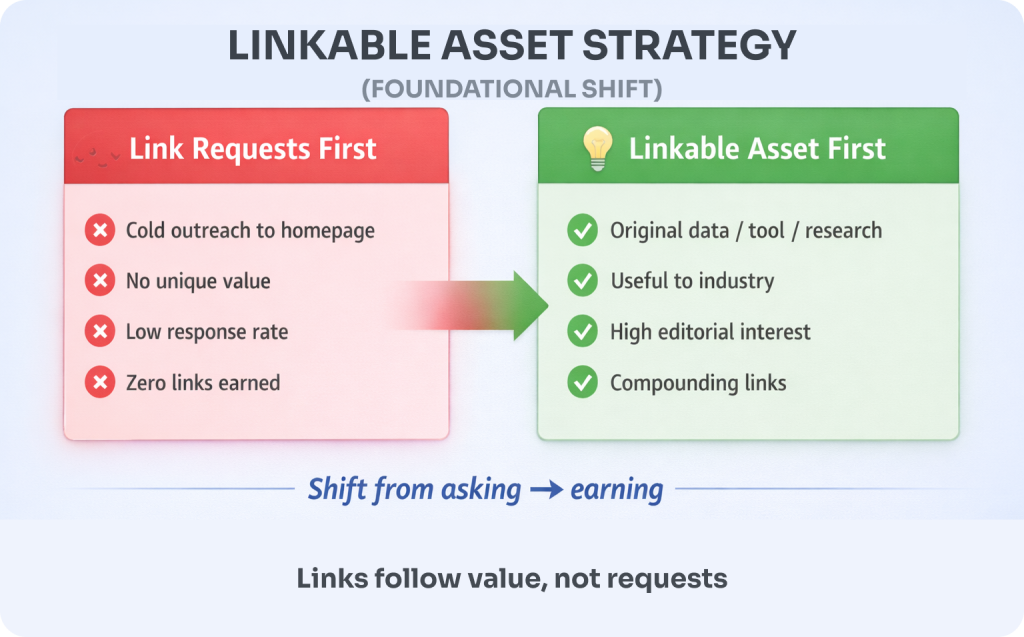
This could be an industry statistics page compiled from multiple authoritative sources with your own analysis added, an original survey of 500 or more industry professionals with findings that challenge conventional thinking, a free tool or calculator that solves a common problem in your niche, or a comprehensive guide that fills an obvious gap in existing content.
The critical requirement is that the asset must be genuinely useful to people who have no interest in buying your product.
If the only reason to link to it is commercial, it will not earn editorial links.
Content and links: BuzzSumo’s analysis of 100 million articles found that original research and authoritative reference content are the two content types that consistently earn both links and shares, with the majority of all other content receiving zero backlinks, making data-led content the highest-leverage investment in early link building.
Once you have a linkable asset, the outreach conversation becomes significantly easier.
Journalists and bloggers are far more receptive to being pitched a useful resource than a homepage or product page.
This is where white label link building partners can accelerate the process dramatically.
A partner with existing editorial relationships across hundreds of publications can distribute your asset to relevant editors much faster than cold outreach from an unknown domain with no track record.
Leveraging AI for Startup Link Building
AI tools have genuinely levelled the playing field for startups in several practical ways that translate directly into faster authority building.
Content generation tools can help startups produce high-quality blog content, data analyses, and industry commentary at a pace that would otherwise require a full content team.
A solo founder with a clear topic expertise can now publish two to three well-researched articles per week using AI as a drafting assistant, building a content base that attracts links organically.
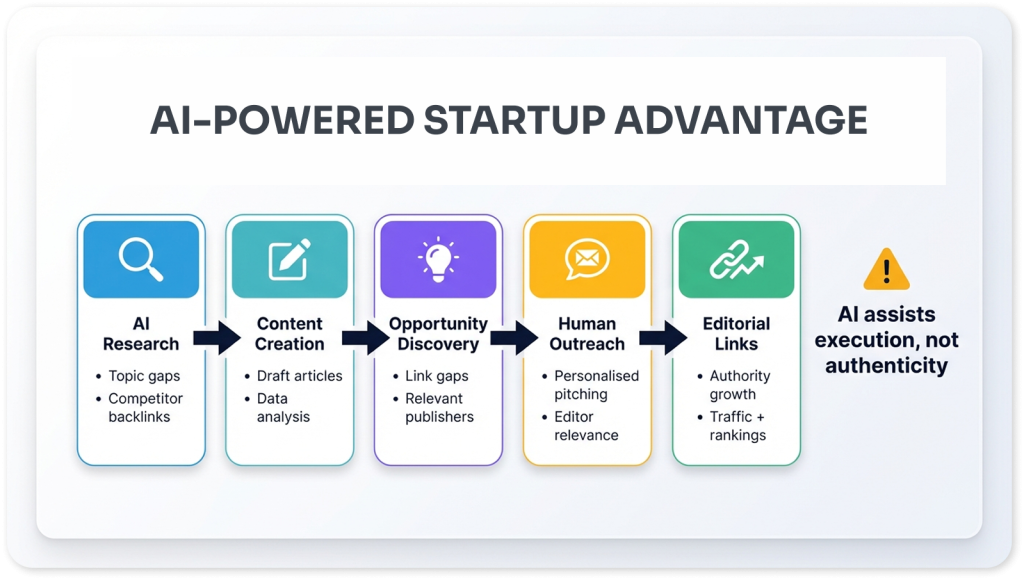
AI-powered prospecting tools can identify link opportunities by analysing competitor backlink profiles and surfacing sites that link to similar companies but not to you.
These gap analysis tools were previously available only through expensive enterprise platforms, but in 2026, accessible versions exist at price points that even bootstrapped startups can afford.
Organic content shift: According to the Content Marketing Institute’s 2025 benchmark data, 89% of marketers now use AI tools in content creation, with the share creating content entirely without AI dropping from 65% to just 5% in two years. Making original human-edited content with genuine proprietary data increasingly scarce and proportionally more valuable for link attraction.
However, startups should be cautious about over-relying on AI for outreach personalisation.
Editors at quality publications receive hundreds of pitches daily and can spot AI-generated outreach with increasing accuracy.
In 2026, the tolerance for generic, robotic pitches is at an all-time low.
Use AI for research, data gathering, and initial draft creation, but add genuine human insight, specific references to the editor’s recent work, and authentic enthusiasm before sending any outreach email.
Startups with limited budgets should also explore reseller link building programmes which allow them to access agency-grade link building at lower per-unit costs.
By working through an intermediary rather than engaging a full-service agency directly, startups can stretch their link building budgets 30 to 50 percent further while still receiving quality placements.
Building Authority Alongside AI Visibility
In 2026, startups need to think beyond traditional PageRank and consider the broader ecosystem of AI-mediated discovery.
Links now influence whether your brand appears in AI-generated search results from Google’s AI Overviews, whether ChatGPT mentions your product when answering relevant queries, and whether Perplexity cites your content in its research-style responses.
Building links from authoritative, topically relevant sources increases the probability that large language models will encounter and reference your brand when processing queries in your space.
This is particularly valuable for startups because AI citations can provide exposure that would otherwise require significant paid advertising or years of organic authority building.
Domain authority and growth correlation: Ahrefs’ correlation study across 218,713 domains found that Domain Rating correlates well with organic keyword rankings and search traffic, with Ahrefs’ own data confirming that pages on higher-DR domains consistently rank for a broader breadth of keyword variations, with the effect compounding as authority builds.
ions.
This dual benefit of traditional ranking improvement and AI citation influence makes outsourcing link building to specialists particularly strategic for startups.
Rather than spending months learning the craft of link building through expensive trial and error, startups can deploy their limited capital toward experienced teams who already understand which link types and sources drive both traditional rankings and AI-mediated visibility.
For bootstrapped startups, prioritise one excellent linkable asset over ten mediocre blog posts. A well-researched industry statistics page, a free tool, or an original survey can generate 20 to 50 organic links over its lifetime, delivering an outsized return on your content investment. Build one exceptional resource, then use it as your outreach anchor for the first six months.
A Practical Timeline for Startup Link Building
Months one and two should focus on foundation building: create your core linkable assets, establish social media profiles, submit to relevant directories, and build relationships in industry communities.
Months three through six should emphasise active outreach: pitch your resources to relevant publications, respond to journalist queries, contribute expert commentary, and begin guest posting on mid-tier industry blogs.
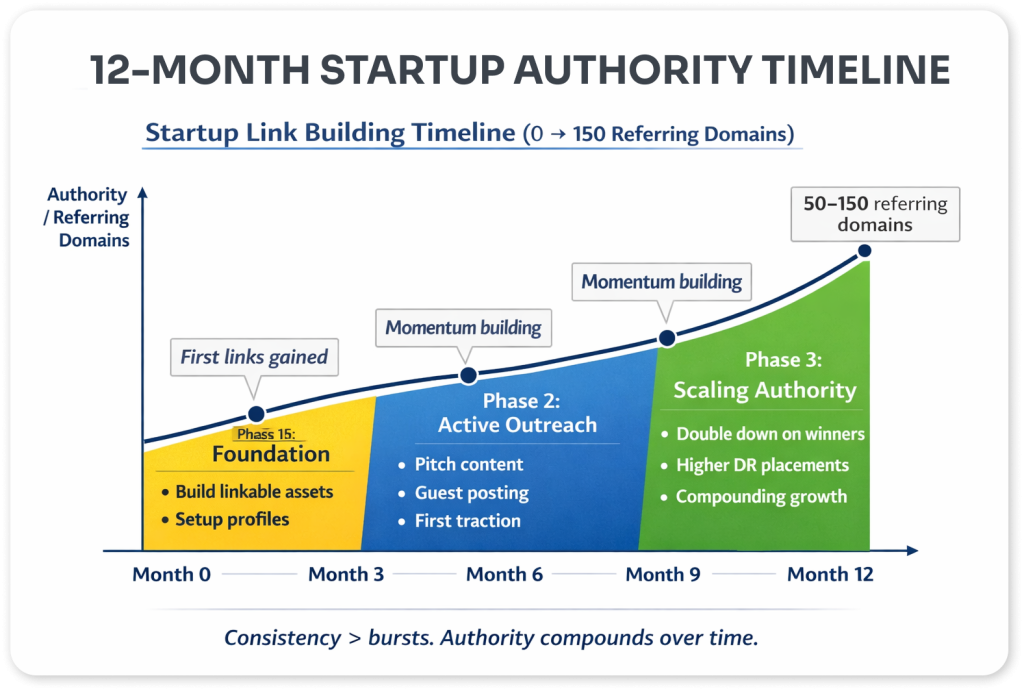
Months six through twelve should focus on scaling what works: double down on the content types and outreach approaches that generated the best results, invest in digital PR campaigns, and begin targeting higher-authority publications as your domain’s credibility grows.
By month twelve, a startup executing this playbook consistently should have 50 to 150 referring domains with measurable ranking improvements for target keywords.
The startups that succeed at link building are those that treat it as an ongoing investment rather than a one-time project, recognising that the compounding nature of authority building means the returns accelerate over time even as the per-link effort decreases as your brand becomes more recognised.
Common Link Building Mistakes That Slow Startup Growth
Most startups that fail to generate results from link building do not fail because the strategy is wrong.
They fail because of five specific execution mistakes that are entirely preventable with the right approach from the outset.
The first and most common mistake is prioritising link volume over link relevance.
Startups under pressure to show domain authority growth quickly often purchase packages that promise high link volumes at low per-unit costs.
A backlink profile filled with placements on unrelated websites contributes minimal topical authority signal to target pages.
Google’s algorithms assess not just the authority of linking domains but their topical relevance to the linked content.
Twenty relevant links from websites that genuinely cover your industry will consistently outperform one hundred links from unrelated lifestyle, news, or general interest sites.
The second mistake is ignoring anchor text diversity.
Over-optimising with exact-match commercial anchor text is a pattern that Google’s SpamBrain system identifies as manipulative.
Linking to your homepage with the exact keyword phrase you want to rank for, repeatedly, is a clear signal of manipulation.
Healthy anchor text profiles contain a mix of branded anchors, naked URLs, generic anchors, and a smaller proportion of partial-match and exact-match commercial phrases.
Teams that build all their early links with identical commercial anchors create patterns that can trigger algorithmic scrutiny, even if the individual links are on legitimate sites.
The third mistake is inconsistency.
Link building delivers compounding returns, meaning the benefit of each new link is amplified by the foundation of existing authority.
Running campaigns for two months, pausing for three to redirect budget, then restarting creates a link velocity profile that looks unnatural and fails to build sustained momentum.
A commitment to even three to five links per month consistently outperforms sporadic bursts of twenty links followed by multi-month pauses.
The fourth mistake is starting too late.
Many startups prioritise product development, paid acquisition, and content creation in their first twelve months without investing in domain authority.
When they eventually pursue link building, they find themselves twelve to eighteen months behind competitors who started earlier.
Authority is built incrementally over time, and companies that begin building their link profile at launch hold a structural advantage that is very difficult for late starters to close.
The fifth mistake is failing to track which pages receive links and monitor the ranking outcomes for those pages specifically.
Link building without measurement is investment without feedback. Use rank tracking tools to monitor position changes for the pages receiving links.
Apply this data to assess which content types, which linking domains, and which anchor text variations produce the best ranking results.
Over time, this data builds a startup-specific link building playbook far more valuable than any generic industry guide.





 Start the conversation