


The cost of backlinks in 2026 depends on a matrix of factors that interact in complex ways.
These include the authority of the linking domain as measured by metrics like Domain Rating, the topical relevance of the linking content to your site, and the type of placement.
Placement types include guest posts, niche edits, and digital PR features.
The method used to acquire the link and the overall quality and reputation of the publisher also affect the final cost.
Costs range from effectively free for organically earned links that result from exceptional content, to $10,000 or more for premium editorial features in top-tier national publications.
This guide breaks down the real, current costs across different link types and acquisition methods.
It is designed to help you budget effectively, set realistic expectations with stakeholders, evaluate provider proposals critically, and avoid both overpaying for middling quality and underpaying in ways that create risk.
Cost by Link Type and Placement Method
Guest post placements involve a custom article written and published on a third-party site with your link included.
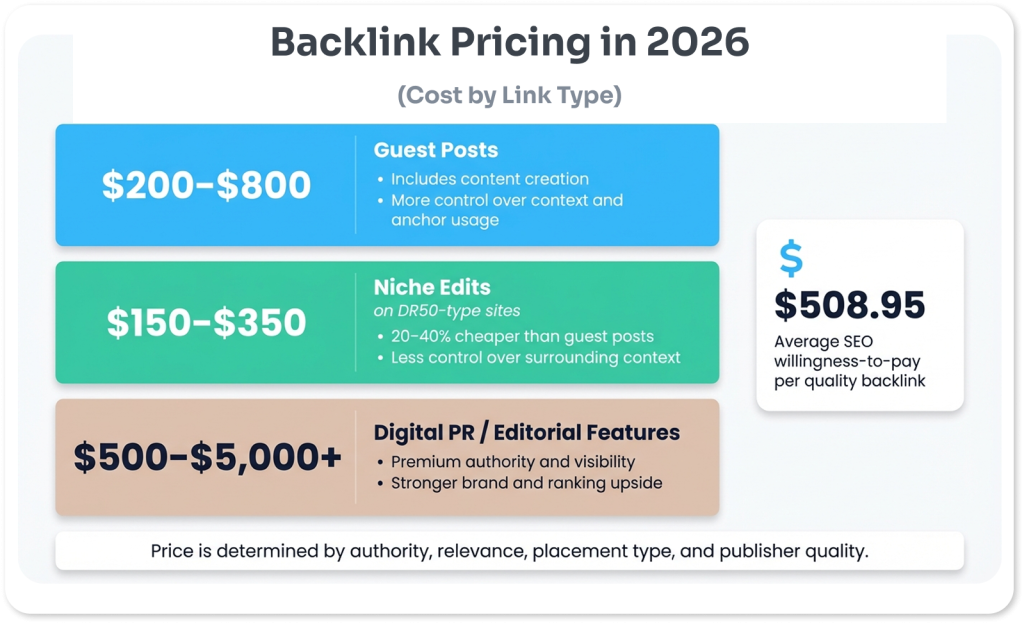
These typically cost $200 to $800 for sites in the DR 40 to 70 range.
The price includes both content creation and placement coordination.
The cost varies based on the editorial standards of the target site, the depth and quality of content required, and whether the provider has an existing relationship with the publisher.
Niche edits, or contextual link insertions, involve adding your link to an existing published article.
These run 20 to 40 percent less than equivalent guest posts because no new content creation is required.
A niche edit on a DR 50 site might cost $150 to $350 compared to $250 to $500 for a guest post on a comparable domain.
The trade-off is that you have less control over the surrounding content and anchor text context.
These benchmarks are well-supported by market data. According to the 2026 Link Building Statistics report compiled by Editorial.Link, the average price SEOs are willing to pay for a single high-quality backlink is $508.95, with 80.9 percent of SEO professionals believing link building will become more expensive over the next two to three years.
Digital PR placements in genuine news outlets and media publications represent the premium end of the market.
These range from $500 to $5,000 per placement depending on the publication’s authority and audience reach.
Top-tier national publications and major industry outlets command the highest prices.
They deliver proportionally greater ranking impact and brand visibility benefits.
For detailed pricing benchmarks broken down by domain rating tier, geographic market, and provider type, our link building pricing guide provides comprehensive market data based on surveys of over 100 agencies and providers operating in the 2026 market.
DIY Versus Agency Costs: The True Comparison
Building links yourself through in-house efforts reduces the per-link agency fee but introduces significant time costs that must be honestly accounted for.
A skilled in-house link builder can secure editorial placements for $50 to $200 each in direct costs covering tools, email infrastructure, and occasional content creation fees.
However, this does not account for the 15 to 25 hours per month of skilled labour required for prospecting, outreach, follow-up, content coordination, and quality verification.
The true fully loaded cost is significantly higher. Vazoola’s 2026 link building cost analysis found that building 30 backlinks in-house typically costs between $18,500 and $34,620 per month when accounting for SEO strategy, link building specialists, and content creation at current salary rates, putting the true per-link cost well above what most teams initially estimate.
When fully loaded with salary, benefits, tools, training, and management overhead, an in-house link builder’s effective cost often exceeds $5,000 to $8,000 per month for 8 to 15 quality links.
This puts the fully loaded per-link cost at $400 to $700.
That is comparable to or higher than agency pricing for equivalent quality unless you are building at significant scale that amortises the fixed costs across a larger number of links.
Agencies charge a premium that reflects their expertise, established editorial relationships, quality control infrastructure, and the operational efficiency that comes from managing link building as their sole focus.
For agencies evaluating whether to build internal teams or outsource, link building software platforms can reduce internal labour costs by 20 to 30 percent through workflow automation.
However, they require experienced operators to use effectively and do not replace the need for editorial relationship development.
The Hidden Costs of Cheap Links
The cheapest backlinks on the market, those priced under $100 each from unknown providers, almost always come with hidden costs that far exceed any savings on the initial purchase price.
The most common hidden costs include penalty risk from low-quality placements that trigger ranking losses requiring months of expensive recovery work.
Wasted budget on links from irrelevant sites that provide no measurable ranking benefit is another common issue.
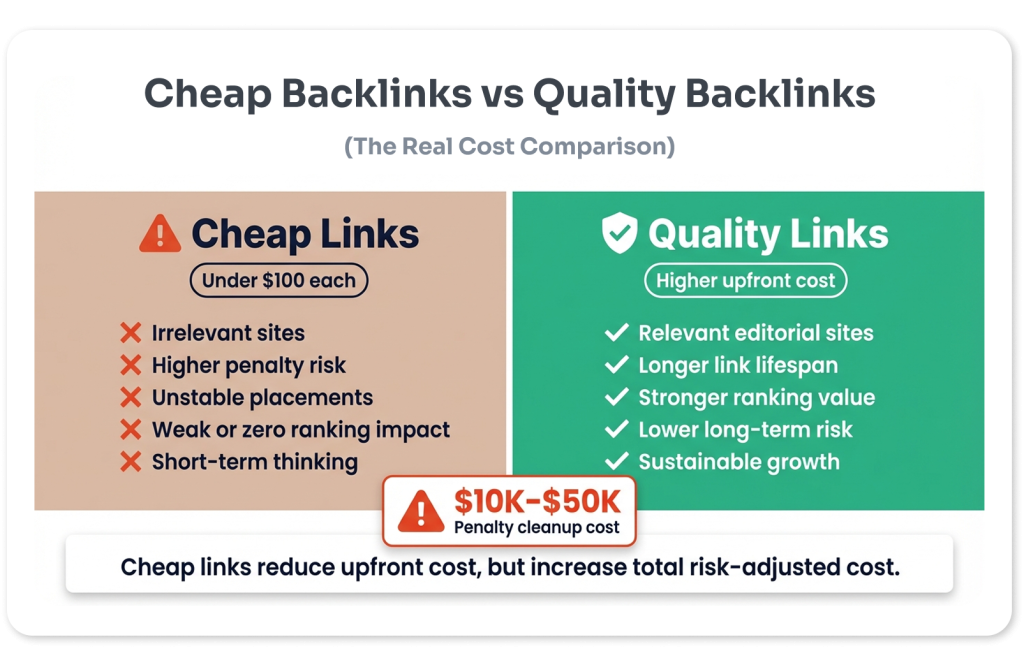
Link instability is a third hidden cost, where links placed on low-quality sites are removed within weeks or months when the hosting site is abandoned or penalised.
The market has reached a clear consensus on this. Reporter Outreach’s 2026 link building data found that 62 percent of SEOs now prioritise quality over quantity, with only 9 percent still chasing link volume — a significant shift reflecting hard-won lessons about the real cost of cheap, risky placements.
A conservative estimate of the total cost of dealing with a link-related penalty ranges from $10,000 to $50,000 depending on the size and revenue of the affected site.
This includes revenue lost during ranking recovery, professional fees for disavow work and site cleanup, and the opportunity cost of delayed growth.
Even a small probability of triggering such a penalty makes cheap links economically irrational when compared to the reliable returns of quality placements.
Investing in quality from the start is always more cost-effective than recovering from the damage caused by cheap, risky links.
If you are evaluating providers, look for those who offer transparent quality standards, are willing to share sample placements and client references, and can clearly explain their quality control processes.
The difference between legitimate link acquisition and risky shortcuts is one of the most important distinctions any SEO professional or business owner can understand.
For teams exploring direct link exchange as a seemingly cost-free alternative to paid link building, understand that reciprocal link schemes carry their own significant risks and detection probabilities.
These make them unreliable as a primary strategy for building sustainable authority.
The AI Search Factor in 2026
AI tools and market dynamics have created fascinating and complex new pricing tensions in the backlink acquisition market.
Buyers and providers are still learning to navigate these dynamics.
On one hand, AI-powered prospecting, content creation assistance, and outreach personalisation have reduced the operational cost of link building by an estimated 20 to 30 percent across the industry.
This theoretically allows providers to offer lower prices while maintaining margins.
On the other hand, the dramatically increased strategic importance of quality backlinks for AI search visibility has driven up demand from sophisticated marketers.
Links directly influence whether brands are cited in ChatGPT, Perplexity, and Google AI Overview responses.
This is particularly true for high-authority placements from the authoritative publications that most heavily influence LLM citation patterns.
The data on this is striking. Ahrefs research cited by Reporter Outreach found that brand mentions correlate 3x more strongly with AI visibility than backlinks alone, with a correlation of 0.664 versus 0.218 across 75,000 brands, making digital PR placements that earn both a backlink and an editorial mention exceptionally valuable in 2026.
The net effect on pricing is that mid-tier link placements in the DR 40 to 60 range have remained relatively price-stable.
Premium placements on DR 70-plus publications have become meaningfully more expensive.
More companies are competing for a fundamentally limited supply of high-authority editorial opportunities.
Practical Implementation Guidance
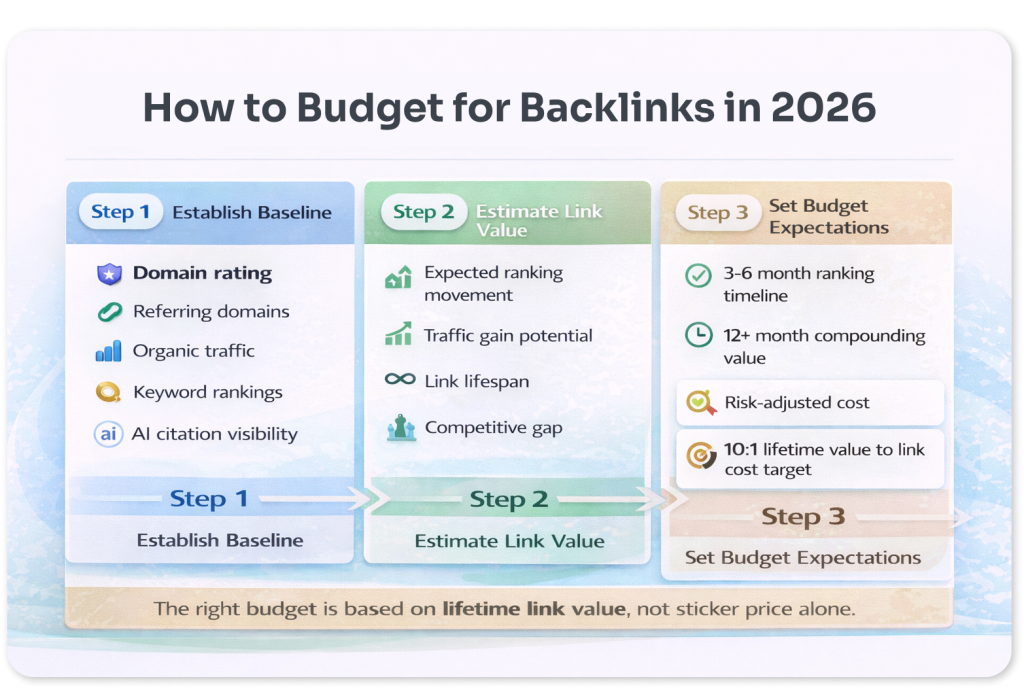
Before committing budget to any link acquisition provider, invest the time to establish comprehensive baseline metrics for your website’s current authority position.
Document your current domain rating, total number of referring domains, and their quality distribution.
Record organic traffic levels for your target keywords and pages.
Note your current rankings for your priority keyword set.
Gather any existing AI citation visibility data you can access.
Record these metrics in a standardised format so you can measure the incremental impact of your link building investment over time with precision.
Avoid relying on subjective impressions when assessing results.
Set realistic expectations for timeline to results.
Meaningful and measurable ranking improvements from link building typically require three to six months of sustained effort to materialise.
The full compounding impact often is not fully visible until twelve months or more into a consistent programme.
Budget planning should account for this timeline. Siege Media recommends targeting a 10:1 ratio of lifetime link value to manual link cost to account for the uncertainty inherent in SEO, with their data showing that most businesses should expect a lifetime link value of between $5,000 and $15,000 per well-placed backlink when ranking improvements are fully attributed.
Strategic Context and Market Positioning
The market for professional backlink acquisition services has matured substantially since the early days of bulk directory submissions, blog comment spam, and indiscriminate link buying from anonymous sellers.
In 2026, professional link building operates with a level of sophistication comparable to media buying or public relations.
Established pricing models are based on transparent quality metrics.
Comprehensive performance tracking and attribution systems are now standard practice.
Industry standards for quality and ethical practice are well-established among reputable providers.
This professionalisation has raised both the quality floor and the quality ceiling.
Publisher fees have risen sharply alongside this maturation. Reporter Outreach data shows that publisher placement fees have risen 20 to 40 percent over the past two years as publishers recognise the commercial value of their editorial inventory, meaning budgets that worked in 2024 need meaningful adjustment for 2026 rates.
Understanding the total cost of ownership for backlinks requires a comprehensive financial analysis beyond the initial per-link acquisition price.
Factor in the expected lifespan of each link.
Higher-quality editorial placements typically persist for three to five years or longer.
Cheap placements on low-quality sites may be removed within three to six months as the hosting site is abandoned, sold, or penalised.
Consider the opportunity cost of the time your team spends managing the acquisition process.
Outsourcing to specialists who have established relationships and optimised processes is often more efficient.
Account for the risk premium associated with different quality levels.
A single algorithmic penalty event triggered by low-quality links can cost more in lost revenue and recovery expenses than years of investment in quality-focused link building.
The economics of backlink acquisition in 2026 are increasingly shaped by competitive dynamics within specific markets and keyword verticals.
In industries where all major competing websites actively invest in ongoing link building programmes, maintaining competitive parity in search rankings requires sustained, consistent investment.
Companies that pause or stop their link building while competitors continue to invest create a widening authority gap.
That gap becomes exponentially more expensive to close over time.
This competitive reality makes sustained monthly link building programmes significantly more cost-effective than sporadic campaigns.
Looking Ahead: Key Takeaways for 2026 and Beyond
The link building landscape continues to evolve at an accelerating pace.
This evolution is driven by advances in AI technology, changes in search engine algorithms, and shifting user behaviour.
User behaviour increasingly includes AI-mediated information discovery alongside traditional search.
Companies that invest in sustainable, quality-focused approaches today are building competitive advantages that compound over time.
These advantages become more valuable and more difficult for competitors to replicate with each passing quarter of consistent investment.
The strategic decisions you make about link building in 2026 will shape your organic visibility, AI citation profile, and competitive positioning for years to come.
This makes it one of the most consequential investments in your broader digital marketing portfolio.
The cost of inaction is measurable. SEMrush data shows that 90.63 percent of all web pages receive zero organic traffic from Google, a reminder that the gap between well-linked pages and everything else is not narrowing. It is widening with every month of competitive link building investment.
Explore the Blue Tree Digital case studies to see the real-world traffic and revenue impact of quality-focused link building programmes across a range of industries and budgets.





 Start the conversation