



Tools like Google AI Overviews, Perplexity, and ChatGPT pull answers from multiple websites, then show a small set of cited sources. Those are AI SEO citations and they’re often more important than your classic organic ranking.
Links and brand mentions both affect whether you get cited. Links help search engines and AI systems see your site as an authority.
Brand mentions help AI connect your brand to topics, entities, and queries.
This article explains, in practical terms, how links and brand mentions work together to influence AI citations and what you can do to get your brand quoted more often.
In this article…
- What are AI SEO Citations?
- How Do Links Shape AI Training Data, Indexes, and Citation Engines?
- Why Brand Mentions Matter So Much for AI Citations
- Do Links or Brand Mentions Matter More for AI SEO Citations?
- How To Engineer Your Link and Brand Mention Strategy for AI-First SEO
- How Do You Measure and Optimize Your Brand’s AI Citation Footprint?
- FAQ – Links, Brand Mentions, and AI SEO Citations
Key Takeaways
- AI SEO citations show which brands AI systems trust and reference inside AI-generated answers, not just on search result pages.
- Links help AI find and index your content, while brand mentions and entity strength determine if you’re cited.
- Repeated, context-rich mentions across trusted sites correlate 3x more with appearing in AI Overviews than backlink volume alone.
- Build AI-ready pillar content, earn white-hat authority links, and secure consistent brand mentions through PR and thought leadership.
What are AI SEO Citations?
AI SEO citations are the sources that AI tools show (or reference) when they generate an answer.
They look like source cards, small links under an AI overview, or numbered references next to a paragraph. They matter because that’s where attention flows now.

Backlinks, on the other hand, live inside web pages. They help search engines understand authority and relevance.
AI citations live inside AI interfaces. They help users see which brands an AI trusts enough to reference. Understanding the difference is step one if you want to be visible in AI search, not just in traditional SERPs.
What Do We Actually Mean by AI SEO Citations?
AI SEO citations are the visible credits AI systems give to web pages and brands when they answer a query. Think of them as “who gets named” when an AI summarizes the web. If you’re not cited, users may never discover you.
AI tools work in two stages: retrieve information, then generate an answer. In the retrieval stage, they pull from search indexes or their own crawls.
In the generation stage, they decide which sources to expose to the user as citations. These show up as cards, small links under summaries, or inline references in chat-style tools.
Most platforms follow the same pattern:
- Google AI Overviews: show a short list of source cards under the AI block.
- Bing / Copilot: surface links alongside the AI answer.
- ChatGPT / other LLMs: show numbered references or “learn more” citations.
These citations don’t just credit you. They shape who users see as a leading solution.
Recent studies on AI Overviews show a big share of clicks being siphoned from classic blue links into AI blocks, which means citations are becoming the new “position zero.”
What’s the Difference Between Backlinks, AI Citations, and Brand Mentions?
Backlinks help search engines rank pages. AI citations help AIs show sources.
Brand mentions help AIs and search engines understand which entities (brands, products, people) are connected to which topics even when there is no link.

Here’s the simple breakdown:
- Backlinks: Links from one page to another. Classic SEO authority signal.
- AI citations: Links or mentions inside AI answers and summaries. Visibility signal inside AI interfaces.
- Brand mentions: Your brand or product name appearing in text, with or without a link. Increasingly important for AI, which is trained on raw text.
To make the differences concrete, the table below compares how each signal behaves and where it shows up in the user journey.
This helps you see why backlinks alone are not enough anymore if you want to be cited by AI systems consistently.
| Signal type | Where it appears | Who chooses it | How AI uses it | Clickable for users? |
| Backlink | Inside web pages | Site editors, publishers | Authority, relevance, crawl & indexing signals | Yes |
| AI citation | Inside AI answers / overviews | AI system | Source attribution, trust, explanation support | Usually yes |
| Brand mention | Anywhere in on-page text, off-site | Other sites, media, users | Entity recognition, topic association, co-occurrence | Not always |
Studies of AI Overview visibility show something interesting: brand web mentions correlate more strongly with AI Overview presence than raw backlink counts, even though link metrics still matter.
That means AI is leaning heavily on “who gets talked about” as well as “who has links.”
How Do Links Shape AI Training Data, Indexes, and Citation Engines?
Links still matter for AI, but not in the old “more links = higher rankings” sense. They now act as trust and discovery signals that feed the indexes and models AI systems rely on. If links don’t point to you, AI often never sees you.
Most AI search products don’t crawl a totally separate web. They lean on:
- Classic search indexes (Google, Bing)
- Their own crawlers built on top of that
- Large language models trained on public web data
Backlinks influence all three layers by telling these systems which pages are worth finding, keeping, and re-using.
How Do AI Search Systems Choose Which Sources to Cite?
AI search systems pick sources in two stages: retrieve first, then generate. Links mostly influence that first stage, but if you’re not retrieved, you never get cited.
At a simple level, most AI search flows look like this:
- Query understanding – model interprets your question (intent, entities, context)
- Document retrieval – system pulls candidate pages from an index
- Answer generation – LLM summarizes those pages into a response
- Citation selection – system chooses which sources to show as citations or source cards
Here’s what that means for links in practice:
- Strong backlinks → better rankings in the underlying index
- Better rankings → higher chance of being retrieved for the AI answer
- More retrieval → more opportunities to be chosen as a citation
So even when AI tools talk about “citations” as something new, in the background they’re still leaning on the link-shaped web we’ve spent 20 years building.
To make it concrete, most major AI search tools work roughly like this:
- Google AI Overviews pull from Google’s own index. Pages with strong organic visibility and authority are more likely to be used as sources.
- Perplexity & Copilot rely heavily on Bing’s index, which is also link-driven.
- ChatGPT Search & similar tools combine a proprietary index with web data, but still use authority and popularity signals shaped by links.
So, while AI citations feel new in the UI, the selection logic is still deeply influenced by your backlink profile.
How Do Backlinks Still Indirectly Control AI Citations Through Classic SEO?
Backlinks now influence AI visibility less as a direct ranking factor inside the model, and more as infrastructure: they shape which content is discoverable, trusted, and re-used.
You can think about it as a chain reaction:
- Quality backlinks help your pages rank and stay indexed
- Indexed, ranking pages become training data and retrieval candidates for AI
- When those pages answer queries clearly, they become prime citation candidates
- AI systems start using and re-using those pages, reinforcing you as a trusted source
A simple way to visualize this:
| Stage | What’s happening | How links matter today |
| Crawl & index | Search/AI systems find and store your pages | Links help bots discover and prioritize URLs |
| Ranking & retrieval | Systems pick candidates for a query | Authoritative links boost chances of being selected |
| AI answer generation | LLM summarizes multiple pages | Only retrieved pages can influence the final answer |
| Citation selection (UI) | System chooses which URLs to show | Strong sources are more likely to be exposed as cards |
Several recent GEO-focused studies make the same point: LLMs don’t “count links” in the same way search engines do, but they strongly benefit from the ecosystem shaped by those links.
Trusted domains with consistent, high-quality backlinks show up more often in AI Overviews and other AI answers.
So instead of thinking: “How many links do I need to get cited by AI?”
Reframe it as: “How can I use backlinks to make my content unmissable in the indexes AI pulls from?”
That means:
- Fewer, higher-quality links from authoritative, topic-relevant sites
- Links into deep, explanatory content (not just homepages)
- Links that reinforce your brand as the source for a specific topic or question
Later in the article, when we talk about white-hat link building and high-authority backlinks, we’ll connect this to concrete plays you can run to strengthen that underlying authority graph, not just chase “link count for rankings.”
Why Brand Mentions Matter So Much for AI Citations
Brand mentions are any place your brand is named, on a blog, in a podcast transcript, in a forum thread even if there is no hyperlink. For AI, these mentions are raw training data.
They help models learn who you are and what you’re about, which is exactly what they need to decide whether to cite you.
In classic SEO, unlinked mentions were “nice to have.” In AI SEO, they’re much closer to “must have.”

Multiple recent studies and industry analyses show that brands with strong web-wide mention profiles are far more likely to appear in AI Overviews and other generative answers even when they’re not always ranking #1 organically.
Why Entity Recognition and Co-Occurrence Run the Show in AI SEO
To understand why mentions matter, you have to think like a model, not like a search result. AI systems don’t just look for URLs; they look for entities and how those entities show up together across the web.
When AI researchers talk about entity SEO, they mean optimizing so that machines clearly understand your brand as a distinct “thing” tied to specific topics, products, and problems.
Brand mentions are the main raw material for that understanding.
Across thousands of pages, AI models look for patterns like:
- How often your brand name appears next to key topics
- Which other brands or entities appear with you (“co-occurrence”)
- Whether you show up in trusted sources (news, industry blogs, reports)
- What sentiment and context surround those mentions (reviews, roundups, docs)
Over time, that creates an entity graph in the model’s “head”:
| Signal type | What AI infers from it | Example |
| Frequent topic pairing | “This brand is strongly tied to this problem/solution.” | Your brand often mentioned with “technical SEO audit” |
| Co-occurrence with leaders | “This brand belongs in this peer set.” | Mentioned alongside market leaders in comparisons |
| Trusted source coverage | “This brand is safe to surface in answers.” | Cited in niche industry publications |
| Consistent sentiment | “This brand is positively associated with outcome X.” | Reviews, case studies, testimonials |
Why Unlinked Brand Mentions Help in AI Results
Unlinked brand mentions don’t pass PageRank in the classic sense, but they still matter a lot especially for AI.
Search engines and AI systems can detect when your name appears, understand the context, and use that as a non-link authority signal.
Several things are happening at once:
- Search engines have long treated some unlinked mentions as “implied links” or citations, especially in local and brand search.
- Google spokespeople have confirmed they can “pick up mentions” even when there is no hyperlink, feeding into your overall reputation and E-E-A-T profile.
- Recent GEO/AI studies show branded web mentions are among the strongest correlating factors for whether your brand appears in AI Overviews and other AI search experiences.
Put simply, for generative AI, who gets talked about can matter as much as who gets linked to.
Here’s how linked vs unlinked mentions compare from an AI SEO perspective:
| Type of mention | Link? | What it gives classic SEO | What it gives AI SEO |
| Contextual backlink | Yes | PageRank, crawl path, anchor text relevance | Strong authority + entity + topical context |
| Branded mention w/ link | Yes | Authority + brand search lift | Clear brand–topic association, easy to cite |
| Branded mention no link | No | Reputation signal, possible “implied link” | Entity reinforcement, co-occurrence, sentiment & topical ties |
| Brand in UGC (forums, social, etc.) | Sometimes | Indirect (influence, awareness) | Training data and context for models, especially in GEO studies |
One recent analysis of AI citation patterns notes that AI engines “reward brands that show up repeatedly in third-party content, even when there’s no link,” especially across trusted news and niche sources.
Do Links or Brand Mentions Matter More for AI SEO Citations?
Brand mentions now move AI citations more than raw link counts but you still need both.
Recent data on 75,000 brands shows branded web mentions correlate about 3x more strongly with appearing in AI Overviews than the number of backlinks.
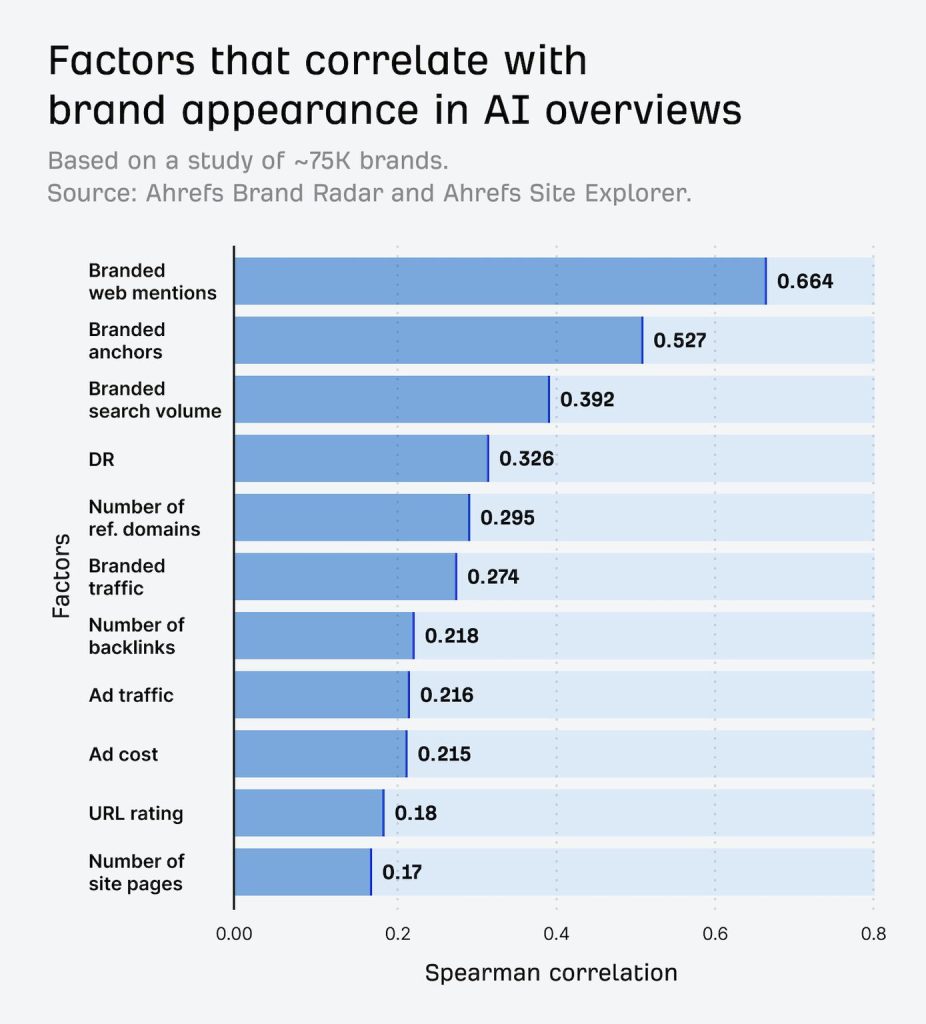
Source: Ahrefs
But here’s the catch: links are still the scaffolding that gets your content into the index. Mentions are what convince AI that your brand belongs in the answer.
Do Different Industries Need a Different Mix of Links vs Mentions?
Different industries don’t play the same AI game. SaaS, ecommerce, local, and enterprise brands need different blends of classic link authority and broad brand visibility to win citations.
From large-scale AI Overview studies, we know:
- Branded web mentions show the strongest correlation with AI Overview visibility (correlation ≈ 0.664).
- Backlink metrics (referring domains, total backlinks) have much weaker but still positive correlations.
So the question isn’t “links vs mentions”. It’s: “For my category, how much should I invest in authority links vs brand visibility?”
Here’s a practical way to think about it:
| Type | Where AI “hears” about you | What matters most for citations | Recommended bias |
| B2B SaaS | Reviews, comparison posts, analyst reports, LinkedIn | Thought leadership + brand mentions in expert content | 40% links / 60% mentions |
| Ecommerce | Category roundups, UGC, YouTube, Reddit, TikTok | Volume of mentions + trust in review/UGC platforms | 50% links / 50% mentions |
| Local / Services | Local listings, local media, niche blogs, forums | NAP consistency + local citations + review content | 30% links / 70% mentions |
| Enterprise | Analyst reports, news, industry whitepapers | Entity strength + high-authority citations, not volume | 60% links / 40% mentions |
These ratios aren’t strict rules; they reflect how AI platforms source information:
- Google AI Overviews lean heavily on mixed sources (docs, blogs, LinkedIn, Reddit, YouTube).
- Perplexity over-indexes on community content like Reddit and reviews.
- ChatGPT uses more encyclopedic and high-authority sources (Wikipedia, big publishers).
That means:
- In SaaS/B2B, being name-dropped in category explainers, G2-style roundups, and LinkedIn content matters as much as DR.
- In ecommerce, you want your product and brand name appearing in reviews, “best X for Y” posts, and UGC that models will ingest.
- In local, AI tools lean on entity consistency (business name, address, category) and review-driven mentions.
If you ignore links, you risk never making it into the index. If you ignore brand mentions, you risk being in the index but never chosen as the brand to cite.
How To Engineer Your Link and Brand Mention Strategy for AI-First SEO
If you want more AI citations, you can’t just “build links” or “do PR” in isolation. You need a system that creates AI-ready assets, then points both links and mentions at them until they become the obvious sources for your topic.
That system has two moving parts:
- Content that is easy for AI to reuse and cite
- Promotion that generates both backlinks and brand mentions across trusted sites
Let’s break those down into practical moves.
How To Build AI-Ready Assets That Attract Links, Mentions, and Citations
If you want AI to cite you, you need pages that answer questions so clearly that humans and models both treat them as reference material. Think “definitive answers,” not just “blog posts.”
The fastest path is to build a small set of pillar assets that naturally earn links, mentions, and AI citations over time.
These assets usually follow patterns you can systematize:
- Original data (benchmarks, surveys, pricing studies)
- Frameworks and definitions (what, how, why, pros/cons)
- Comparison content (X vs Y, “best tools,” vendor landscapes)
- Process breakdowns (step-by-step, checklists, templates)
Those asset types work because they’re:
- Highly reusable (other sites cite them)
- Easy for AI models to summarize and extract
- Naturally aligned with “What / How / Why / Best” queries
You can structure each pillar page with an AI-first layout:
- Start with a one-paragraph direct answer to the main query
- Follow with a scannable table or checklist of key variables
- Expand into sections that mirror common sub-questions
- Add examples, formulas, and mini-case studies models can latch onto
Here’s a simple way to map asset types to outcomes:
| Asset type | Main goal | Best for attracting |
| Original data / benchmarks | Become “source of truth” | AI citations + editorial links |
| “What is / How to” guides | Capture broad demand | Topical authority + mentions |
| Comparison / “best tools” pages | Capture bottom-of-funnel intent | Links from listicles + AI picks |
| Framework / checklist posts | Get quoted in how-to content | Mentions in guides and playbooks |
How To Use Digital PR, Thought Leadership, and White-Hat Link Building to Feed AI
You don’t get AI citations by hoping models find you. You get them by deliberately placing your brand and URLs into the sources those models already trust through white-hat link building and digital PR.
Think of it as three overlapping plays:
- White-hat authority link building
- Digital PR for mentions in trusted publications
- Vertical-specific SEO to make those links/mentions contextually strong
First, you still need safe, authority-building links:
- Guest posts and expert contributions on relevant, high-authority sites
- Resource page placements that point to your best explainer or study
- Niche-relevant guides that link to your tools, frameworks, or data
A white-hat approach (no PBNs, no spam, no manipulative anchors) is exactly what AI-focused search systems want, because they lean on the same “trust graph” traditional search uses.

This is where AI models really start to notice you. When the same brand keeps appearing in expert explainers, roundups, and third-party guides, the models learn you’re a legitimate entity in that category, not just another domain with links.
Third, tune it to your vertical so the mentions match how AI sees your category:
- If you run an online store, your AI-first strategy should combine link earning to category pages with PR and UGC that feed your product/entity footprint.
- If you’re a SaaS or B2B platform, being cited as a “go-to tool” or “recommended vendor” in comparison content is huge.
Here’s how the whole machine fits together:
| Layer | What you do | What AI sees |
| Pillar content | Create definitive, structured answers | High-quality reference pages |
| Authority links | Earn placements from relevant, trusted domains | Safe, authoritative sources in the link graph |
| Digital PR | Get quoted, mentioned, and featured in media | Brand/entity repeatedly associated with key topics |
| Vertical SEO | Align terms, schemas, and examples to your niche | Clear mapping of your brand to specific queries |
Over time, that gives you a defensible AI authority footprint: your name and URLs keep showing up in the exact set of sources AI systems consult and ingest.
Once that happens, citations become much less about “luck” and much more about “inevitable.”
How Do You Measure and Optimize Your Brand’s AI Citation Footprint?
You can’t improve what you don’t measure. If AI is the new shelf, you need a way to track how often you appear, where, and for what queries.
That means three layers of tracking:
- Direct AI citations and mentions
- Web-wide brand mentions
- Classic SEO + revenue metrics that move with those citations
Let’s turn that into something you can actually instrument.
What Metrics Actually Indicate Growing AI Visibility?
Think of AI visibility as a stack: platform-level metrics, web signals, and business outcomes. You want a simple dashboard that tells you whether you’re becoming more visible, more trusted, and more chosen by AI systems over time.
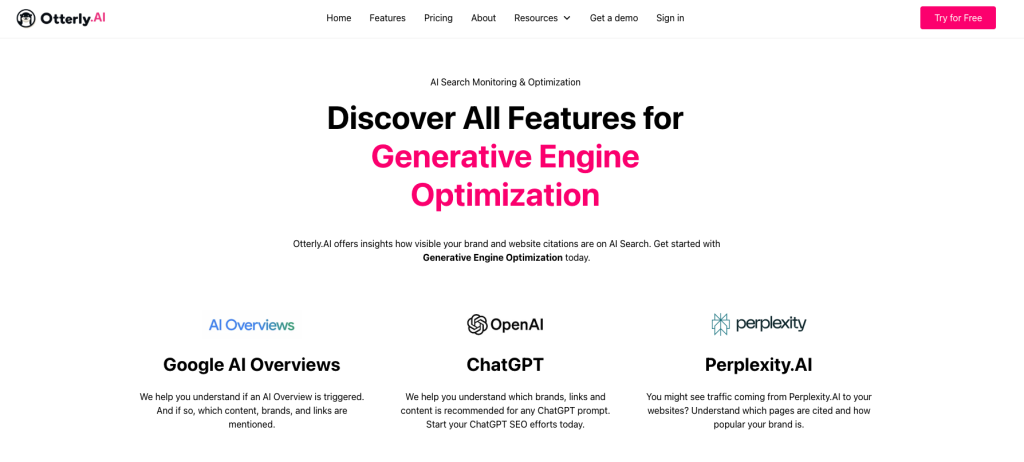
First, track direct AI mentions and citations. Tools like Otterly, Surfer’s AI Tracker, and other AI overview trackers monitor how often your brand shows up in Google AI Overviews, ChatGPT, Perplexity, Gemini, and Copilot.
Second, pair that with web-wide branded mentions from SEO suites or brand monitoring. This gives you the “raw material” AI is ingesting: where you’re mentioned, in what context, and on which domains.
Third, connect those to traffic and conversion metrics in Google Analytics and Search Console.
Here’s a simple way to structure your measurement:
| Layer | Metric | How to track it | Why it matters for AI SEO |
| AI platforms | # of citations per platform per month | AI visibility tools (Otterly, Surfer, etc.) | Direct signal you’re being chosen |
| AI query coverage | # of prompts where you appear | Prompt-based testing, AI tracking tools | Shows breadth of use cases you own |
| Web mentions | Branded web mentions over time | SEO/PR tools, brand monitoring | Core driver of AI Overview visibility |
| Classic SEO | Organic sessions, rankings, CTR | GA4, Search Console | Underlying index and retrieval strength |
| Revenue impact | Leads, demos, sales influenced by AI | CRM notes, attribution fields, post-signup surveys | Proves AI visibility is more than “nice PR” |
FAQ – Links, Brand Mentions, and AI SEO Citations
Can I appear in AI results without backlinks?
Yes, but it’s rare. AI systems lean on indexes where authority still depends heavily on links. Strong brand mentions can get you some visibility, but consistent citations usually come from pages with at least a baseline backlink profile.
Do nofollow links matter for AI citations?
Yes, indirectly. Nofollow links from trusted sites still contribute to visibility, discovery, and brand mentions. AI models see the text and the association, even if traditional PageRank isn’t passed in the classic sense.
Are unlinked brand mentions actually used by AI systems?
Yes. Models are trained on raw text, so every unlinked mention becomes training data. Search engines also treat some mentions as “implied links” or reputation signals, especially in local and brand contexts.
Do higher Google rankings guarantee better AI coverage?
No. Higher rankings help you get into the candidate pool, but AI citations correlate more strongly with branded web mentions and authority than exact position. A strong entity profile can beat a slightly higher-ranked but weaker brand.
Should I prioritize links or brand mentions for AI SEO?
Treat links as infrastructure and mentions as fuel. You need enough quality links for discovery and trust, then as many credible brand mentions as possible to signal that you’re a leading entity in your space.
How often should I audit my AI citations?
Monthly is a good baseline. For fast-moving categories, weekly checks across AI Overviews, ChatGPT, and Perplexity help you catch new opportunities and losses before they turn into revenue problems.
Can AI citations drive measurable revenue?
Yes. Brands already see AI-born traffic and leads, especially from comparison and “best tools” queries. The key is to track AI as a source in forms, CRM, and surveys so you can tie mentions to pipeline.
Will optimizing for AI hurt my traditional SEO?
Done right, no. Structuring content for AI with clear sections, entities, schema, and definitive answers usually improves classic SEO as well. Most AI SEO best practices overlap with solid, modern SEO fundamentals.





 Start the conversation