



Bad backlinks are links created to manipulate rankings instead of citing value.
Google classifies “link spam” under its spam policies and can algorithmically ignore it or apply manual actions that reduce visibility or remove pages entirely.
The short version: bad links are silent growth killers so let’s expose them.
For SaaS, fintech, e-commerce, and legal, the stakes are higher: churn-sensitive funnels, compliance-heavy branding, razor-thin margins, and high-intent case-generation.
If a human reviewer issues a manual action, your entire site can be suppressed until you fix the issue and request reconsideration.
In this article…
- What are Bad Backlinks?
- Why Bad Backlinks Destroy Your Rankings
- How To Identify Bad Backlinks Fast
- Do Bad Backlinks Hurt All Industries the Same?
- How To Remove or Disavow Bad Backlinks Strategically
- What Happens If You Ignore Bad Backlinks?
- Why You Need a Long-Term Backlink Strategy
- Conclusion
- FAQs – Bad Backlinks
Key Takeaways
- Google ignores lots of junk links but punishes patterns especially paid, networked, or scaled schemes.
- Use tools for triage (Semrush 45+ markers; Ahrefs filters) and human review for final calls.
- Remove first, then disavow unremovable risks particularly under manual action.
- Shift to niche-relevant, digital PR-driven authority that survives updates.
What are Bad Backlinks?
Bad backlinks are links intended to manipulate rankings. They are paid, irrelevant, automated, or networked links rather than earned editorial citations.
Google may ignore many, but serial abuse can trigger manual actions that suppress your visibility. The nuance? Not every “ugly” link is toxic.
Google’s spam policies explicitly call out link spam and link schemes (buying/selling links that pass PageRank, large-scale guest posting for links, automated linking, and manipulative anchor patterns).

Practically, Google’s systems discount a lot of junk on their own; what hurts is sustained, manipulative activity or transparent paid/sponsored links without rel=”nofollow”/rel=”sponsored”.
If you do receive a manual action for unnatural links, you’ll see it in Search Console’s Manual Actions report and must remove as many offending links as possible before submitting a reconsideration request.
The disavow tool is an advanced measure for links you cannot get removed; Google advises using it cautiously, after genuine outreach to webmasters.
Tools like Semrush offer a Toxicity Score, using 45+ markers, to flag likely risks (e.g., link networks, deindexed sources, malware pages, or spam anchors).

Use these as triage, not gospel: verify relevance, traffic, and editorial context before labeling a link “bad.”
When in doubt, prioritize links that clearly violate policy or were created solely to manipulate rankings.
Common Bad Backlink Types & Fixes
| Type | Why It Violates Policy | Risk | Best Fix |
| Paid dofollow placements | Passing PageRank via paid/sponsored links | High | Remove or rel=”sponsored”; document outreach; disavow if no removal |
| Link networks/PBNs | Artificially built to pass authority | High | Request removal; mass domain-level disavow if unresponsive |
| Scaled guest posts for links | Large-scale, low-quality articles | Medium–High | Reduce/cleanup; switch to quality, relevant placements |
| Spam anchors | Manipulative exact-match text | Medium | Diversify anchors; remove worst offenders; educate partners |
| Sitewide/footer links | Template links passing PageRank | Medium | Add rel=”nofollow”; limit to single page; remove injected links |
| Irrelevant directories | Off-topic link dumps | Low–Medium | Remove low-quality entries; keep vetted, niche-relevant ones |
Policy basis & tooling notes: Google spam policies (link schemes) define paid/manipulative linking; Semrush toxic markers help surface patterns but require human review.
Contextual resources (for doing this the right way):
- Build authority the right way: White-Hat Link Building a framework for earning editorial links at scale.
- Avoid buying trouble: Buy Backlinks? when payment = policy risk.
- Industry playbooks: SaaS SEO Services and Ecommerce SEO: how to build relevant, defensible links in competitive niches.
Why Bad Backlinks Destroy Your Rankings
Bad backlinks can be ignored by algorithms or they can trigger manual actions that suppress your pages or entire site.
The difference is scale, intent, and patterns. If you’re leaning on manipulative links, you’re playing chicken with a moving train.

Google combats link spam with automated systems and human reviewers.
Automated systems (e.g., spam updates) primarily discount or ignore low-quality links, which means a lot of “ugly” backlinks don’t help you.
But when reviewers see systematic manipulation, paid links passing PageRank, link networks, scaled guest posts for PageRank, or manipulative anchor patterns you risk a Manual Action.
That’s when visibility tanks, and key pages can be suppressed until you clean up and submit a reconsideration request.
In 2025, Google also tightened rules around site reputation abuse (a cousin to “parasite SEO”) and other low-quality content tactics.
For e-commerce brands leaning on coupon networks or pay-to-play “top deals” placements, the policy made penalties and devaluations more likely.
The takeaway: you can’t borrow authority from thin, third-party placements anymore; you have to earn it.
Industry examples (what failure looks like):
- SaaS: A PM software vendor buys dozens of “Top SaaS Lists” with exact-match anchors. Traffic stalls post-update; GSC shows a Manual Action for unnatural links.
- Fintech: A lending app gets “featured” on thin finance blogs with templated reviews; rankings drop after a spam update.
- E-commerce: Coupon site placements use dofollow links at scale; sudden decline post-policy tightening on reputation abuse.
- Legal: City-wide “best lawyers” directories sell dofollow placements; reconsideration requires removing paid links. (Manual actions require link removal efforts before reconsideration.)
Impact matrix (algorithmic devaluation vs. manual action)
| Trigger | What Google Does | Symptoms | Priority |
| Random spam links | Often ignored/discounted | No clear ranking change | Low |
| Patterned manipulation | Algorithmic dampening of signals | Slower gains, volatility | Medium |
| Clear link schemes | Manual Action possible | Sudden drops; messages in GSC | Highest |
Manual actions are visible in Search Console; you must clean up and request reconsideration. Don’t jump to disavow without genuine removal attempts first.
How To Identify Bad Backlinks Fast
Start with a tool-based triage (Semrush Toxicity Scores, Ahrefs backlink filters), then manually validate relevance, link intent, and anchor patterns.
Tools surface suspects; your judgment makes the final call. Here’s the exact workflow we use across SaaS, fintech, e-commerce, and legal.
Semrush’s Backlink Audit flags 45+ toxic markers and scores links from 0–100. Use this to triage not to auto-disavow.
Prioritize 60–100 first, then investigate anchors, page context, and domain relevance. Ahrefs helps confirm patterns: isolate exact-match anchors, filter for sitewide links, and check referring domain footprints.
The goal is to spot manipulative intent and off-topic sources, not to panic about every low-authority site.
Fast triage workflow (10 steps):
- Export all links (GSC + Ahrefs).
- In Semrush: filter TS 60–100.
- Sort by anchor so flag exact-match commercial anchors.
- Check link placement (in-content vs. footer/sitewide).
- Open 10–15 source pages and look for “link selling” footprints.
- Tag obvious networks (shared IPs/themes).
- Check source traffic (no real users → red flag).
- Note sponsored/advertorials without rel=”sponsored”.
- Mark unremovable links for potential domain-level disavow.
- Start outreach for removals; document everything.
Anchor-mix heuristics: Anchor text distribution should prioritize safety and natural patterns. Branded and URL anchors should dominate, while partial matches are used in moderation.
Exact-match anchors must remain a small minority, as overuse especially beyond 10–12% in high link-velocity campaigns correlates with increased risk of filters or penalties.
Tell-tale signs by industry:
- SaaS: Dozens of identical “Top Tools” listicles across look-alike sites.
- Fintech: Affiliate-style “best cards/apps” pages on thin blogs.
- E-commerce: Coupon placements with dofollow links at scale.
- Legal: Local “best lawyer” pages selling placements without sponsored/nofollow. (Policy basis: link schemes; advertorials must use rel=”sponsored”.)
Toxic Markers to Validate Manually
| Marker | Why It’s Risky | What to Look For | Tool Hint |
| Exact-match anchors | Manipulation signal | Repeated commercial phrases | Ahrefs anchor report |
| Sitewide/footer links | Template-driven PageRank flow | Global footer/sidebar links | Ahrefs link type |
| Paid/sponsored dofollow | Violates link scheme policy | “Sponsored” content with dofollow | Manual check |
| PBN/network footprints | Artificial authority | Similar WHOIS/IP/themes | Mixed tools |
| Off-topic directories | No topical fit/user value | Link dumps, no curation | Toxicity markers |
Semrush Toxicity Scores surface candidates; human review decides.
Do Bad Backlinks Hurt All Industries the Same?
Yes, everyone’s vulnerable but not equally.
Regulated and affiliate-heavy niches get hit harder because their link footprints often overlap with policy hotspots (advertorials, coupon lists, scaled reviews).
The fix isn’t the same for all and here’s how to tailor it.
The policy is uniform (link schemes are prohibited), but risk concentration differs.
E-commerce brands frequently rely on coupon/discount syndication and “Top X Deals” roundups, which now fall under stricter site reputation abuse scrutiny if they exploit a host’s authority.
Fintech lives in affiliate-dense ecosystems where “best card/app” pages are monetized and often mislabeled (dofollow), drawing attention.
Legal is plagued by low-quality local directories and pay-to-play “best lawyer” lists.
SaaS tends to scale “guest posts” and “tool listicles,” which look manipulative when anchors and templates repeat.
The solution is niche-relevant, editorial coverage and clear labeling (rel=”sponsored”/nofollow) on any paid placement.
Risk Map by Industry
| Industry | Typical Risky Links | Policy Touchpoint | What to Do Next |
| SaaS | Repetitive listicles, scaled guest posts | Link schemes (scaled link building) | Cull duplicative posts; pursue digital PR & customer-driven case studies |
| Fintech | Affiliate-style “best app/card” reviews | Advertorials must be labeled | Flip to rel=”sponsored”; pursue earned finance media |
| E-commerce | Coupon network placements | Site reputation abuse / paid links | Keep coupons, add rel=”sponsored”, diversify into niche blogs |
| Legal | Paid directories/awards lists | Link buying | Remove paid dofollow; build local citations & news mentions |
Tip: shift from generic placements to niche-relevant backlinks that stand algorithmic and manual scrutiny.
How To Remove or Disavow Bad Backlinks Strategically
Remove what you can, document everything, and disavow only when removal isn’t possible especially if you have (or risk) a manual action.
Google treats disavow as a strong suggestion, not a guarantee. Do it right, or you can make things worse.
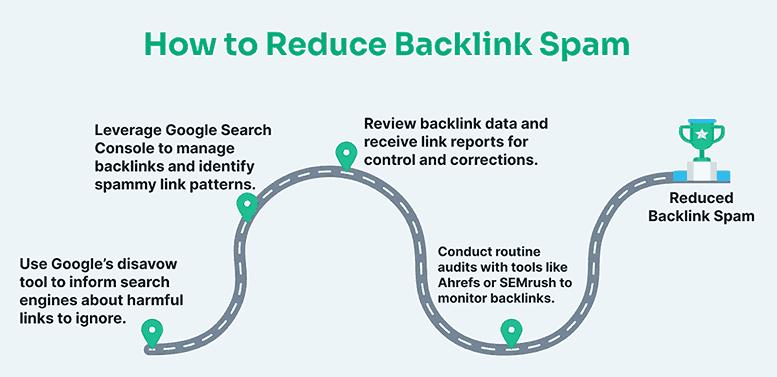
Start with triage (TS 60–100; obvious schemes). For each domain, try removal first: email the webmaster, cite the URL and anchor, and request nofollow/removal.

Keep a log (CSV: date, contact, status). If you can’t remove links or the domain is a link network/PBN compile a disavow file and upload it in Search Console.
Disavow is an advanced feature and should be used with caution; misuse can harm performance because you’re telling Google to ignore potential signals.
In manual actions, Google expects good-faith attempts to remove links before disavowing and filing a reconsideration request.
Removal vs. Disavow vs. Ignore
| Situation | Action | Notes |
| Clearly paid dofollow links | Remove or rel=”sponsored” | If host refuses, disavow domain |
| Network/PBN footprint | Disavow domain | Removal unlikely; document attempts |
| Low-quality but unintentional | Usually ignore | Google often discounts random junk |
| Manual Action in GSC | Remove → disavow → reconsideration | Provide evidence of outreach |
Google: Disavow is a strong suggestion; Google typically ignores those links when assessing your site.
Email outreach template (30-second version):
Subject: Link removal/nofollow request
“Hi [Name], we found a dofollow link to [Your Page] from [Their URL] using anchor ‘[text]’. To align with Google policies, could you remove or add rel=‘nofollow/sponsored’?
We’ll happily update our reference to your site if helpful. Thanks, [Your Name].”
Disavow file syntax (examples):
# Example disavow file for domain-level actions
domain:spammy-example.com
domain:thin-coupon-network.net
# For specific URLs (use rarely)
https://irrelevant-blog.org/post-123

Upload via Search Console’s disavow tool; keep one canonical file per property.
What Happens If You Ignore Bad Backlinks?
A fast timeline, then the compounding risk curve. This helps executives understand the cost of inaction.
Often nothing until everything breaks at once. Many junk links get ignored.
But patterns accumulate, reviews happen, and one update or manual action can erase 6–12 months of growth overnight. Here’s the realistic risk curve.

Google’s automated systems keep most spam out of results similar to email filters. That lulls teams into a false sense of security.
The problem surfaces when a pattern looks intentional (e.g., repeated paid listicles, scaled guest posts, coupon networks with dofollow).
A spam update or manual review can re-evaluate your link graph quickly. If the result is devaluation, you’ll feel stalled growth; if it’s a Manual Action, you’ll see sharp declines and a message in GSC.
Recovery requires removal, disavow, and reconsideration, which may take weeks to months to settle as systems relearn trust. The longer you wait, the more evidence piles up against you.
Risk timeline (typical)
- Month 0–3: Junk links accumulate; no visible change.
- Month 3–6: Updates discount some signals; growth slows.
- Month 6–9: Manual review risk rises if patterns persist.
- Anytime: Manual Action → immediate suppression of pages.
- Recovery: Weeks–months after thorough cleanup and reconsideration.
News watch: Google has tightened enforcement around low-quality and “reputation abuse” content since March 2024, increasing exposure for coupon/affiliate-heavy strategies.
Why You Need a Long-Term Backlink Strategy
Real authority beats link detox. Use this section as your roadmap for safer growth.
Cleanup is the start, not the strategy. You need a pipeline of niche-relevant, editorial links that align with policy and users.
Think digital PR, expert commentary, and content with real distribution, this is how you future-proof rankings. Let’s map it.
The safest growth compounds from on-topic coverage on sites with real audiences. Digital PR and link insertions into aged, relevant content outperform random guest posts.

For SaaS, target integrations/partners and product-led content that earns links (benchmarks, data studies).
For fintech, pursue expert commentary on compliance, fraud, or payments in respected outlets (use rel=”sponsored” where appropriate).
For e-commerce, lean into product data, review transparency, and newsjacking for seasonal demand.
For legal, prioritize local news, case-law explainers, and authoritative citations. This is the opposite of “buying links” and it’s what survives updates.
Build-and-protect blueprint (checklist):
- Quarterly backlink audits (triage → review → remediate).
- Keep branded anchor dominant; cap exact-match usage.
- Label paid placements (rel=”sponsored”) and limit them.
- Digital PR campaigns around proprietary data.
- Niche-relevant placements (quality over DA).
- Create internal link hubs to distribute equity.
Durable Acquisition by Industry
| Industry | Durable Tactics | Sample Asset |
| SaaS | Partner integrations, benchmarks, expert roundups | “State of {Category} 2025” report |
| Fintech | Regulatory explainers, fraud data, analyst quotes | “Chargeback Trends Q1–Q4” |
| E-commerce | Product data studies, UGC research, seasonal guides | “Black Friday Pricing Index” |
| Legal | Local news commentary, case explainer series | “Case Outcomes by County 5-Year View” |
Conclusion
Bad backlinks are not a mystery, just math and motive. If a link exists primarily to pass PageRank rather than serve users, it’s a liability.
Clean up what you can, disavow what you can’t, and replace risk with durable, niche-relevant authority. That’s the operating system for sustainable growth in SaaS, fintech, e-commerce, and legal.
Google discounts a lot of junk on its own. What sinks sites is patterned manipulation, scaled listicles, pay-to-play placements, exact-match anchors repeated across look-alike pages.
The fix isn’t heroic. It’s a process. Audit quarterly. Remove or relabel. Disavow when necessary.
Then invest in editorial coverage, data assets, and partners who actually move markets not just metrics.
FAQs – Bad Backlinks
Do I need to disavow every bad link?
No. Google ignores most junk. Disavow when removal isn’t possible and risk is real (patterns, paid links, manual action).
How fast can I recover from a manual action?
After cleanup and reconsideration, recovery can take weeks to months as systems relearn trust.
Are all guest posts risky?
No. High-quality, relevant editorials are fine. Scaled, templated guest posts for PageRank are risky.
Should I pay for links if they’re labeled sponsored?
If labeled rel=”sponsored”, they shouldn’t pass PageRank. These are ads, not authority builders. Use sparingly.
What Toxicity Score is “bad”?
Use Semrush’s 60–100 as a triage bucket; always manually verify before action.
Can spammy links from competitors hurt me?
Usually not; Google discounts obvious spam. Patterns matter more than one-off blasts.
What anchors are safest?
Branded and natural anchors. Keep exact-match limited and contextual.
Do updates target links or content now?
Both. Recent updates also target scaled/low-quality and reputation-abuse tactics.





 Start the conversation