


Bulk link building packages offer a volume-based approach to backlink acquisition, allowing agencies and businesses to purchase multiple links at discounted per-unit pricing within a structured monthly programme.
In 2026, the demand for quality bulk packages has grown substantially as more companies recognise that consistent, ongoing link building outperforms sporadic one-off campaigns by a significant margin.
Industry benchmark: According to Ahrefs‘ analysis of approximately 920 million web pages, the number of referring domains to a page is the strongest correlating backlink factor as far as rankings are concerned, with a clear positive correlation between unique referring domains and organic search traffic.
The critical distinction in the 2026 market is between bulk quantity and bulk quality, and understanding this difference is essential for making sound investment decisions.
Packages that promise fifty links per month at $20 each are almost certainly using tactics that will harm your site long-term, including PBN placements, AI-generated content farms, hacked sites, or foreign-language domains with no genuine readership.
Legitimate bulk packages typically offer 10 to 30 quality-vetted editorial links per month with per-link costs that reflect the genuine effort required to secure placements on real websites with editorial standards.
The economics of bulk packages work because providers can achieve operational efficiencies when managing larger volumes.
Outreach teams can leverage relationships across multiple client campaigns, content teams can maintain consistent output schedules, and quality control processes can be systematised for efficiency.
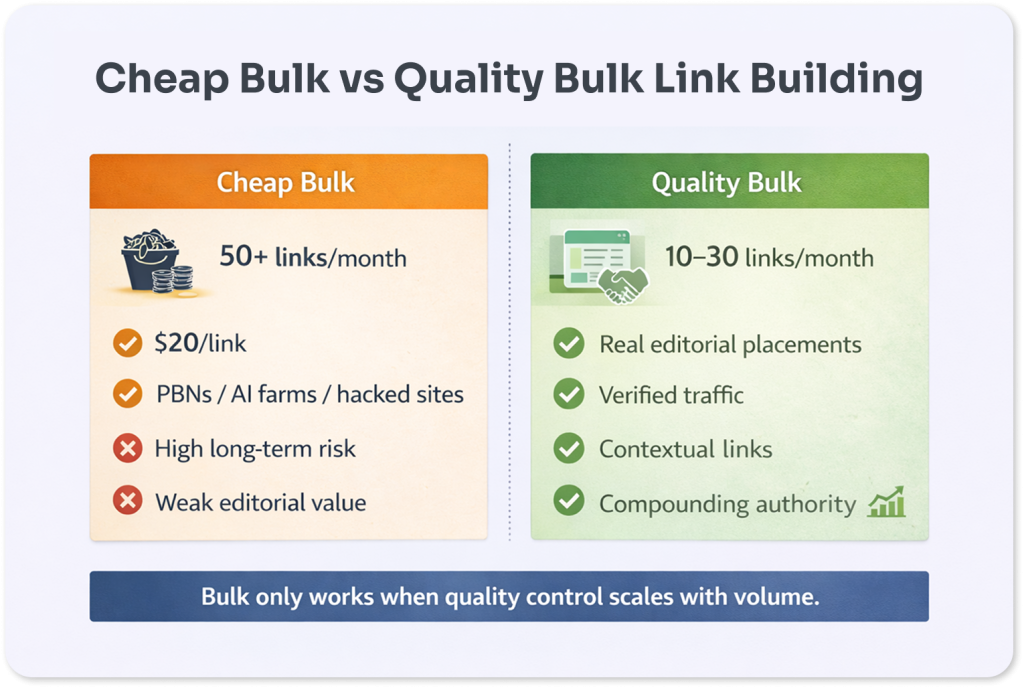
These operational savings are passed on as volume discounts without requiring any reduction in placement quality.
What a Quality Bulk Package Should Include
A reputable bulk link building package in 2026 should include several non-negotiable elements that distinguish it from cheap alternatives.
First, transparent site vetting against clearly defined quality thresholds, typically a minimum domain rating of 30 to 40 with verified organic traffic and genuine editorial standards.
Second, custom content written specifically for each placement rather than spun or AI-generated articles submitted without human editing.
Third, contextual link placement within the body of relevant articles rather than author bios, sidebar widgets, or footer links that carry minimal authority.
Fourth, detailed monthly reporting with full placement URLs, domain metrics at the time of placement, anchor text used, and indexing status for each link.
| Quality Indicator | What to Look For | Red Flag |
|---|---|---|
| Domain Rating | DR 30-40+ with verified organic traffic | High DR but near-zero organic visitors |
| Content | Custom-written, contextually relevant | Spun, AI-only, or duplicated content |
| Link Placement | Within body copy of relevant article | Author bio, sidebar, or footer placement |
| Reporting | Full URLs, metrics, anchor text, index status | Spreadsheet with domain names only |
| Timeline | 3-6 month minimum commitment | No minimum term or immediate bulk delivery |
Finally, a reasonable timeline commitment, typically three to six months minimum, because link building delivers compounding returns that only materialise with sustained effort.
Quality vs. volume research: Backlinko’s analysis of 11.8 million Google search results, conducted in partnership with Ahrefs, found that the #1 ranking result earns an average of 3.8x more backlinks than pages in positions 2–10 — a gap driven primarily by editorial links from authoritative sources, reinforcing quality acquisition as the primary return driver over directory submissions, guest post farms, and link exchanges.
The biggest misconception in bulk link building is that volume and quality are mutually exclusive. The best providers achieve both by systematising quality control rather than compromising on it.
The question to ask any bulk package provider is: show me the process you use to vet every site before a single link goes live.
Bulk Link Building and AI Search Visibility
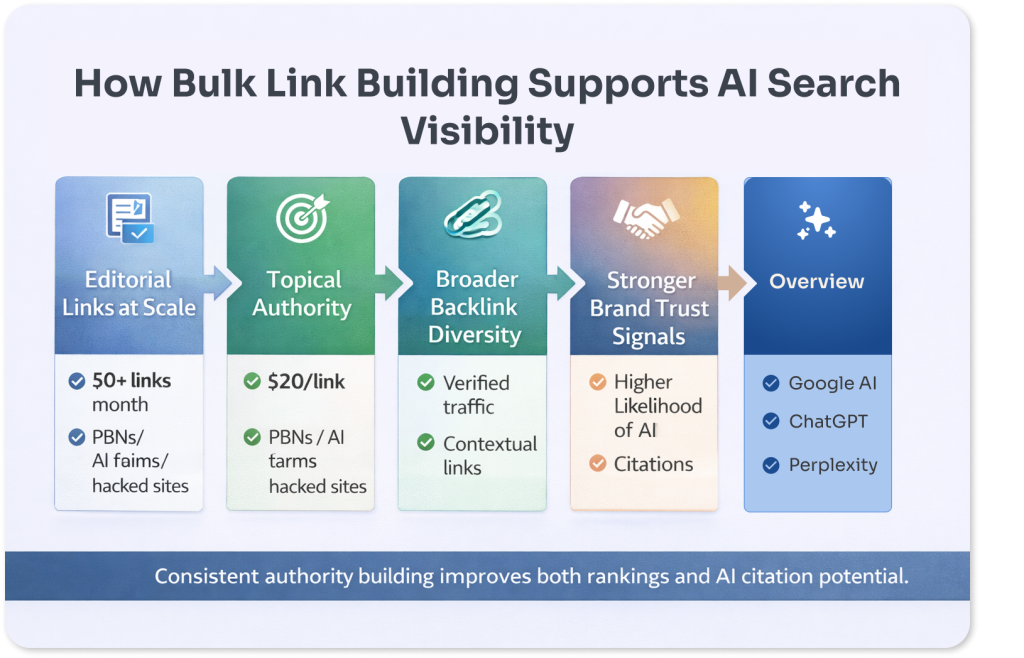
One significantly underappreciated benefit of bulk link building in 2026 is its impact on AI search visibility and the emerging field of Generative Engine Optimisation.
Large language models like GPT, Gemini, and Claude use the breadth, diversity, and quality of your backlink profile as one of many signals when deciding whether to cite your brand in generated responses.
A website with links from dozens of authoritative, topically relevant sources across different publication types is far more likely to be referenced in AI answers than one with a thin or concentrated link profile.
AI Overviews data: According to Semrush tracking data, AI Overviews now appear on approximately 45 percent of all Google search results pages, with informational queries triggering AI-generated summaries at an even higher rate. Brands cited in these overviews report significantly higher click-through rates and branded search volume.
This makes bulk packages particularly valuable for companies competing in spaces where AI-generated answers are displacing traditional organic search results.
In informational queries, which represent the majority of Google searches, AI Overviews now appear on approximately 45 percent of results pages.
Bulk packages provide the sustained link velocity needed to build this kind of comprehensive authority profile.
For agencies looking to resell bulk packages to their own clients, combining volume pricing with reseller link building margins creates a highly profitable service line that scales predictably.
The monthly recurring nature of bulk packages also improves agency cash flow compared to project-based link building engagements that can be unpredictable.
Avoiding Common Bulk Package Pitfalls
The companies winning visibility in these AI-dominated results are those with extensive, high-quality link profiles built over months and years of consistent, strategic acquisition.
The most common mistake companies make with bulk packages is prioritising quantity targets over relevance and quality requirements.
Twenty contextually relevant links from websites in your niche that your target audience actually reads will always outperform fifty random links from unrelated domains that happen to meet a minimum DR threshold.
Insist on topical targeting as a core requirement of any bulk package, and review a sample of placements each month to verify quality before considering the deliverable complete.
Another frequent error is maintaining the same bulk link building strategy for too long without adjustment.
Your link building priorities should evolve as your rankings improve, as competitors shift their strategies, and as your content portfolio expands.
Before committing to any bulk package, ask the provider for a sample audit report from an existing client (with client permission and data redacted). This reveals the actual reporting depth, domain quality, and communication standards you will receive. Providers who cannot produce a clean sample report almost certainly cannot produce clean links either.
Review your bulk package parameters quarterly and adjust target pages, anchor text emphasis, and domain rating requirements based on current competitive dynamics.
Campaign consistency data: SEMrush research found that consistent monthly link acquisition outperforms quarterly burst campaigns by 67 percent in ranking velocity, as search engines reward gradual, natural-looking link profile growth over sudden spikes.
Selecting the Right Bulk Package for Your Needs
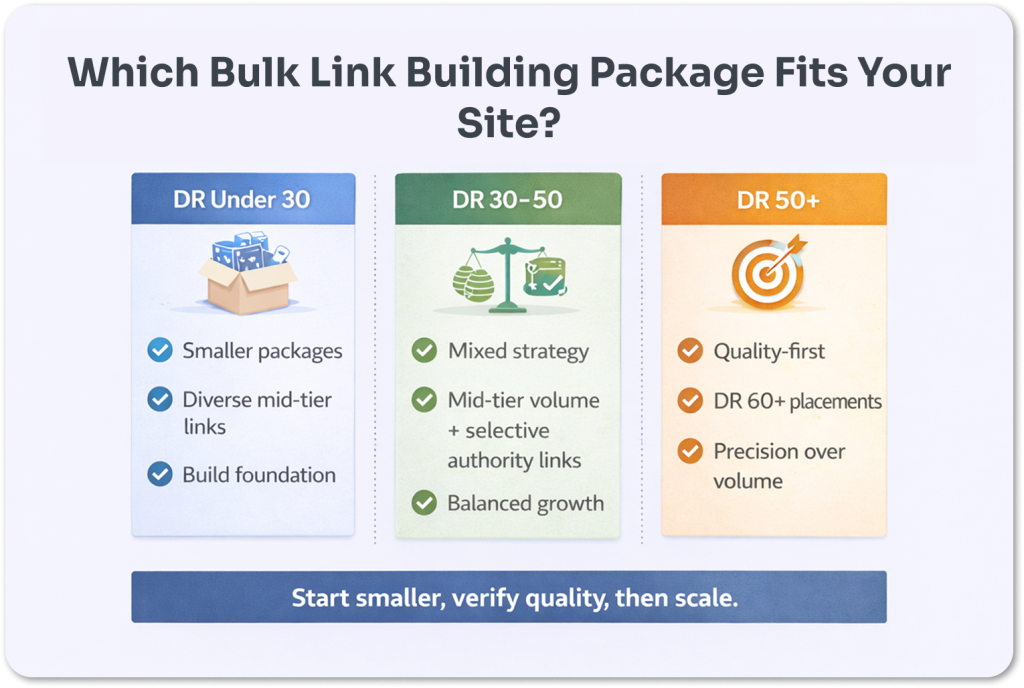
The right bulk package depends on your current domain authority, competitive landscape, and budget constraints.
Sites with DR under 30 should focus on smaller packages of diverse, mid-tier links to build foundational authority.
Sites with DR 30 to 50 benefit most from a mix of mid-tier volume and occasional high-authority placements.
Sites with DR 50 plus should emphasise quality over volume, targeting primarily DR 60 plus placements that move the needle in competitive search environments.
Budget allocation should account for the long-term nature of link building.
A six-month commitment at a sustainable monthly spend will deliver significantly better results than a two-month sprint at double the monthly budget.
Search engines evaluate link profiles over time, and gradual, consistent growth patterns are both more effective for rankings and less likely to trigger algorithmic scrutiny than sudden link velocity spikes.
When evaluating package proposals from multiple providers, compare not just the per-link price and volume commitments but also the quality verification processes, reporting granularity, editorial relationship depth, and responsiveness to client requests.
The cheapest package is almost never the best value when you factor in the risk-adjusted returns over a twelve-month period.
Companies new to link building at scale should resist the temptation to jump straight to high-volume packages.
Start with smaller packages of five to ten links per month, verify quality rigorously, and increase volume gradually as you confirm the provider’s standards meet your expectations.
For startups and early-stage companies in particular, our guide on link building for startups covers how to begin building authority efficiently and strategically before scaling to bulk acquisition.
How to Measure ROI from a Bulk Link Building Campaign
Bulk link building is a long-term investment, and measuring its return requires a different framework than you would apply to paid advertising or email campaigns.
Unlike channels with immediate feedback loops, link building’s impact compounds over months.
Its gains are distributed across multiple ranking improvements, traffic gains, and conversion events often separated from the link acquisition itself by a significant lag.
The most reliable primary metric for bulk link building ROI is keyword ranking velocity across your target URL set.
Establish a baseline ranking position for the 20 to 50 keywords most closely associated with the pages receiving links, then track position changes monthly.
In a well-executed bulk campaign, the first measurable ranking movements typically appear at weeks six to ten.
More significant position improvements follow between months three and six, as the new links accumulate authority and are weighted by Google’s algorithms.
Domain rating and domain authority scores are useful secondary metrics, but their movement is slower and less granular than keyword rankings.
Expect DR improvements of 3 to 8 points over a six-month bulk campaign, depending on your starting position and the quality of acquired links.
The competitive profile of your referring domain gap relative to competitors also affects the pace of improvement.
Organic traffic growth is the most commercially meaningful metric, but also the most delayed.
Traffic gains from link building typically materialise one to three months after the ranking improvements that drive them.
That creates a total lag of four to nine months between initial link acquisition and observable organic traffic impact.
Factor this lag into any internal ROI reporting to avoid prematurely cancelling campaigns that are performing correctly but have not yet produced measurable traffic.
For e-commerce and lead generation businesses, the full ROI calculation should assign a revenue or lead value to organic sessions driven by ranking improvements from the link campaign.
If your organic conversion rate is 3 percent and your average order value is $200, each additional 100 organic monthly sessions is worth $600 per month, or $7,200 annualised.
Against a monthly bulk package cost of $2,000 to $5,000, a campaign generating 300 to 400 incremental organic sessions per month reaches break-even within four to six months.
Compounding returns follow beyond that point.
Reporting cadence matters as much as the metrics themselves.
Monthly link building reports should include new link counts with full placement URLs, domain metrics at time of placement, anchor text distribution analysis, and ranking position changes for the target URL set.
Quarterly reviews should assess whether link velocity and quality profile are consistent with the competitive benchmarks needed to close your authority gap with top-ranking competitors.





 Start the conversation