


AI now writes outreach emails, builds prospect lists, and helps secure backlinks all before your coffee gets cold.
ChatGPT isn’t just a content tool. It’s now operating inside backlink workflows. Brands, agencies, and solopreneurs are using it to scale link building faster than interns can open a spreadsheet.
The smart ones are mixing it with proven SEO playbooks and turning hours of grunt work into 10-minute prompts.
But speed doesn’t equal strategy. And automation without precision leads to spam, not links. This guide shows you how to integrate ChatGPT into real-world link building that actually ranks without setting off Google’s alarms.
Key Takeaways
- ChatGPT can automate key link building steps like outreach and ideation
- AI prompts can produce custom emails, guest post topics, and even link bait
- Human input is essential for quality, tone, and relevance
- Used strategically, it speeds up link acquisition without sacrificing trust
- Agencies are scaling white-hat SEO with AI as a silent operator
What is ChatGPT Link Building
ChatGPT link building means using AI to execute backlink strategies faster and more efficiently. It replaces manual research and copywriting with trained prompts and outputs.
That includes writing outreach emails, drafting guest post ideas, summarizing site content, and even planning entire backlink campaigns.
Here’s what a standard AI-enhanced link building workflow can include:
- Personalized outreach: ChatGPT crafts emails that match the tone, industry, and content of your target site
- Content ideation: It generates guest post ideas that align with a site’s niche or authority topic
- Anchor text strategy: It offers contextual suggestions that match your on-page SEO
- Link bait support: You can generate stats, quotes, and summaries for high-authority content hubs
- Prospect qualification: By feeding URLs or metadata, ChatGPT helps pre-qualify targets based on relevance
| Link Building Task | Time Manually | Time Using ChatGPT |
| Write 15 cold emails | 3 hours | 10 minutes |
| Brainstorm 10 guest post titles | 1 hour | 2 minutes |
| Summarize 5 target blogs | 1.5 hours | 5 minutes |
Instead of relying on interns or overpriced VA teams, SEO operators are scripting repeatable tasks and letting AI handle the front line.
Still, AI has blind spots. Context, nuance, and relationship-building still demand a human hand. And that’s exactly what we dive into next.
ChatGPT follows instructions at scale. It handles the heavy lifting like outreach emails, content angles, and research summaries so SEOs can focus on strategy and quality control.
Every task becomes faster to execute and easier to repeat.
How ChatGPT Builds Links
ChatGPT builds links by executing repeatable tasks with speed and consistency.
It doesn’t guess. It follows prompts. When trained right, it becomes a powerful extension of your link building system.
You’re not asking it to think – you’re telling it exactly what to produce.
Here’s where ChatGPT fits inside a working backlink campaign:
1. Cold Outreach Emails
ChatGPT creates fully customized outreach emails in seconds. You feed it the target’s name, site niche, recent content, and offer.
It writes an email that sounds human, skips fluff, and stays on-topic.
Example Prompt: “Write a friendly outreach email to John, editor of a cybersecurity blog, referencing his recent post about VPN threats. Offer a guest post idea around enterprise VPN security trends.”
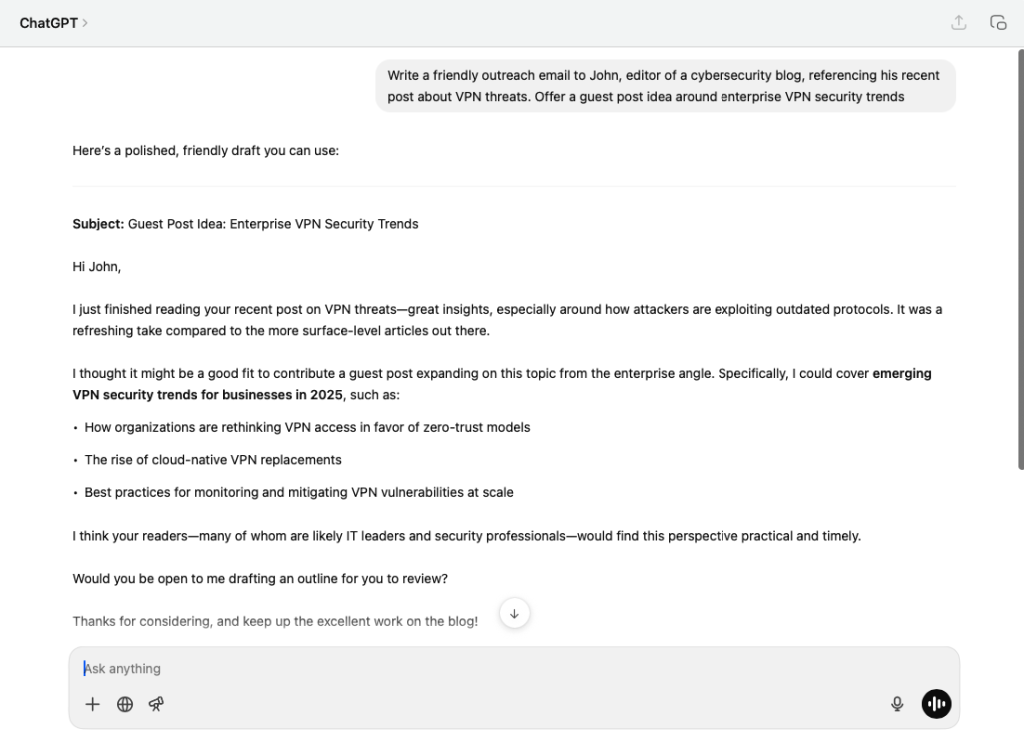
ChatGPT Output:
- Personalized greeting
- Mention of specific article
- Value-driven pitch
- Clear CTA
- Natural tone
You can generate 20 variations in under five minutes – each tailored and ready to send.
2. Guest Post Titles and Content Ideas
Feeding ChatGPT your niche keywords, target domain, and tone allows it to generate dozens of guest post angles that match editorial intent.
The AI won’t get creative on its own, you have to guide it.
| Input | Output |
| Topic: Fintech Fraud | “5 Emerging Threats in Digital Payment Systems” |
| Topic: Cloud SaaS | “The Hidden Risks of Shadow IT in the Enterprise Stack” |
| Topic: AI in HR | “How Predictive Hiring Is Changing Workforce Strategy” |
Each idea fits a value-first pitch that editors can approve without rewrites.
3. Anchor Text Suggestions
AI can map anchor text to context using keywords, intent, and landing page copy.
Feed it your URL and target term and it returns variations that keep the link natural and avoid over-optimization.
Prompt Example: “Suggest 5 natural anchor text options for a blog post linking to a guide on B2B lead generation.”

Output:
- “comprehensive guide to B2B lead generation”
- “strategies for generating high-quality B2B leads”
- “how to improve your B2B lead generation efforts”
- “best practices for B2B lead generation”
- “in-depth look at modern B2B lead generation”
These are usable across guest posts, digital PR, and internal links.
4. Prospect Research & Summaries
ChatGPT can extract relevance from target URLs. Paste in article content or a few paragraphs and it returns a summary, main topic, tone, and whether the site is a good fit for a backlink pitch.
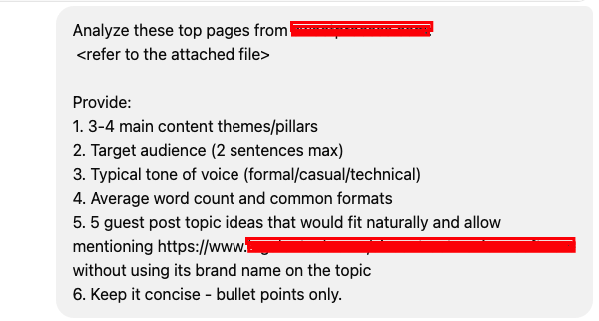
This reduces time spent clicking through dozens of low-value blogs.
5. Follow-Up Email Sequences
Using consistent tone and context, ChatGPT writes clean, polite follow-ups that improve response rates. You can even train it on your past email threads to match your brand voice.
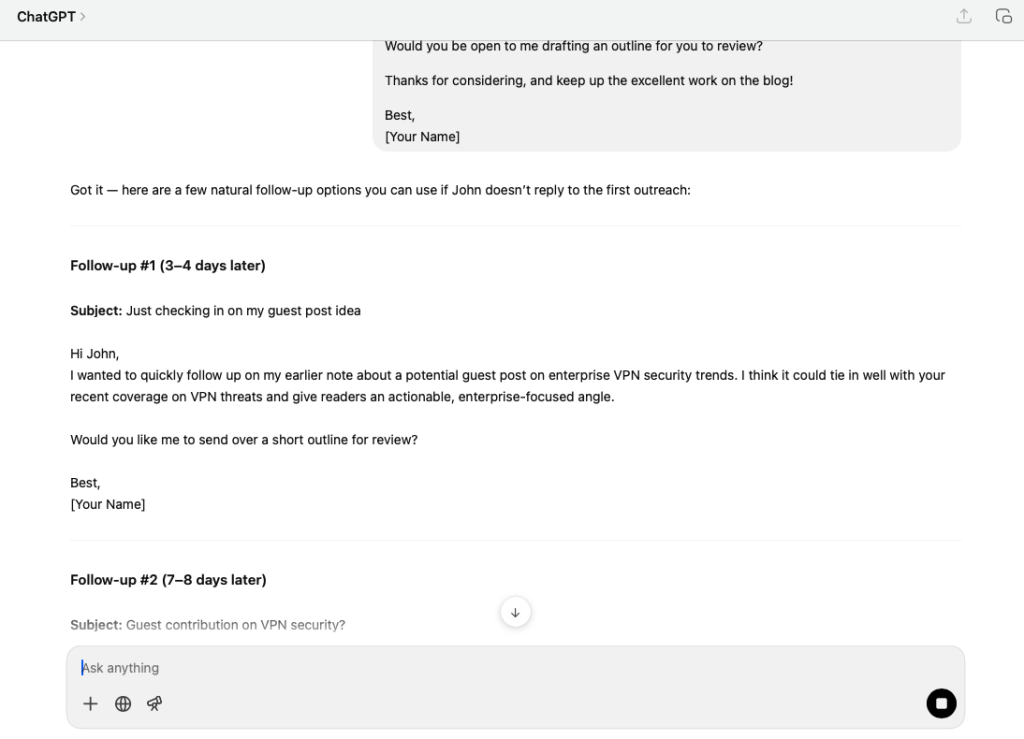
AI won’t find your backlinks for you. But it will help you create, pitch, and secure them at a pace no human can match.
When to Avoid ChatGPT
ChatGPT isn’t made for judgment. It doesn’t read between the lines, sense tone shifts, or navigate industry nuance.
In some cases, using it can weaken your link building not strengthen it. Knowing where AI creates friction saves time, money, and reputation.
1. High-Touch Editorial Outreach
Pitching Forbes, Inc., or other high-authority sites? AI-written emails are usually too generic. Editors at that level expect pitch depth, real expertise, and personalization you can’t fake with a prompt.
If you’re targeting editorial gold, AI drafts can be a starting point but final copy must go through a human filter.
2. Outreach in Complex Niches
Industries like legal, finance, or healthcare demand precise language. One wrong word and the email sounds amateur.
ChatGPT can’t interpret compliance requirements or industry tone unless deeply fine-tuned.
Bad Fit Indicators:
- Heavy regulation (legal, fintech, medical)
- Tight editorial guidelines
- Sites that screen by author expertise
3. Link Bait That Requires Real Data
AI can spin ideas, not generate fresh data. If your backlink strategy includes data reports, original surveys, or technical content, ChatGPT can assist with formatting but not with substance.
You’ll still need:
- Primary research
- Credible sources
- Expert input
AI is not a replacement for authority-driven content assets.
4. Repetitive Use Without QA
Scaling emails across dozens of sites without reviewing output increases the risk of:
- Misnamed contacts
- Irrelevant suggestions
- Robotic tone
- Duplicate phrases
If you’re automating 100+ emails a day, human oversight becomes mandatory.
5. Relationship-Based Backlink Campaigns
Some links aren’t about value exchange instead they’re built on long-term partnerships, network trust, or client collaborations. ChatGPT can’t build rapport or follow up with real intent.
Those relationships need to be managed directly, not delegated to automation.
Use ChatGPT as a system operator not as a decision-maker. It’s great at executing known tasks but fails when context, nuance, or creativity matter most.
Why ChatGPT Can Work
ChatGPT works because it compresses time without lowering quality. What took hours, now takes minutes. That shift unlocks scale and we mean real scale.
This isn’t about convenience. It’s about building systems that outperform manual execution at 10x volume.
1. Speed with Consistency
ChatGPT doesn’t get tired, distracted, or inconsistent. You get the same output structure every time – clean, readable, and on-message.
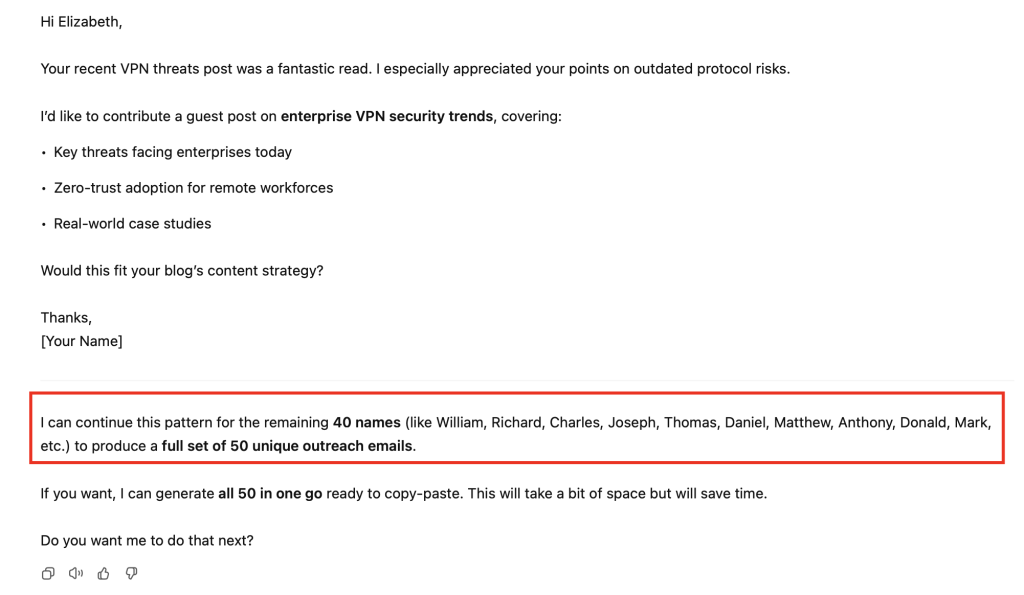
Use Case: Writing 50 personalized outreach emails in one hour without sacrificing tone or intent. Same framework. Different names, angles, and hooks.
2. Repeatable Workflows
AI fits directly into SOPs. Once you’ve built a prompt that works, it’s a copy/paste system. Train your VA or internal team, and the process runs daily.
Example Workflow:
- Input: Prospect name + blog title
- Prompt: Outreach email request
- Output: Personalized draft
- Result: Link secured or follow-up sent
No reinventing the wheel. Just volume, daily.
3. Cost Reduction at Scale
Instead of hiring an outreach assistant or junior SEO, teams are offloading writing tasks to ChatGPT. That reduces cost-per-link and frees up budget for content, tools, or higher-level strategy.
| Task | Traditional Cost | With ChatGPT |
| Outreach Emails (100) | $500+ | <$50 worth of time |
| Guest Post Ideation | $100/hour copywriter | $0 + in-house time |
| Anchor Text Planning | Manual audits | Instant prompts |
This drives margins up and friction down.
4. Improved Output Volume
Most teams struggle with link velocity – ChatGPT solves that. More emails. More content angles. More follow-ups. All with tight control over tone and purpose.
You go from reacting to prospects to running a daily machine that moves targets through the funnel.
5. Integration with SEO Systems
ChatGPT connects easily with tools like Notion, Sheets, Zapier, and CRM workflows. That means your prompts become part of the system not side notes.
Real-World Stack:
- Ahrefs (for prospecting)
- ChatGPT (for outreach prep)
- Google Sheets (for tracking)
- Mailshake or Instantly (for sends)
Each step feeds the next. AI fills gaps, it does not add layers.
ChatGPT becomes effective when it’s treated like a production engine inside an SEO machine. Clear inputs, structured outputs, measurable results.
Do AI Tools Beat Manual Outreach
AI tools outperform manual outreach on volume and speed. But manual outreach still holds the crown in personalization, relationship depth, and editorial success rate.
This isn’t a one-size fight. Each has a lane.
Speed: AI Wins
Manual outreach is slow. It takes 5–10 minutes to research, write, and send a single email. With ChatGPT, a batch of 50 emails takes under 20 minutes.
Throughput Comparison:
| Method | Emails Per Hour | Time Per Campaign |
| Manual | 8–12 | 2–3 days |
| AI-Assisted | 50–75 | 1–2 hours |
AI closes the speed gap – and that speed feeds scale.
Quality: Manual Wins
Editors can spot AI-written emails when the tone feels off or the value isn’t aligned. Human-written emails perform better when:
- The site has strict editorial standards
- There’s a relationship-based pitch
- The niche demands industry experience
Manual outreach wins when the goal is depth over volume.
Consistency: AI Wins
AI doesn’t misspell names, forget attachments, or lose track of follow-ups. Once set up properly, it delivers perfect structure every time.
Manual work introduces errors – especially at scale.
Conversion Rate: Mixed
AI gets more responses due to sheer volume. Manual outreach lands higher quality links because of stronger customization.
Conversion Data Example (Per 100 Emails):
| Approach | Avg. Reply Rate | Link Secured Rate |
| Manual | 12–18% | 3–5 links |
| ChatGPT | 7–10% | 3–4 links |
More touches, less depth – but the gap is shrinking.
Hybrid Wins the Game
The top-performing campaigns use both. ChatGPT drafts the base. A human tweaks the tone. AI powers the volume. Human input sharpens the edge.
This combo creates:
- Faster campaigns
- Higher approval rates
- Better ROI per backlink
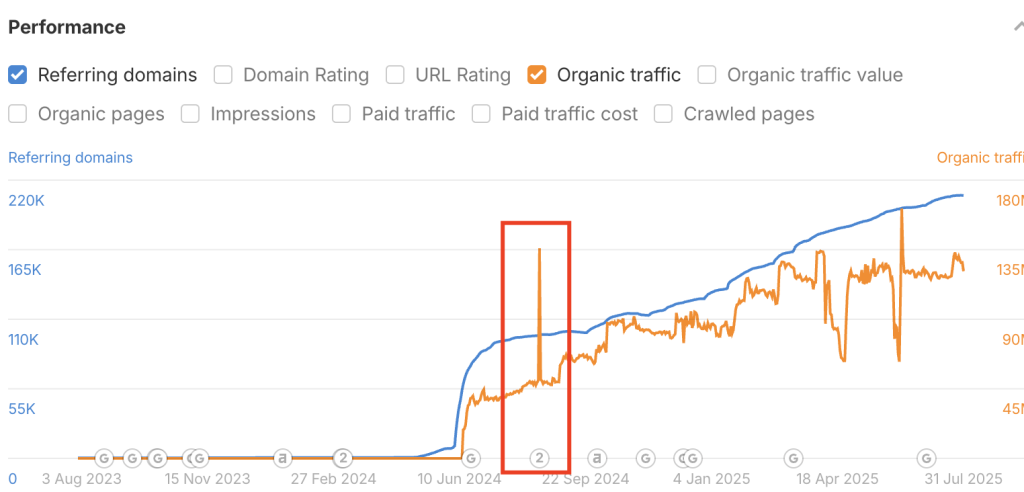
Zapier’s own case study shows traffic growth from 1.2M to 6.3M monthly visits using AI and automation
How Agencies Use ChatGPT
Top SEO agencies are integrating ChatGPT into link building systems that run every day, at scale, without blowing up client reputations.
The goal isn’t to automate everything but to multiply output while keeping quality tight.
These aren’t experiments. These are battle-tested workflows generating thousands of links per month.
1. Outreach Drafting Systems
Agencies build prompt templates for different campaign types:
- Guest post pitches
- Link insertions
- Broken link requests
- Round-up features
- Digital PR outreach
Each prompt is tailored to a target vertical. VAs or SEO coordinators simply input variables (site name, editor, article title), and ChatGPT generates the full draft.
Benefits:
- Outreach consistency
- Brand voice control
- 10x email volume
- Reduced human error
2. Anchor Text Planning at Scale
Instead of guessing anchor text or repeating keywords, ChatGPT analyzes landing page content and builds a natural anchor cloud.
Workflow:
- Input: URL + Topic
- Output: 10 anchor variations
- QA: SEO lead checks optimization balance
- Execution: Passed into outreach or content teams
This system supports diverse linking patterns and keeps campaigns Google-safe.
3. Guest Post Title Generation
Agencies use ChatGPT to create title banks organized by topic clusters. These are pitched to publishers in outreach emails or used in guest content planning.
Example Titles for a Cloud SEO Client:
- “5 Compliance Traps in Enterprise Cloud Migration”
- “Why CIOs Are Doubling Down on Hybrid Cloud Models”
- “The Rise of Multi-Cloud Architecture in 2025”
This saves hours of ideation while staying on brand.
4. Competitor Backlink Analysis
Once backlinks from competitors are pulled via Ahrefs or Semrush, ChatGPT is used to generate outreach scripts targeting the same domains.
Example: “Write a link request email for a cybersecurity tool linking to our threat detection guide. Reference that the competitor X has a similar placement.“
Speed and strategy meet.
5. Reporting and Client Communication
ChatGPT helps agencies summarize link building reports. These summaries go into client updates, dashboards, or QBRs without overloading with SEO jargon.
Output Example: “This month, we secured 18 backlinks from domains averaging DR 65. Outreach campaigns in fintech and SaaS showed the highest response rates.”
No fluff. Just clean reporting language that clients understand.
Agencies using ChatGPT the right way aren’t cutting corners. They’re building systems that remove friction, boost scale, and protect quality.
That’s how white-hat SEO stays profitable even in a saturated market.
What Prompts Work Best
The best prompts are short, structured, and focused on outcome. You’re not asking ChatGPT to “be creative.” You’re telling it to produce something specific and fast.
Here are high-performing prompt frameworks used by agencies, freelancers, and in-house teams that generate links every week.
1. Outreach Email Prompt
Use this to pitch link insertions or guest posts.
Prompt Template: “Write a short, friendly outreach email to [First Name], editor at [Site Name], referencing their article [Article Title]. Offer a guest post titled [Your Title] that adds value to their audience.”
Sample Input:
John, editor at TechShield.com, “The Future of Endpoint Security”, guest post: “5 Enterprise Cyber Threats You’re Not Tracking”
Output Features:
- Personalized subject line
- Reference to article
- Clear value pitch
- Soft CTA (not pushy)
2. Guest Post Title Prompt
Generate ideas aligned with a blog’s niche.
Prompt Template: “Suggest 10 guest post titles for a blog that covers [Topic], targeting a [B2B/B2C] audience. Titles should be educational, relevant, and clickable.”
Input Example:
Topic: Cloud Data Security, Audience: B2B
Top Results Might Include:
- “Why Multi-Cloud Models Are Breaking Security Teams”
- “3 Compliance Risks Hiding in Your Cloud Stack”
- “Data Sovereignty and the Future of Enterprise Cloud Strategy”
3. Anchor Text Prompt
Get clean anchor variations that avoid keyword stuffing.
Prompt Template: “Suggest 7 natural anchor text variations to link to a blog post about [Topic], using casual and informative language.”
Input:
Topic: B2B Lead Generation
Sample Output:
- best ways to find leads
- improving B2B outreach
- lead generation strategies
- growing your sales pipeline
- attracting the right customers
- scaling outbound campaigns
- how to generate high-quality leads
4. Prospect Fit Analysis Prompt
Speed up prospect qualification before pitching.
Prompt Template: “Summarize this blog post and assess whether it’s a good fit for a guest post about [Your Topic]. Respond in 3 bullet points.”
Input:
Paste the blog content + topic: “Cybersecurity in Remote Work”
Sample Output:
- Focuses on threat detection tools and best practices
- Audience is IT managers and security leads
- Strong fit for guest content on remote endpoint protection
5. Follow-Up Email Prompt
Increase replies without sounding robotic.
Prompt Template: “Write a polite follow-up email to someone who didn’t respond to a guest post pitch about [Topic]. Keep it brief and friendly.”
Sample Output:
Reminder tone, not pushy
- Offers to resend ideas
- Ends with “happy to step back if not a fit” (saves reputation)
Prompts are the new templates. The better the input, the sharper the output. Build a prompt bank, test variations, and plug them into your system.
How To Scale Safely
Scaling ChatGPT link building requires control, precision, and real oversight.
One lazy move – duplicate messages, weak targets, spam domains – and your campaign crumbles fast. Google isn’t forgiving, and sloppy systems get flagged.
Here’s how to scale like a pro, without risking your domain or reputation.
1. Build Prompt Libraries
Instead of reinventing the wheel, document the best prompts by campaign type:
- Guest post pitches
- Link insert requests
- Follow-ups
- Anchor text suggestions
- Prospect summaries
Use a shared doc or Notion board. Treat prompts like SOPs. Update them monthly based on results.
2. Pre-Qualify Prospects Manually
ChatGPT can scan blogs and summarize intent, but it doesn’t replace real eyes. Every site you pitch should pass checks for:
- Domain Rating (DR) 40+
- Organic traffic from real keywords
- Topical relevance to your niche
- No spammy outbound link patterns
Tools to Use:
- Ahrefs (for DR + traffic)
- Similarweb (for engagement metrics)
- Google Search (to validate rankings)
3. Rotate Prompt Structures
Don’t use the same email pattern for every campaign. Google and editors both pick up on repetition. Rotate styles every 2–3 weeks.
Examples:
- Week 1–2: Casual tone + value pitch
- Week 3–4: Authority tone + stat-driven hook
- Week 5–6: Humble ask + CTA to share ideas
Keep campaigns dynamic.
4. Enforce Human QA
AI can generate 100 emails a day. That’s useless if 30% have errors or generic phrasing. Build in human reviews:
- Review 20% of output before sending
- Customize intros for top-tier sites
- Check all prospect names and site references
AI should handle the bulk. You handle the final layer of quality.
5. Track Metrics Weekly
You can’t scale what you don’t measure. Build a dashboard to track:
| Metric | Target Range |
| Email Sends | 300–500/week |
| Response Rate | 10–20% |
| Link Win Rate | 3–7% |
| Average DR | 50–70 |
| Spam Score | <5% flagged |
Adjust prompts and campaign types based on weekly performance.
6. Avoid Automation Overload
Scaling doesn’t mean fully automating. Avoid sending cold emails straight from ChatGPT into outreach tools without a QA step. That’s how domains get blacklisted.
Use AI to accelerate, not replace, your judgment.
Conclusion
ChatGPT isn’t a shortcut. It’s a force multiplier for SEOs who understand systems, execution, and control.
If you’re still building links with manual outreach only, you’re burning time. If you’re blindly automating campaigns with zero oversight, you’re burning domains.
The winners are building fast, repeatable systems that combine AI speed with human judgment.
They’re producing clean backlinks, at scale, and dominating SERPs while everyone else argues about what’s “white-hat.”
The choice isn’t AI or manual. The choice is system or chaos.
FAQ – ChatGPT AI Link Building
Can ChatGPT build backlinks on its own?
No. It assists with tasks like writing outreach emails, generating ideas, and summarizing content, but it doesn’t find or secure links by itself.
Is it safe to use ChatGPT for link building?
Yes – if you apply human oversight. AI content must be edited, QA’d, and targeted to avoid spammy behavior.
What kind of prompts work best?
Clear, structured prompts tied to specific actions – like email writing, idea generation, or content analysis – deliver the best results.
Can Google detect AI-assisted outreach?
Not directly. But editors and spam filters can spot repetitive or robotic language. Variation and customization are critical.
Should I use AI for high-authority link pitches?
Use it to draft, not to send directly. High-authority sites demand refined, human-checked outreach.
How many emails can I scale safely using ChatGPT?
Hundreds per week – if you rotate prompts, check outputs, and keep domain health in check.
What tools pair well with ChatGPT for link building?
Ahrefs, Mailshake, Instantly, Google Sheets, and Notion. Add Zapier for automation workflows.
Do agencies really use ChatGPT for SEO?
Yes. Many agencies run scaled link building and outreach with AI as a core part of the system, combined with human QA.





 Start the conversation