


A link exchange is an agreement between two websites to link to each other with the intent of improving backlink counts and search rankings.
In 2026, link exchanges sit in one of the most misunderstood positions in SEO, simultaneously dismissed as an outdated manipulation tactic and quietly practised by a significant proportion of the web’s highest-ranking pages.
The truth is more nuanced than either position allows. Reciprocal links are a natural byproduct of how the web works, any two sites operating in the same niche will organically accumulate some mutual link overlap simply by citing each other’s best content.
What Google’s spam policies prohibit is not reciprocal linking itself, but the coordinated, volume-driven pursuit of reciprocal links as a ranking manipulation strategy.
Understanding exactly where that line sits, and how Google’s AI-driven detection systems identify which side of it you are on, is the practical question this page answers.
It is one of the more important compliance questions for any B2B or SaaS brand running an active link building programme in 2026.
This page is part of our white hat link building content hub, the complete guide to building editorial authority within Google’s policy framework.
For the foundational policy context that underpins everything on this page, read our guide to Google’s backlink policy.
In this article…
- What is a link exchange and how does it work?
- What does Google’s policy actually say about link exchanges?
- How does Google detect coordinated link exchanges in 2026?
- What does the data actually say about reciprocal links and rankings?
- What is the difference between a direct and an indirect link exchange in terms of risk?
- When is reciprocal linking acceptable under Google’s guidelines?
- When does reciprocal linking become a link scheme?
- How do you approach link partnership outreach the right way in 2026?
- How do link exchanges affect AI search visibility and GEO in 2026?
- How do you audit your backlink profile for excessive reciprocal linking risk?
- Not sure where your link profile sits on the compliance spectrum?
- Frequently Asked Questions
What is a link exchange and how does it work?
A link exchange is an arrangement where two or more websites agree to link to each other, typically with the intention of increasing each site’s backlink count and search ranking.
The simplest form is direct reciprocal linking — Site A links to Site B, Site B links back to Site A. More sophisticated variants involve indirect three-way exchanges that obscure the reciprocal pattern.
Link exchanges as a deliberate tactic date back to the earliest years of search engine optimisation, when PageRank’s dependence on link volume made reciprocal arrangement an obvious shortcut to accumulating backlinks quickly.
At their peak in the mid-2000s, dedicated link exchange directories and automated link swapping services operated openly, connecting sites that wanted to trade links at scale.
That era ended with Google’s Penguin update in 2012, which imposed significant ranking penalties on sites whose profiles showed the statistical patterns of coordinated link exchange, particularly high volumes of reciprocal links across unrelated niches with over-optimised anchor text.
The tactic never disappeared, but it evolved considerably in response to enforcement pressure.
Direct (reciprocal) exchanges
In a direct link exchange, Site A adds a link to Site B within its content, and Site B adds a link back to Site A.
Both links are typically contextual, embedded within relevant articles rather than in footers or sidebars, and both parties benefit from the resulting PageRank transfer.
The structural footprint of a direct exchange is straightforward for Google’s systems to identify when it appears at scale: two domains with multiple mutual links, coordinated anchor text, and acquisition timing that correlates between the two profiles.
Indirect (A-B-C) exchanges
The more sophisticated variant addresses the direct footprint problem. In an A-B-C exchange, Site A links to Site B from a guest post published on a third-party domain (Site C).
Site B then links back to Site A directly. Because the link from A to B does not appear on Site A’s own domain, the mutual link relationship is harder to identify through standard backlink profile analysis.
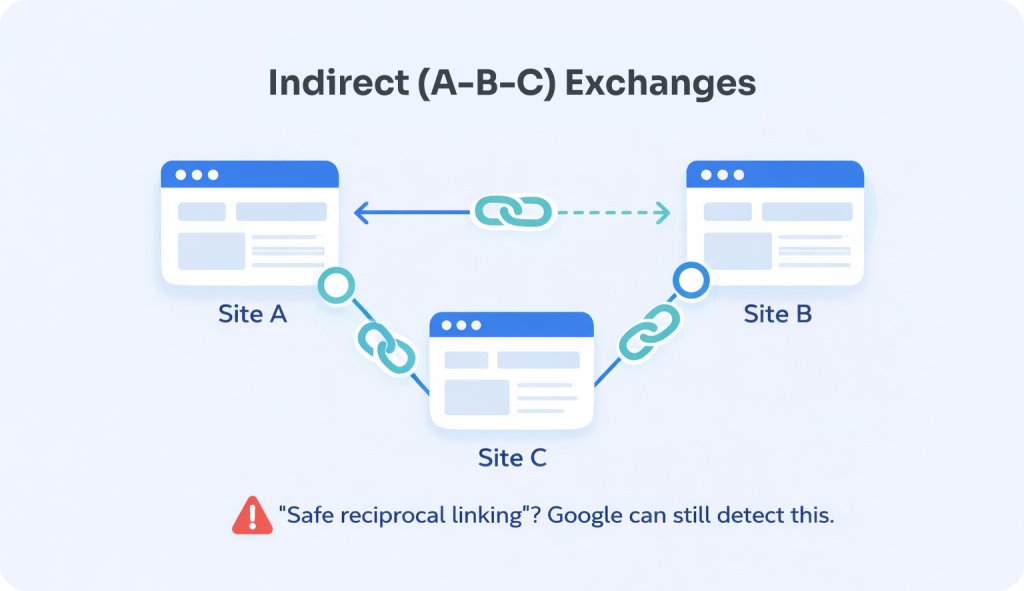
This is sometimes marketed as “safe reciprocal linking” or “three-way link building.” It is worth being precise about the risk profile: the intent is the same as a direct exchange, to manufacture the appearance of editorial endorsement in both directions, and Google’s network-level analysis is designed to identify exactly these indirect reciprocal patterns.
The structural footprint changes; the fundamental nature of the arrangement does not.
What does Google’s policy actually say about link exchanges?
Google’s spam policies explicitly list “excessive link exchanges”, defined as arrangements like “link to me and I’ll link to you”, as a link scheme that violates its guidelines.
The operative word in Google’s policy is “excessive”: the guidelines do not categorically prohibit all reciprocal linking, only coordinated reciprocal linking at volume as a ranking manipulation strategy.
This is the nuance that most coverage of link exchanges misses.
Google’s documented position acknowledges that mutual links between sites are a natural occurrence on the web, what it prohibits is the intentional orchestration of reciprocal linking at scale specifically for the purpose of manipulating rankings.
The policy distinction turns on intent and volume, not on the mere presence of mutual links in a profile.
Google’s current spam policies, updated in December 2025, categorise the following specific link exchange-related violations:
- Buying or selling links that pass PageRank: including arrangements where the “payment” is a return link rather than money
- Excessive link exchanges: coordinated volume reciprocal linking between the same set of domains
- Large-scale article marketing or guest posting campaigns: where links are the primary purpose rather than audience value
- Automated link building: using software or services to create link exchange arrangements at scale
The “paid link” framing extends further than most practitioners acknowledge. When Site A links to Site B in exchange for a return link from Site B, Google can reasonably characterise that return link as a form of payment — a non-cash exchange where the currency is PageRank.
Under this interpretation, coordinated link exchanges and paid link acquisition are violations of the same underlying policy: manipulating the editorial independence that gives links their authority signal.
For the complete policy framework that governs this area, our Google backlink policy guide covers how these rules have evolved from Penguin through to SpamBrain’s real-time detection capabilities in 2026.
How does Google detect coordinated link exchanges in 2026?
Google’s SpamBrain system detects coordinated link exchanges through network-level pattern analysis, identifying clusters of domains with statistically anomalous mutual link density, correlated acquisition timing, and anchor text coordination that cannot be explained by organic editorial behaviour.
In 2026, this detection operates continuously in real time rather than through periodic algorithmic sweeps.
The detection challenge for Google is distinguishing between two superficially similar situations: two authoritative sites in the same niche that have organically cited each other’s content over time (legitimate), and two sites that have agreed to insert mutual links within a specific time window to improve each other’s metrics (violation).
The signals Google uses to make this distinction are primarily statistical and relational rather than based on any single link attribute.
Network-level footprint analysis
SpamBrain analyses the full network of linking relationships between domains, not just individual link pairs.
A link exchange network leaves characteristic patterns: clusters of domains with high mutual link density, often operating in the same or adjacent niches, with acquisition timestamps that correlate across the cluster.
This pattern is statistically improbable under organic editorial behaviour and becomes more detectable as the network grows larger.
The A-B-C indirect exchange variant partially addresses the direct mutual link footprint but does not eliminate the network-level signal.
If Sites A, B, and C are all participants in an exchange network, their broader link relationship patterns, including the anchor text distributions, the topic clusters of linking pages, and the timing correlations, still produce a detectable network signature.
AI-driven intent classification
Google’s AI-powered ranking systems have become increasingly capable of classifying whether a link placement reflects a genuine editorial decision or a coordinated arrangement.
Signals that feed this classification include: whether the linking content was published specifically for the purpose of containing the link, whether the anchor text matches the target page’s commercial keyword targets rather than describing the source content, and whether the linking page has any audience engagement that suggests genuine readership.
A guest post published on a low-traffic site with no comments, no social shares, and content that exists primarily as a vehicle for outbound links, with anchor text optimised for the recipient’s commercial keywords, scores very differently in this classification than an editorial mention within a well-read industry publication’s original reporting.
Velocity and timing correlation
When two sites execute a direct link exchange, the timing of the two link acquisitions is typically correlated, both links tend to appear within days or weeks of each other.
At the individual link level, this is unremarkable. Across a large-scale exchange programme involving dozens of domains, the timing correlation pattern becomes statistically significant and algorithmically detectable.
This is one reason why large link exchange networks are more vulnerable to SpamBrain detection than isolated individual exchanges.
The 2026 detection shift: Unlike the Penguin era, where enforcement arrived in periodic algorithm updates that affected entire domains, SpamBrain’s real-time processing means that identified link scheme patterns can be devalued within days of acquisition, before they ever deliver the ranking benefit that motivated them.
What does the data actually say about reciprocal links and rankings?
Research across large-scale backlink datasets consistently shows that reciprocal links are a normal feature of high-performing backlink profiles, not an anomaly.
An Ahrefs study of 140,000 domains found that 73.6% had at least one reciprocal link, and 43.7% of top-ranking pages for non-branded queries contain reciprocal links.
Natural niche overlap alone produces approximately 19% reciprocal link overlap without any intentional exchange.
These statistics reframe the link exchange question significantly. If 73.6% of domains have reciprocal links and 43.7% of top-ranking pages contain them, it is empirically clear that the presence of reciprocal links in a backlink profile is not itself a ranking negative.
What the data cannot tell us, but Google’s policy distinguishes, is the proportion of those reciprocal links that arose organically versus through coordinated arrangements.
Natural niche overlap as the baseline
Any two sites operating in the same topic area will independently cite many of the same resources and authorities.
When Site A writes about link building strategy and references Site B’s original research, and Site B subsequently publishes a guide to SEO auditing that references Site A’s methodology framework, a reciprocal link relationship exists, despite neither party having coordinated it.
This natural niche overlap baseline of approximately 19% exists purely as a function of operating within shared topical communities.
This is the practical basis for the “expert relationship” position on link exchanges: you should not avoid linking to a site simply because they have linked to you, if their content is genuinely the best available resource for your audience.
The link decision should be editorially motivated; the fact that it produces a reciprocal relationship is a consequence of the editorial logic, not the cause of it.
What the data does not support
The research confirms that reciprocal links exist in high-ranking profiles, it does not suggest that pursuing reciprocal links at scale is a reliable path to achieving those rankings.
The causation runs in the opposite direction: sites that create excellent content attract links from their peers, who they in turn cite for the same reason. The links are a symptom of mutual authority, not the cause of it.
A strategy designed to acquire reciprocal links as a primary mechanism is therefore working backwards from the data, attempting to create the symptom without the underlying cause.
At best, this produces a temporary ranking lift that reverses with the next SpamBrain update cycle. At worst, it produces a contaminated profile that suppresses the effectiveness of every legitimate link acquired alongside the manipulated ones.
What is the difference between a direct and an indirect link exchange in terms of risk?
Direct link exchanges, where two sites link to each other, are detectable through standard backlink profile analysis and carry higher pattern-level risk at scale.
Indirect A-B-C exchanges reduce the direct mutual link footprint but do not eliminate the underlying network signal that SpamBrain analyses at the domain cluster level.
The risk difference between them is one of detection probability, not policy compliance, both are link schemes when executed as a deliberate ranking strategy.
This is an important distinction to be precise about. Some practitioners position the A-B-C exchange as a “white hat” variant of reciprocal linking on the basis that it avoids the direct footprint.
This conflates the detection mechanism with the policy violation. Google’s spam policies prohibit the arrangement itself, the coordinated exchange of linking value for ranking benefit, not any specific structural form of that arrangement.
The practical risk levels do differ, however, which is why it is worth understanding both structures:
| Factor | Direct Exchange (A↔B) | Indirect Exchange (A→C→B, B→A) |
|---|---|---|
| Mutual link footprint | Visible in both profiles | Absent from Site A’s domain |
| Network-level detectability | High (at scale) | Moderate (harder at small scale; still detectable in networks) |
| Policy compliance | Violation (if coordinated for ranking) | Violation (same intent, different structure) |
| Anchor text anomaly risk | Present if over-optimised | Present if guest post content is thin |
| Effort required | Low | Higher (requires third-party content) |
The table illustrates why neither structure is a safe basis for a scalable link acquisition strategy.
The indirect variant requires significantly more effort per link exchange and reduces, but does not eliminate, detection risk.
For that investment, it delivers the same fundamental risk exposure as the direct variant: a link profile containing manufactured editorial endorsements rather than earned ones.
When is reciprocal linking acceptable under Google’s guidelines?
Reciprocal linking is acceptable under Google’s guidelines when both links exist because they are genuinely the best available resource for each site’s audience, not because they were placed as part of a coordinated exchange arrangement.
The test is whether each link would have been placed independently on its editorial merit if the other link did not exist.
This is the expert consensus position that distinguishes white hat SEO practitioners from those who approach link building purely as a manipulation exercise.
Leading SEO authorities consistently argue that you should not avoid linking to a site simply because they have linked to you, if their content is genuinely the best resource available on a topic relevant to your audience, the editorial case for the link exists independently of the reciprocal relationship.
The editorial independence test
Apply a simple decision framework to any reciprocal link situation: if the other site had never linked to you, would you still be placing this link?
If the honest answer is yes – because their content is genuinely the most useful resource you can direct your audience to on this specific point, the link is editorially justified and the reciprocal relationship is incidental.
If the honest answer is no – you are placing the link primarily because they linked to you, and the content you are linking to is not meaningfully better than three other resources you are not linking to, the link is being placed for the exchange value rather than the editorial value.
That distinction is precisely what Google’s policy is designed to enforce.
Industry partnership contexts
B2B SaaS companies and agencies that operate within a defined partner ecosystem, integration partners, resellers, complementary tool vendors, will naturally accumulate mutual link relationships as part of legitimate co-marketing activities.
A CRM platform linking to its integration partners, who link back within their integration documentation, is a relationship-driven linking pattern that reflects genuine business relationships rather than a link scheme.
These contexts are low-risk because the links have a clear non-SEO motivation, documenting a genuine integration or partnership, and because the anchor text and content context typically reflect the business relationship rather than commercial keyword optimisation.
They look, to Google’s systems, like what they are: links placed because a business relationship exists, not links placed because someone is trying to game rankings.
When does reciprocal linking become a link scheme?
Reciprocal linking becomes a link scheme when the exchange arrangement is the primary motivation for placing the links, when volume, keyword anchor optimisation, or systematic coordination replace editorial judgment as the decision-making framework.
The transition from acceptable to prohibited is primarily one of intent and scale rather than structure.
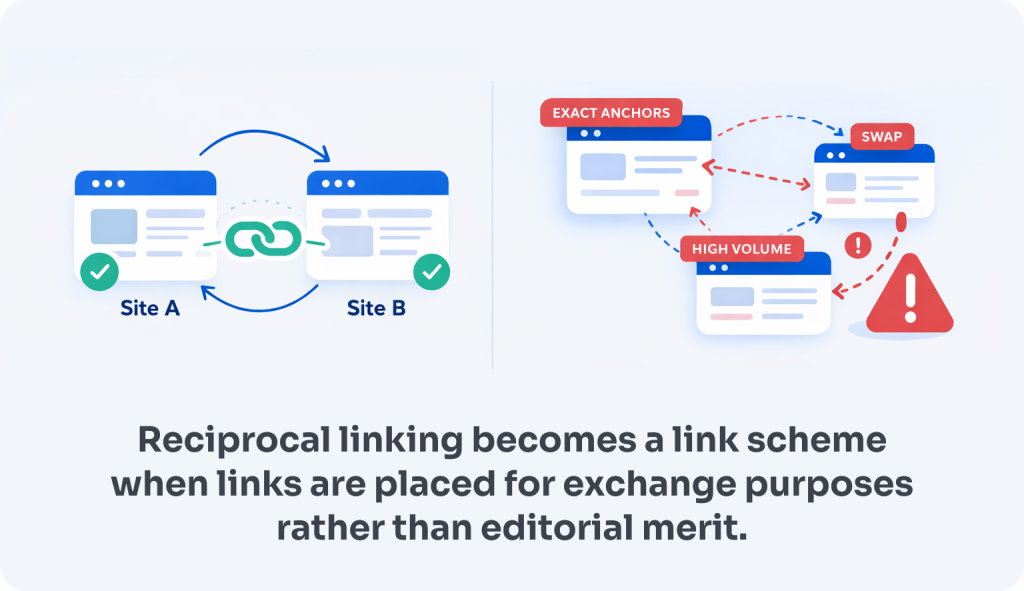
The patterns that indicate a link exchange has crossed into scheme territory are consistent with the broader indicators Google’s systems use to identify unnatural links generally:
Volume and velocity signals
A small number of mutual links between two sites that operate in the same niche, accumulated gradually over time, is a natural niche overlap pattern.
The same two sites exchanging links with 40 other domains in a coordinated six-week outreach campaign, all using similar anchor text, all with links appearing within weeks of each other, is a coordinated link scheme by any reasonable interpretation of Google’s policy.
The threshold is not a specific number, but a statistical implausibility test: would this volume and timing of mutual link acquisition be achievable through organic editorial behaviour?
If the answer requires assuming that every relevant site in your niche independently decided to link to you within the same six-week window, the pattern is implausible and the risk profile is high.
Anchor text optimisation as the tell
Perhaps the clearest signal that a reciprocal link arrangement is commercially motivated rather than editorially motivated is the anchor text pattern.
When mutual links consistently use exact-match commercial keyword anchors, the precise phrases that each site wants to rank for, rather than descriptive contextual anchors that reflect the content of the linking article, the commercial motivation is explicit in the data.
Organic editorial links produce diverse anchor text because independent writers use natural language when describing what they are linking to.
Coordinated exchanges produce homogeneous anchor text because the parties involved specify the anchors they want.
SpamBrain is specifically trained on this signal, and it remains one of the highest-confidence indicators of manipulation in current backlink profile analysis.
Automated link exchange networks
The highest-risk category in this area is participation in automated link exchange networks, services that connect sites seeking reciprocal links and facilitate the placements at scale.
These networks are structurally identical to link farms in their operational model: a coordinated infrastructure built specifically to manufacture editorial-looking links at volume.
The December 2024 spam update specifically targeted this type of network, and participation in them presents the highest penalty risk in the link exchange landscape.
Avoiding these networks is non-negotiable for any site operating a serious long-term SEO strategy.
The short-term ranking lift they produce, when they produce one at all, is structurally temporary: the same network detection that identified and devalued similar schemes in December 2024 is now more sensitive than ever to new network formations.
How do you approach link partnership outreach the right way in 2026?
Ethical link partnership outreach in 2026 is relationship-first and value-first, it starts by identifying genuinely complementary sites whose content serves the same audience you do, leads with the value you can offer them, and positions mutual linking as a natural consequence of industry collaboration rather than a transactional exchange.
The outreach methodology that works is the same as the methodology that looks natural to Google’s systems: because it is natural.
This is where the tactical shift from “link exchange” to “industry partnership building” produces both compliance and effectiveness benefits simultaneously.
A well-executed partnership outreach campaign that focuses on genuine content collaboration, co-authored resources, shared data studies, mutual resource referencing, produces mutual links that are editorially defensible because they arose from editorial activity.
Identifying the right partners
Partner targeting should start with relevance, not authority metrics. The ideal link partner is a site whose content is genuinely useful to your audience, complementary rather than competitive, operating in an adjacent topic area that your readers care about.
Domain Rating (DR) and Domain Authority (DA) are useful secondary filters for assessing the authority the partnership would deliver, but they should never be the primary selection criterion: a highly relevant DR 45 site is a better link partner than an irrelevant DR 80 one from both an editorial and a policy compliance perspective.
Relevance also significantly affects the link value Google assigns to the placement.
As covered in our Google backlink policy guide, Google’s systems increasingly weight the semantic context surrounding a link, the topical relationship between the linking page and the destination page, as a primary quality signal.
A contextually relevant link from a moderately authoritative site delivers more ranking signal than an off-topic link from a highly authoritative one.
The value-first outreach framework
Outreach that leads with what you can offer, rather than what you want, converts at a higher rate and establishes the partnership on a foundation that reflects genuine mutual value.
Practical approaches include:
- Pre-link first: Link to the potential partner’s content in something you publish before making any outreach contact. When you then reach out, the partnership is already partially established — you have demonstrated that you find their content valuable enough to cite it without any reciprocal expectation.
- Specific content referencing: Personalised outreach that references a specific article, piece of data, or perspective from the partner’s site signals that your interest is genuine rather than template-driven. Generic outreach that could have been sent to any site in the niche is immediately recognisable as a mass link exchange request.
- Collaborative framing: Positioning the partnership as an opportunity to co-create something — a joint data study, a collaborative guide, a shared resource — shifts the conversation from “can we trade links” to “can we build something valuable together.” The links become a natural outcome of the collaboration rather than its stated purpose.
Email outreach standards for 2026
The mechanics of effective link partnership outreach align with the standards of any professional B2B communication:
- Subject lines should be specific and concise. 2–7 words that communicate genuine relevance to the recipient rather than generic intrigue
- The body should lead with specific observation (what you noticed about their content) before any request
- Never request a meeting or call as a first-contact action partnership outreach is a low-friction request; escalating it to a meeting immediately signals that the ask is larger than it should be
- One follow-up, after 3–5 business days, is appropriate — multiple follow-up sequences signal volume-driven outreach rather than genuine interest
How do link exchanges affect AI search visibility and GEO in 2026?
In the context of Generative Engine Optimisation (GEO), the quality dimension of link exchange decisions becomes more important than ever.
AI search systems – including Google’s AI Overviews, Perplexity, and ChatGPT Search, weight editorial authority signals in their source selection, which means that links from genuinely authoritative, contextually relevant sources build AI citation probability, while links from manufactured exchange networks do the opposite.
As we cover in our white hat link building guide, AI search engines are trained on web data where highly cited, authoritative sources are disproportionately represented.
A link exchange that produces links from high-authority publications in your vertical, because the editorial collaboration genuinely merited the citation, contributes to the brand entity signals that AI systems use to identify trustworthy sources.
A link exchange network that produces links from low-traffic content farms does not, regardless of the anchor text or the DA score of the linking domain.
The AI citation context requirement
When AI search systems dynamically retrieve sources to support generated responses, they prioritise content that appears in authoritative contexts, cited within expert-level writing, referenced by credible institutions, and appearing across multiple independent high-trust sources.
This is exactly the link profile that genuine editorial partnership building produces, and exactly the profile that coordinated exchange networks cannot replicate at scale.
The practical implication for link exchange strategy in 2026 is that the GEO objective and the white hat SEO objective are perfectly aligned: both are achieved by acquiring links from sources that are genuinely authoritative in your niche, acquired through editorial merit rather than commercial arrangement.
Any link that would improve your traditional Google rankings through genuine authority signal will also improve your AI search citation probability.
Any link that would only deliver value through PageRank manipulation, and would be devalued by SpamBrain if detected, contributes nothing to your AI visibility.
How do you audit your backlink profile for excessive reciprocal linking risk?
Auditing for reciprocal linking risk requires extracting your full referring domain list, identifying domains that also appear in your outbound link profile, assessing the proportion of mutual links against your total profile, and evaluating whether the anchor text and timing patterns of those mutual links reflect organic niche overlap or coordinated exchange activity.
This is a more targeted version of the full backlink policy compliance audit process covered in our Google backlink policy guide. It focuses specifically on the reciprocal link dimension rather than the full spectrum of policy risks.
Identifying mutual links in your profile
In Ahrefs, the Site Explorer tool allows you to export your full referring domain list. Cross-reference this against your own outbound links (visible under “Linked domains” in the same tool).
Any domain that appears in both lists is a potential reciprocal link relationship. Note the number of mutual links between you and each domain, the anchor text used on both sides, and the acquisition timeline.
Assessment framework
Not every mutual link warrants concern. Apply the following criteria:
- Low risk: Mutual links with sites you have a genuine business relationship with (partners, clients, industry peers), where both links use natural descriptive anchors and were acquired at different points in time
- Medium risk: Mutual links where both links appeared within a short time window, or where the anchor text on one side is commercial keyword-optimised
- High risk: Multiple mutual links with the same domain, using exact-match commercial anchors on both sides, acquired within the same time period — particularly if this pattern is replicated across multiple domains
If your audit surfaces high-risk patterns at meaningful scale, particularly if those patterns correlate with ranking drops following a Google spam update, the appropriate remediation steps are covered in our guide to disavowing toxic backlinks.
Where the links are from sites you have a genuine relationship with, direct outreach to request removal is preferable to disavow, as it cleanly removes the signal rather than asking Google to discount it.
Ongoing monitoring
Reciprocal link risk is not a one-time audit concern. As your site grows and acquires more links, the proportion of mutual links in your profile will naturally increase, particularly if you operate in a niche where a small number of authoritative sites dominate the publishing landscape.
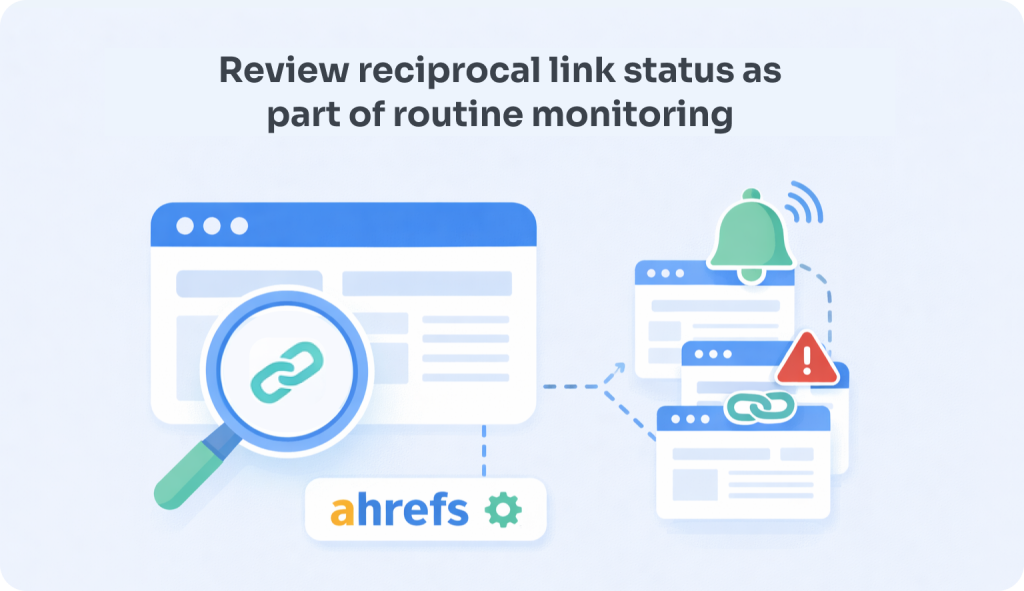
Set up Ahrefs alerts for new referring domains and review the mutual link status of each new significant linking domain as part of your routine profile monitoring.
If you are concerned about whether your existing profile contains patterns that would be flagged by current Google spam detection, our resource on why your backlinks are decreasing covers the diagnostic process for identifying whether algorithmic devaluation is affecting your current profile performance, including how to determine whether a reciprocal linking pattern is a likely contributing factor.
Not sure where your link profile sits on the compliance spectrum?
Link exchange risk is one of the more difficult backlink profile issues to self-diagnose because the line between natural niche overlap and coordinated scheme activity is defined by intent and pattern rather than any single visible attribute.
If your site has a history of active link building and you are uncertain whether your current reciprocal link ratio presents algorithmic risk, particularly following the December 2024 or October 2025 spam updates, a professional profile review gives you a clear answer.
BlueTree Digital provides free backlink profile reviews for B2B SaaS and technology companies, covering mutual link exposure, anchor text risk, network affiliation signals, and a clear assessment of what a compliant 2026 link building strategy looks like for your domain.
→ Request a free backlink profile review
For the complete strategic framework on building editorial authority within Google’s policy guidelines, including the advanced tactics that deliver compounding link equity without any exchange risk, read our white hat link building guide.

Frequently Asked Questions
Are link exchanges always against Google’s guidelines?
No. Google’s spam policies prohibit “excessive link exchanges”, coordinated reciprocal linking at volume for ranking manipulation, not mutual links that arise organically from operating in the same niche. Research shows that 73.6% of all domains have at least one reciprocal link, and 43.7% of top-ranking pages contain them. The policy distinction is between links placed for editorial reasons that happen to be reciprocal, and links placed primarily because a reciprocal arrangement exists.
What is an A-B-C link exchange and is it safer than a direct exchange?
An A-B-C exchange is an indirect reciprocal arrangement where Site A links to Site B from a third-party guest post (Site C), and Site B links back to Site A directly, avoiding the direct mutual link footprint in both profiles. It is harder to detect through standard backlink analysis than a direct exchange, but it does not eliminate the network-level signal that Google’s SpamBrain analyses. Both structures violate Google’s policy when executed as a deliberate ranking strategy, and the risk difference between them is one of detection probability rather than policy compliance.
How many reciprocal links are too many?
There is no specific threshold, Google’s assessment is based on whether the pattern is statistically plausible for organic editorial activity. A natural niche overlap of approximately 19% reciprocal links is typical for sites operating in competitive verticals. The risk signals are: a high concentration of mutual links with the same small set of domains, correlated acquisition timing across multiple mutual link relationships, and exact-match commercial anchor text appearing on both sides of multiple exchanges. Any of these patterns in combination warrants an audit.
What should I do if I have already participated in link exchanges?
Audit your profile to assess the scale and risk pattern of existing mutual links. For high-risk patterns, particularly those involving exact-match anchors, short acquisition windows, or domains you know participated in exchange networks — direct removal outreach is preferable to disavow. Our complete guide to disavowing toxic backlinks covers the full remediation process for profiles where exchange links cannot be removed through direct outreach.
Is a “link partnership” the same as a link exchange?
The distinction is in the foundation of the relationship. A link partnership built around genuine co-marketing activity, shared data studies, collaborative guides, mutual integration documentation, produces mutual links that are editorially defensible because they arose from genuine collaborative work. A “link partnership” that is a rebranded link exchange, where the mutual links are the purpose of the relationship rather than a consequence of genuine collaboration, carries the same policy risk as any other coordinated exchange arrangement. The test remains the editorial independence question: would each link exist if the other one did not?





 Start the conversation