


A startup PR strategy in 2026 needs to account for three realities.
Journalists receive more pitches than ever before.
AI has changed how stories are discovered, researched, and written.
And the definition of media coverage has expanded well beyond traditional publications to include podcasts, newsletters, YouTube, and AI-generated responses.
The startups that earn consistent, high-quality coverage in this environment are not the ones with the biggest budgets.
They are the ones with the sharpest narratives, the most targeted outreach, and the discipline to treat PR as an ongoing system rather than a series of launch-week scrambles.
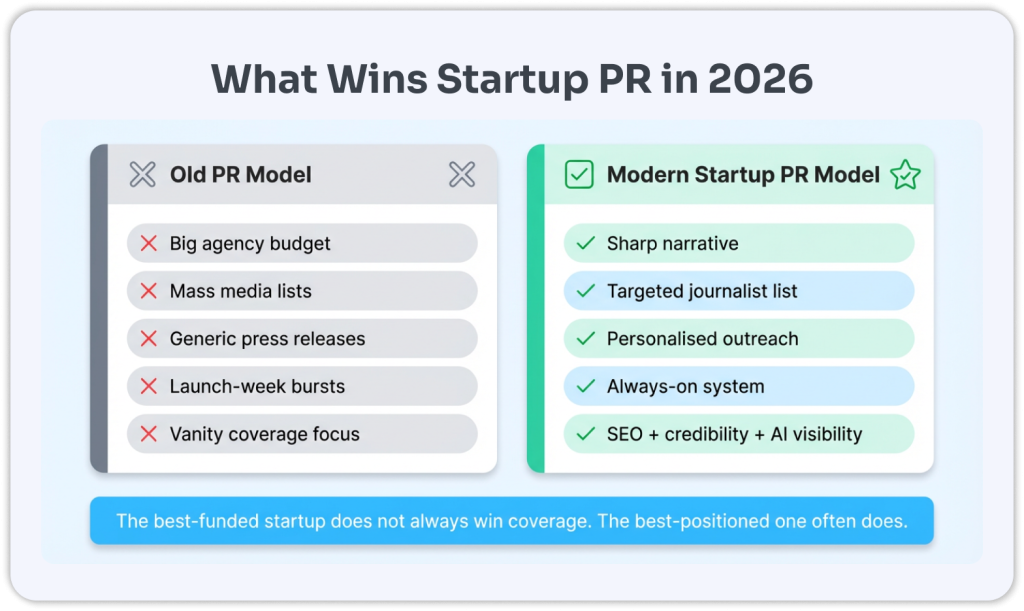
The stakes are real: the average journalist response rate to PR pitches is just 3.43% in 2025, and only 2% of PR professionals say earning coverage has not become harder.
This guide covers exactly what it takes to beat those odds.
Building Your PR Narrative
Every successful startup PR strategy begins with a clear narrative.
What problem are you solving, and why does it matter right now?
The strongest startup stories connect to a broader trend: AI transformation, climate technology, the future of work, or healthcare innovation.
Your narrative should be adaptable to different formats and audiences without losing its core.
The same story might become a data-driven pitch for TechCrunch, a founder profile for an industry podcast, and a thought leadership piece for a niche blog.
What each version shares is a clearly articulated reason why this story matters to that specific audience right now.
Neuroscience research shows that the brain processes narratives 22 times more effectively than standalone facts.
When a journalist receives 200 pitches in a day, the ones that lead with a story rather than a feature list get read.
For startups in the technology sector specifically, our guide on public relations for tech startups provides sector-specific tactics and examples.
How to Build a Media List That Actually Works
Most startups approach media outreach backwards.
They compile a list of high-profile publications they want coverage in, then try to pitch their way into them cold.
The more effective approach is to start with journalists, not publications.
A media list of 20 to 30 journalists who genuinely cover your space will outperform a blast to 500 generic contacts every time.
According to Cision’s 2025 research, 47% of journalists say they rarely receive relevant outreach, and exclusive access to credible sources now outranks original data as the most valued offering from PR contacts.
Building the right list takes time but follows a clear process.
Read the last five to ten articles from each journalist you are considering.
Understand not just their beat but their angle: do they favour contrarian takes, data-led features, or founder profiles?
Note the sources they quote regularly and the publications they respect.
Start building the relationship two to three months before you ever pitch, by engaging thoughtfully with their work on LinkedIn and sharing genuine insight on their coverage.
When the pitch arrives, it lands in a warm inbox rather than a cold one.
The AI-Augmented PR Workflow
In 2026, the most effective startup PR workflows use AI at each stage without surrendering editorial judgment to it.
For research, AI analyses competitor coverage to identify gaps and angles your category has not yet owned.
For ideation, large language models can brainstorm dozens of pitch angles based on industry trends and a journalist’s recent coverage in minutes.
For outreach, AI helps personalise pitches at scale while maintaining a voice that reads as genuinely human.
The statistics reflect how fast AI adoption has moved: 77% of PR professionals already use tools like ChatGPT in their workflow, with 59% saying AI and automation will grow in importance over the next five years.
The critical human touchpoints remain editorial judgment and relationship management.
Deciding which stories to pursue and which to shelve, knowing when a journalist is receptive, and framing a story for a specific audience’s worldview are things AI can support but not replace.
The startups that misuse AI are the ones generating high-volume, low-quality pitches that flood journalist inboxes.
This is precisely why journalist response rates have declined even as AI tooling has improved.
The advantage goes to founders who use AI to do better preparation, not to send more emails.
Tactical PR Channels for Startups
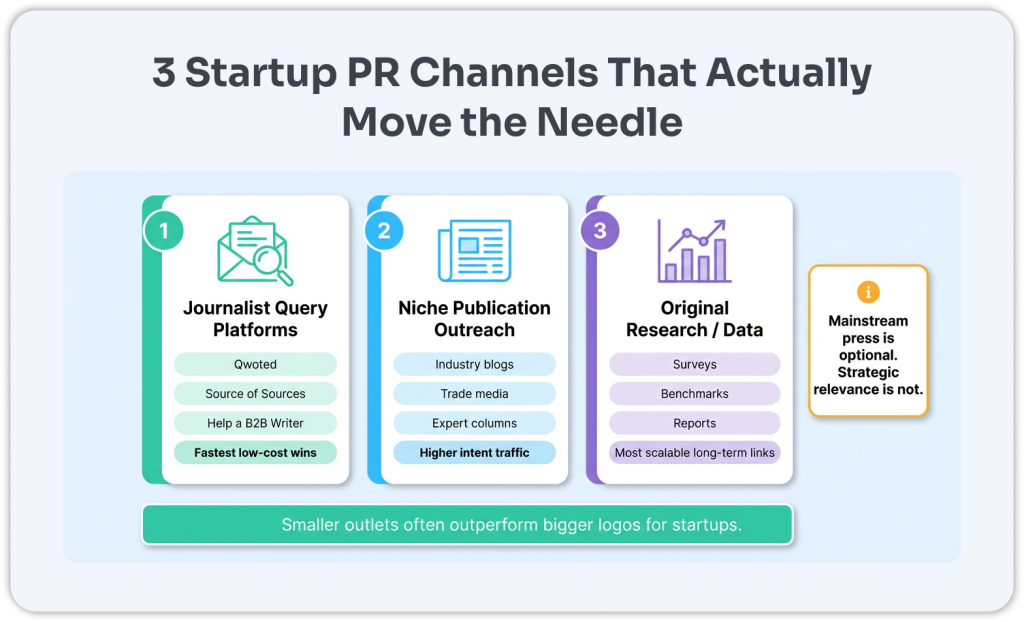
Journalist Query Platforms
Responding to journalist queries remains one of the lowest-cost, highest-return PR tactics available to startups.
The landscape has shifted significantly since HARO was shut down by Cision in December 2024.
In April 2025, Featured.com relaunched the HARO brand, but the quality and spam issues that plagued the original platform under Cision have led many PR professionals to diversify across newer alternatives.
The strongest options in 2026 are Source of Sources (founded by HARO’s original creator, Peter Shankman), Qwoted (which gives verified experts access to journalists at Bloomberg, Business Insider, and Yahoo Finance), and Help a B2B Writer for startups specifically targeting SaaS and B2B content publications.
The key principle across all platforms is the same: respond only when you have genuine expertise on the specific topic, keep responses under 200 words, and lead with the insight rather than a company pitch.
Our guide on HARO link building explains how to maximise response rates and link quality from journalist query platforms in this new landscape.
Blogger and Niche Publication Outreach
Building relationships with bloggers and niche publications through targeted outreach campaigns is often more valuable for early-stage startups than chasing mainstream media.
A feature in a respected industry blog frequently drives more qualified traffic and higher-quality links than a passing mention in a national outlet.
Niche publications also tend to have more editorial flexibility than major outlets, meaning founders can contribute original analysis and thought leadership pieces that would not fit a news wire format.
For a structured approach to this channel, the guide on blogger outreach services covers targeting criteria and outreach sequencing in detail.
Original Research and Data
Publishing original research is the most scalable PR tactic available to a startup with limited resources.
A single data study can generate coverage across multiple publications for months as different journalists discover and reference it.
It does not require a large sample size to be compelling.
A survey of 200 to 300 targeted respondents with a surprising finding is far more newsworthy than a generic market overview sourced from a third party.
The data becomes the hook that differentiates your pitch from the hundreds of others in a journalist’s inbox.
Cision’s 2025 research found that exclusive story access now outranks original research reports as the top journalist preference for the first time.
The practical implication: pair your data with an exclusive angle pitched to one journalist first, before broader distribution.
How to Write a Pitch That Gets Read
The pitch is where most startups lose coverage they should have earned.
The product is genuinely newsworthy, but the email frames it as a company announcement rather than a story a journalist’s audience would want to read.
A strong pitch has four components.
A subject line under 40 characters that leads with the news value, not the company name.
A first sentence that connects your story to something the journalist has covered recently.
Two to three sentences that deliver the core story, including one data point or specific detail that makes it concrete.
A clear, low-friction call to action: offer an interview, a data briefing, or an exclusive preview.
The whole pitch should be under 200 words.
Research across millions of pitches confirms that pitches under 200 words achieve the highest success rates, and the best days to send are Tuesday through Thursday, in the morning before 12pm.
The follow-up matters too.
Wait five to seven business days before sending one short follow-up that adds a new piece of information rather than simply restating the original pitch.
If there is no response after two attempts, move on rather than risk being marked as spam.
The AI Search Factor in 2026
Digital PR campaigns designed for AI visibility have emerged as a rapidly growing specialised segment of the broader PR market in 2026.
These campaigns deliberately target the specific source categories that large language models are most likely to cite when generating responses.
Those include authoritative news publications with established editorial reputations, research institutions and academic publications, government agencies and official bodies, established industry analyst platforms, and authoritative niche publications with deep topical coverage.
By securing coverage and links from these high-trust sources, startups can directly influence how AI systems represent their products and expertise in generated responses.
This creates a compounding competitive advantage as AI-mediated discovery becomes a larger share of total search visibility.
For startups in competitive categories, appearing in AI-generated responses for relevant queries is increasingly more valuable than a traditional SERP ranking.
AI answers appear above organic results, carry implied credibility from the model, and are often the only answer a user reads.
The digital PR link building guide covers how to design campaigns that maximise AI citation visibility alongside traditional SEO outcomes.
Practical Implementation Guidance
When briefing a digital PR agency or internal team, the quality of your brief directly shapes your results.
Provide comprehensive information about your target audience demographics and psychographics.
Share your priority keyword clusters and the specific pages you want to drive authority to.
Include competitive landscape context: which competitors are winning in organic search and AI citations.
Highlight any unique data assets, research capabilities, or recognised expert sources within your organisation that could fuel compelling campaign concepts.
The more strategic context you provide upfront, the more targeted and effective the agency can be in developing campaign concepts that resonate with journalists and drive placements on the right publications.
Schedule regular campaign review sessions to provide industry-specific feedback and ensure ongoing alignment as your product and market evolve.
Strategic Context and Market Positioning
Digital PR has firmly established itself as the premium performance tier of link building in 2026.
It consistently generates editorial placements on high-authority publications that are completely inaccessible through traditional link building outreach methods.
The average well-executed digital PR campaign generates links from publications with a median domain rating of 52.
Top-performing campaigns regularly achieve median placement DRs of 72 or significantly higher across national publications and major industry outlets.
These are precisely the kinds of placements that move rankings meaningfully in competitive search markets.
The strategic integration of digital PR with broader content marketing and SEO strategy has become essential for maximising return on PR investment in 2026.
PR campaigns should never exist in isolation.
They should be deliberately designed to support specific SEO objectives, with campaign topics chosen to target publications relevant to your priority keyword clusters.
Campaign messaging should secure placements that build topical authority in the most strategically important content areas.
Outreach targets should be selected based on both publication authority and topical alignment with the client’s semantic field.
This strategic alignment transforms digital PR from a primarily brand awareness tool into a precision SEO instrument.
To see this in practice, the BlueTree case studies show how these principles have been applied across SaaS, EdTech, fintech, and cybersecurity verticals.
Measuring Digital PR Success: A Multi-Dimensional Framework
Measuring digital PR success requires a framework that goes well beyond simple link counts or media mention tallies.
Track the average domain authority of earned placements and the trend over time.
Measure the organic traffic flowing to the specific pages that contain your links.
Monitor referral traffic driven directly by media coverage.
Track changes in branded search volume following major campaigns as an indicator of awareness impact.
In 2026, measurable changes in AI citation frequency for your brand name and key products are also a critical KPI.
This comprehensive approach reveals the true multi-channel ROI of digital PR investment.
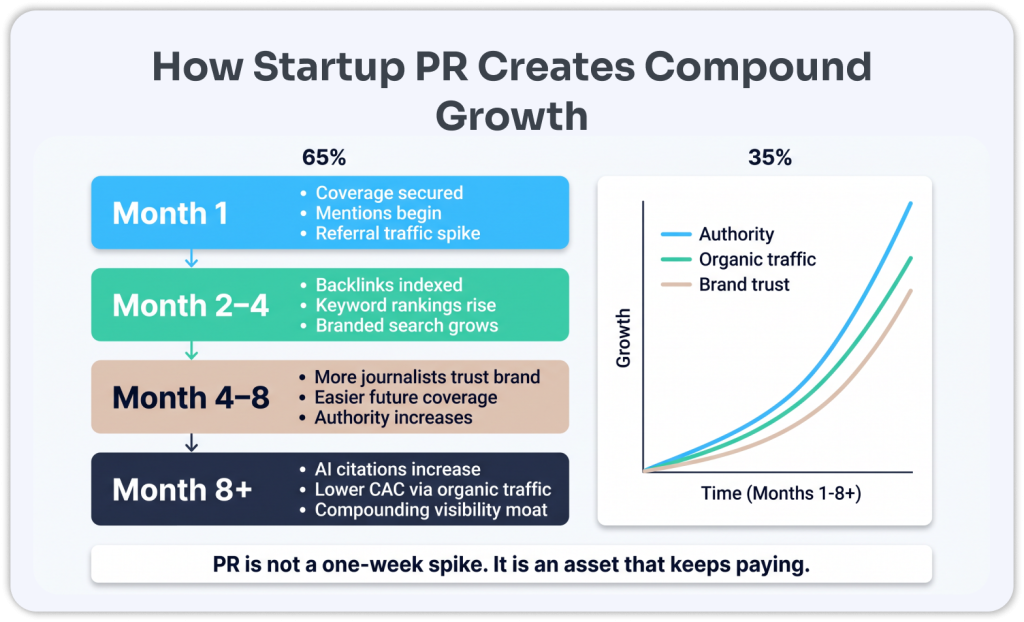
The business case is increasingly clear: 81% of consumers research a brand further after reading editorial or third-party coverage, and 67% of buyers say earned media makes them more likely to consider a brand.
Looking Ahead: Key Takeaways for 2026 and Beyond
The link building and PR landscape continues to evolve at an accelerating pace.
Advances in AI, changes in search algorithms, and the decline of traditional media gatekeepers are reshaping how startups earn visibility.
The fundamentals have not changed: journalists want stories worth telling, and audiences trust editorial coverage more than paid promotion.
What has changed is the precision required to break through.
Startups that invest in building a sharp narrative, a targeted media list, and a consistent cadence of pitching and relationship-building will earn coverage that compounds into lasting SEO authority and AI citation visibility.
Those that treat PR as an intermittent announcement channel will continue to find it expensive and unpredictable.
To explore how a managed PR backlinks programme could work for your startup, browse our full case studies or get in touch for a free audit.





 Start the conversation