


Google’s backlink policy is the framework that determines which links improve your search rankings and which ones risk removing them entirely.
In 2026, that framework is more precisely enforced than at any prior point in Google’s history, powered by machine learning systems that analyse link networks in real time rather than through periodic algorithm sweeps.
Understanding Google’s backlink policy is not optional for any site serious about organic growth. It is the foundational requirement that every link building strategy must satisfy before a single outreach email is sent.
This page explains what the guidelines say, how enforcement has evolved from Penguin to SpamBrain, what link types Google’s systems reward or penalise, and how to audit your own profile against current policy standards.
This resource is part of our white hat link building content hub, the complete guide to building an editorial backlink profile that compounds in value over time and survives every algorithm update.
In this article…
- What is Google’s backlink policy and why does it exist?
- How has Google’s enforcement evolved from Penguin to SpamBrain?
- What technical requirements must a link meet before Google counts it?
- What do rel=”nofollow”, rel=”sponsored”, and rel=”ugc” mean for SEO in 2026?
- What types of backlinks does Google’s policy actively reward?
- What backlink types violate Google’s spam policies in 2026?
- What does a natural backlink profile look like to Google?
- How do internal links factor into Google’s link policy and PageRank distribution?
- How does Google treat Reddit, Quora, and other UGC platform links in 2026?
- How do you audit your backlink profile against Google’s current policy?
- Need a backlink profile audit against Google’s current policies?
- Frequently Asked Questions
What is Google’s backlink policy and why does it exist?
Google’s backlink policy is the set of guidelines that defines which links are treated as genuine editorial endorsements and which are classified as link spam.
Its purpose is to prevent manipulated backlinks from distorting search rankings, protecting the integrity of Google’s relevance model.
Google’s original PageRank algorithm, the mathematical model that made Google’s early search quality superior to its competitors, treated each backlink as a vote of trust between one document and another.
The underlying assumption was that a genuinely useful page would naturally accumulate more high-quality citations over time than a low-quality one.
That assumption was exploited within years of Google’s launch.
By the mid-2000s, entire industries had been built around manufacturing the appearance of editorial endorsement through paid links, link farms, and coordinated network schemes.
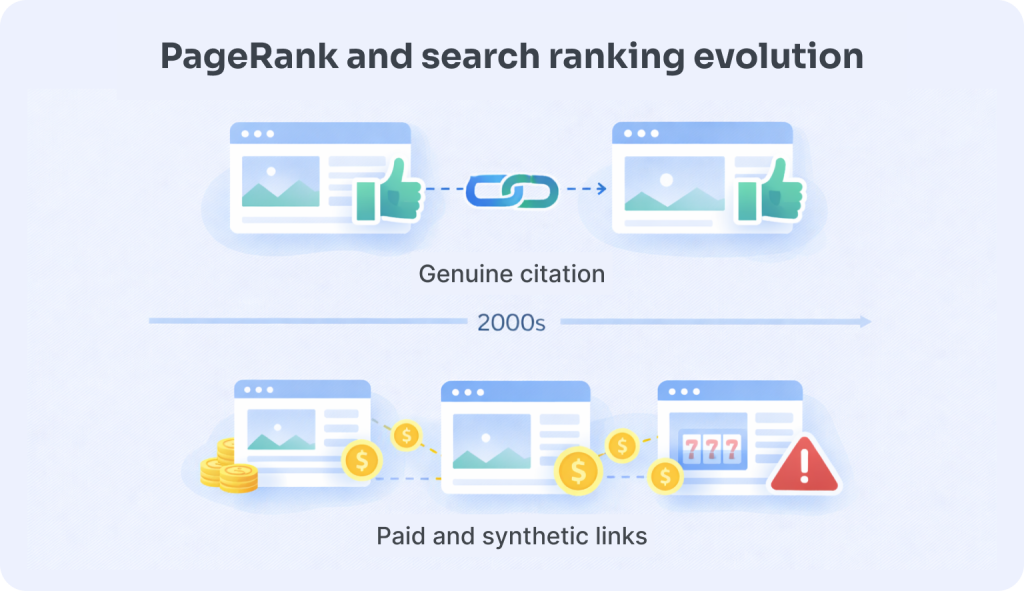
Google’s backlink policy formalised the rules that were implicit in the original PageRank design: links should represent authentic editorial decisions, not commercial transactions.
Google’s current spam policies, updated most recently in December 2025, define link spam as any practice that “manipulates links to or from a site with the intent of manipulating ranking in Google search.”
The key word is intent. Google’s systems are trained to distinguish between a link placed because content is genuinely useful and a link placed primarily to pass PageRank for ranking benefit.
The practical consequence: the same external signal, a backlink, can either accelerate your rankings or trigger a manual action depending entirely on how it was acquired.
Understanding the policy is not just a compliance exercise; it is the prerequisite for building a strategy that works at all.
For a ground-level understanding of the links that satisfy this policy, our guide to natural links explains what genuine editorial citation looks like in practice.
How has Google’s enforcement evolved from Penguin to SpamBrain?
Google’s link spam enforcement has evolved from periodic, pattern-matching algorithm updates (Penguin, 2012) to a real-time, AI-powered detection system called SpamBrain.
That identifies link manipulation at the network level continuously without requiring a named update to take effect. The trajectory matters for understanding current risk.
Each generation of Google’s enforcement was more sophisticated than the last, and the gap between what practitioners could detect and what Google could detect widened significantly at each stage.
| Era | System | Detection Method | Speed | Key Target |
|---|---|---|---|---|
| 2012–2016 | Penguin (v1–v3) | Pattern matching: over-optimised anchors, link velocity spikes | Periodic (months between runs) | Exact-match anchor stuffing, link farms |
| 2016–2021 | Penguin 4.0 (real-time) | Continuous reprocessing; disavow impacts reflected faster | Real-time (continuous) | Link farms, directory spam, footer links |
| 2022–2023 | SpamBrain (initial) | ML network analysis: domain relationships, topic clusters, anchor distribution | Real-time | PBNs, grey-hat guest post networks |
| 2024–present | SpamBrain (enhanced) | Full network-level analysis; BadBackLinks signal active; AI-generated content detection | Real-time (minutes) | AI-generated guest post farms, paid link networks, hacked-link injection |
The Penguin era (2012–2016): Pattern matching at scale
Google’s April 2012 Penguin update was the first major algorithmic crackdown on manipulative link acquisition.
Its mechanism was primarily pattern-based: over-optimised exact-match anchor text, high ratios of followed links from unrelated domains, and sudden velocity spikes were the primary signals.
Sites that had built thousands of keyword-stuffed directory links and footer links overnight saw ranking collapses within the first Penguin rollout cycle.
Penguin’s limitation was its periodic nature. Early versions ran infrequently, sometimes months apart, meaning the consequences of new violations were delayed, and recoveries from disavow file submissions were similarly slow.
Penguin 4.0 in September 2016 changed this by making the algorithm real-time: Google now reprocesses links continuously rather than in batch cycles, and disavow file impacts are reflected much faster.
The types of link schemes that Penguin targeted, link farms, exact-match anchor text manipulation, and large-scale link exchange schemes, did not disappear after 2016.
They adapted, becoming harder to detect through simple pattern analysis alone.
SpamBrain and real-time network analysis (2022–present)
Google’s SpamBrain system, significantly upgraded through the August 2025 spam update, applies machine learning to link quality evaluation at the network level.
SpamBrain does not just assess individual links, it analyses the relational patterns between the linking domain, the linked domain, the topic cluster of the linking content, the anchor text distribution across all links pointing to the target, and the historical behaviour of every domain in the network.
The December 2024 spam update, which followed this enhanced SpamBrain capability, targeted link networks that had operated undetected for years.
Sites that had diversified their manipulated link profiles, mixing grey-hat paid placements with white hat editorial links, found that SpamBrain could identify the contaminated portion of their profile with sufficient precision to devalue it without applying a sitewide penalty.
The October 2025 spam update extended enforcement further, explicitly targeting AI-generated guest post farms, large-scale operations publishing thin, machine-generated content solely to embed paid backlinks as a distinct violation category.
This is significant because many link building services had repositioned their networks as “content marketing” rather than link schemes after earlier enforcement actions.
The enforcement timeline shift: In 2012, a link spam violation might take months to manifest as a ranking penalty. In 2026, SpamBrain flags suspicious link patterns in real time.
Sites using manipulative tactics face algorithmic devaluation in minutes, not months according to data from the August 2025 spam update rollout.
Understanding the Google API leak context: internal Google documentation surfaced in 2024 referenced a “BadBackLinks” signal confirming what many SEOs had long suspected: that spammy or hacked backlinks can actively harm SEO performance, not merely be ignored.
This was significant because Google’s public communications had previously suggested that bad links were simply discounted rather than penalising the receiving site.
The reality, as the API leak indicated, is more nuanced and more punitive for sites with heavily contaminated profiles.
Not sure if your backlink profile is compliant? Get a free audit from BlueTree.
What technical requirements must a link meet before Google counts it?
Google can only reliably follow links that use a standard HTML anchor element (<a>) with a valid href attribute pointing to an absolute or relative URL.
Links implemented through JavaScript event handlers, CSS content properties, or custom elements without a native href may not be parsed by Googlebot and will not pass PageRank.
This is a technical prerequisite that affects both the links pointing to your site and the internal linking structure within it.
A link that Google’s crawler cannot follow does not exist from a ranking signal perspective, regardless of the authority of the page it appears on.
The anchor element requirement
Google’s crawl systems are designed to follow standard HTML links in the format <a href="https://example.com">anchor text</a>. Variations that may not be parseable include:
- Links implemented through JavaScript
onclickhandlers without a correspondinghref - Links that redirect through tracking parameters in ways that obscure the final destination at crawl time
- Links within iframes or embedded elements where the crawl context is unclear
- Links using
data-hrefor custom HTML attributes rather than the standardhref
For the majority of standard CMS-published content, this is not a concern. WordPress, HubSpot, and similar platforms generate standard anchor elements by default.
It becomes relevant when evaluating links from highly custom or JavaScript-heavy publications, or when auditing internal linking across dynamically generated pages.
Anchor text requirements
Google’s documentation is explicit that anchor text should be descriptive, concise, and relevant to the content of both the source page and the destination page.
Generic anchor text “click here,” “read more,” “this article” provides no contextual signal to Google about the relationship between the linked documents.
Descriptive anchor text serves two functions simultaneously: it helps users understand what they will find at the destination (a direct usability improvement), and it provides Google’s systems with a semantic signal about the topic relevance of the link relationship.
A link using the anchor text “link building for B2B SaaS” communicates topical context in a way that “learn more” does not.
The caveat: over-optimised anchor text where a disproportionate percentage of links pointing to a page use identical exact-match commercial keywords is one of the clearest signals of a coordinated link scheme.
A natural link profile shows anchor text diversity: branded anchors, partial-match variations, URL-as-anchor, generic contextual anchors, and descriptive long-form anchors in roughly organic proportions.
Exact-match commercial anchors as the dominant pattern remain one of SpamBrain’s highest-confidence manipulation signals.
What do rel=”nofollow”, rel=”sponsored”, and rel=”ugc” mean for SEO in 2026?
In 2026, Google treats rel=”nofollow”, rel=”sponsored”, and rel=”ugc” as hints rather than strict directives, meaning these attributes influence how Google processes the link but do not guarantee the link passes zero PageRank or is completely excluded from content discovery crawls.
This “hints” model was introduced by Google in September 2019, replacing the earlier binary framework where nofollow links were categorically excluded from PageRank calculations.
The change has significant practical implications for how these attributes should be used and what they actually achieve.
rel=”nofollow”: the default qualifier
The nofollow attribute was originally introduced in 2005 as a way to tell Google “do not associate my site’s editorial endorsement with this link.”
It remains the appropriate attribute for any external link where you have not verified the quality or appropriateness of the destination but do not want to imply editorial endorsement.
Under the current hints model, nofollow links may still contribute to content discovery. Google can use them to find new pages, and in some contexts, they may still contribute signal to PageRank calculations, particularly when the linking page is highly authoritative.
The practical implication: nofollow links from highly authoritative publications are not worthless, even though they carry reduced PageRank transmission compared to followed links.
rel=”sponsored”: the compliance requirement
Google’s spam policies require that any link acquired through payment, product exchange, or commercial arrangement must carry rel=”sponsored” or alternatively rel=”nofollow.”
Failure to mark paid placements appropriately is itself a policy violation, separate from the link quality question.
This applies more broadly than most practitioners acknowledge: sponsored content, affiliate links, paid guest posts, and PR-driven placements where a commercial relationship exists all technically require sponsored attribution.
Many link building services operate in a grey zone here, positioning paid placements as “editorial” to avoid the sponsored tag and maintain the appearance of full followed link value.
rel=”ugc”: the user-generated content signal
The ugc attribute is intended for links within user-generated content forum posts, blog comments, community platform contributions, where the publisher does not editorially control the link placement.
It signals to Google that the link reflects a user’s action rather than the publisher’s endorsement.
Major platforms including Reddit and Quora apply nofollow or ugc attributes to their outbound links by default.
Despite this, these platform links carry significant indirect SEO value, a point we cover in detail in the section on UGC platform links below.
What types of backlinks does Google’s policy actively reward?
Google’s backlink policy rewards links that represent genuine editorial decisions where a publisher independently chooses to cite content because it is useful, original, or authoritative for their audience.
The highest-value link types are editorial mentions from major publications, digital PR citations, and natural links from expert-level niche content.
The reward mechanism is PageRank, the original signal that made Google’s results superior, combined with the trust and entity authority signals that Google’s Knowledge Graph and E-E-A-T systems overlay.
A link from a high-authority publication in your niche is not just a PageRank transfer; it is a trust endorsement that feeds into how Google’s systems model your brand’s expertise and topical authority.
Editorial links from genuine publications
Editorial links are placed by writers or editors who independently decide that your content is the best available resource for their audience on a specific point.
They require no outreach, no exchange, and no commercial arrangement; the content earns the citation on merit.
In practice, pure editorial links are the outcome of having exceptional linkable assets: original research, proprietary data, comprehensive guides, or tools that become go-to references within a professional community.
Our white hat link building guide covers the specific content types that attract these links at scale.
Digital PR and media citations
Digital PR earning backlinks through proactive media outreach, expert commentary placement, and data-driven story pitching produces links that closely resemble organic editorial citations because they appear in contexts (news articles, industry analyses, expert roundups) where Google’s systems expect to find genuine sourcing.
A link in a TechCrunch article, a Forbes contributor piece, or a specialist industry publication carries both direct PageRank value and significant entity authority signal.
Visual asset citations
High-quality original images, infographics, and data visualisations earn backlinks when other publishers embed them with attribution.
Because these links arise from a genuine creative use, the publisher wants to show the visual, rather than a link placement arrangement, they satisfy Google’s editorial independence criterion cleanly.
They also tend to generate diverse anchor text patterns (typically brand name or image description rather than keyword anchors), which reinforces the natural profile signal.
- Context over quantity: Google’s systems increasingly prioritise the words surrounding a link, the sentences before and after it as a contextual relevance signal.
A link embedded within a paragraph that discusses the same topic as the destination page carries more ranking signal than the same link placed in a list or sidebar, regardless of the linking page’s authority metrics.
| Link Type | Google Verdict | Reason |
|---|---|---|
| Editorial citation (no outreach) | Rewarded | Pure editorial independence – the strongest signal |
| Digital PR / media mention | Rewarded | Genuine sourcing context in news/analysis articles |
| Visual asset attribution | Rewarded | Creative use rationale; diverse natural anchor text |
| Resource page inclusion | Rewarded (if earned) | Curated editorial list on a genuine resource page |
| Nofollow from high-authority publication | Indirect value | Brand entity signal; referral traffic; hints model |
| Paid link without rel=sponsored | Penalised | Direct spam policy violation – both sides liable |
| PBN / link farm placement | Penalised | Network-level detection by SpamBrain |
| Over-optimised exact-match anchors (30%+) | Penalised | Statistically implausible for organic acquisition |
| Reciprocal link exchange scheme | Penalised | Coordinated manipulation; violates spirit of policy |
| Hacked / injected backlinks | Negative signal | BadBackLinks signal; can harm receiving site |
What backlink types violate Google’s spam policies in 2026?
Google’s current spam policies explicitly prohibit link acquisition through payment, excessive reciprocation, large-scale coordinated schemes, and manipulative infrastructure, including private blog networks, link farms, guest post networks, and expired domain abuse.
Violations can result in algorithmic devaluation, manual action, or de-indexation.
The December 2024 and October 2025 spam updates significantly expanded the categories Google actively enforces. Understanding the prohibited categories is the first step in auditing your current profile for risk.
Link farms and private blog networks (PBNs)
Link farms are websites created primarily to sell backlinks rather than serve a genuine audience.
Their typical characteristics include a high outbound-to-inbound link ratio, thin or irrelevant content, no identifiable editorial team, and hosting patterns that cluster them with other link-selling properties on shared IP infrastructure.
PBNs are a more sophisticated variant: networks of seemingly independent sites, often built on expired domains with historical authority, that are secretly under common ownership and used to manufacture editorial-looking links.
Google’s SpamBrain system identifies PBNs through network-level analysis, shared hosting signals, overlapping footprints in backlink profiles, coordinated anchor text patterns, and content similarity signatures.
Our detailed resource on link farms covers how these networks are structured and why they fail under current detection.
Similarly, the risks of buying backlinks from these sources are covered extensively, including what to look for when an “editorial outreach” service is actually operating a soft network.
Paid links without disclosure
Any link acquired through payment, product exchange, or commercial arrangement that passes PageRank without the rel=”sponsored” or rel=”nofollow” attribute violates Google’s spam policies directly.
This includes niche edit insertions (paying to add links to existing published articles), paid guest posts marketed without sponsorship disclosure, and monthly link rental arrangements.
Selling links the practice of monetising a website’s authority by inserting paid backlinks for clients is explicitly prohibited from both sides of the transaction.
Both the site selling the link and the site acquiring it are in violation of Google’s guidelines when the link is not properly attributed.
Over-optimised anchor text patterns
A backlink profile where a disproportionate percentage of acquired links use identical exact-match commercial keyword anchors, for example, “best CRM software” or “white hat link building agency” is one of SpamBrain’s clearest signals of coordinated manipulation.
Natural profiles do not produce this pattern because independent writers use diverse language when describing the same destination.
The threshold that triggers concern is not a fixed number, it depends on the competitive context, the site’s history, and the anchor text distribution of top-ranking competitors.
The risk lies in any pattern that is statistically implausible for organic acquisition: 40%+ exact-match anchors is a strong flag; 70%+ is near-certain to attract algorithmic attention in a competitive vertical.
Link schemes and reciprocal linking
Coordinated link exchange arrangements, “I link to you, you link to me” violate Google’s policy when the exchange is the purpose of the link rather than an organic consequence of two sites finding each other’s content valuable.
Our resource on link exchange schemes distinguishes between the handful of legitimate contexts where mutual linking is appropriate and the commercial link exchange networks that function as soft link farms under a different operational model.
Backlink spam from hacked or injected sources
Links injected into other sites without the publisher’s knowledge through vulnerability exploitation, comment spam, or automated injection tools are a distinct category of backlink spam.
As the Google API leak indicated, these links are not simply ignored; they can contribute a negative signal to the receiving site’s backlink profile, particularly when they appear in volume from clearly compromised sources.
| Is this link safe? A quick decision guide | |
|---|---|
| Was the link placed without any payment or commercial arrangement? | Yes: Editorial – compliant |
| If payment was involved, does the link carry rel=sponsored or rel=nofollow? | Yes: Properly disclosed – compliant |
| Does the anchor text describe the destination accurately (not keyword-stuffed)? | Yes: Natural anchor – no risk |
| Is the linking domain a real publication with genuine traffic and an editorial team? | Yes: Safe domain signal |
| Does the link sit within topically relevant content (not a footer, sidebar, or widget)? | Yes: Contextually placed – stronger signal |
| Is the link one of very few outbound links on that page? | Yes: Not a link farm signal |
| If you answered No to any of these, the link may present compliance risk. See the audit steps below or request a free profile review. | |
What does a natural backlink profile look like to Google?
A natural backlink profile contains a diverse mix of link types, anchor text variants, referring domain categories, and acquisition timing patterns that reflect organic editorial behaviour rather than coordinated outreach.
Google’s systems model natural profiles statistically anomalies relative to that model are the detection mechanism.

This is the diagnostic framework that underpins every backlink audit we conduct at BlueTree Digital.
The question is never “is this link good or bad in isolation?” It is “does this link exist within a profile that looks statistically natural for a brand of this size, age, and industry?”
Anchor text diversity
A natural anchor text distribution for a typical B2B SaaS brand might look something like: 40–50% branded anchors (company name, product name, domain URL), 20–30% generic or contextual anchors (descriptive phrases, partial-match variants), 10–15% bare URL anchors, and 5–10% exact-match or near-exact-match commercial keyword anchors.
The exact ratios vary by industry and competitive landscape; what matters is that no single category dominates in a way that is implausible for organic acquisition.
| Anchor Type | Healthy Profile % | Unhealthy Profile % | Risk Signal |
|---|---|---|---|
| Branded (company/product name) | 40-50% | Under 10% | Too few branded anchors signals artificial, non-organic pattern |
| Bare URL / domain as anchor | 10-15% | Under 2% | Missing URL anchors suggests coordinated placement |
| Generic / contextual descriptive | 20-30% | Under 5% | Over-reliance on exact-match at expense of natural language |
| Exact-match commercial keyword | 5-10% | Over 40% | SpamBrain highest-confidence manipulation signal |
| Partial-match / long-form descriptive | 10-15% | Under 5% | Absence of partial-match anchors is statistically anomalous |
Link type diversity
A profile that contains only one link type, for example, 200 guest posts and nothing else — looks operationally suspicious because organic editorial activity produces diverse link types.
Natural profiles typically include editorial citations within articles, resource page inclusions, social platform mentions, directory listings (particularly in industry-specific professional directories), podcast and video descriptions, academic or research citations, and tool/product review links.
The absence of certain link types is itself a signal. A brand with zero directory presence, zero social platform links, and zero product review links, but 150 guest posts with optimised anchors, has a profile that looks constructed rather than accumulated.
Velocity and timing patterns
Natural link acquisition correlates with external events: product launches, media coverage, content publication, industry events.
Acquisition velocity that follows these organic patterns, bursts of links around newsworthy moments, followed by gradual baseline accumulation, looks plausible.
Acquisition velocity that produces a consistent flat rate of 20 links per month for 18 months regardless of brand activity looks like a managed campaign rather than organic growth.
The nofollow component: A natural profile always contains some proportion of nofollow links — social platform links, Wikipedia citations, media coverage with nofollow policies, forum mentions.
A profile containing exclusively followed links is statistically anomalous because no genuine mix of editorial sources produces 100% followed links.
How do internal links factor into Google’s link policy and PageRank distribution?
Internal links are PageRank distribution mechanisms within your own domain.
They determine how authority flows from high-equity pages (like your homepage and pillar pages) to deeper content, and they are the primary tool for signalling topical hierarchy and content relationships to Google’s crawl systems.
Internal linking is sometimes treated as an afterthought relative to external link acquisition, but the two are inseparable in their effect on rankings.
External links build the PageRank reservoir within your domain; internal links determine how that reservoir is distributed across your pages.
A pillar page with 50 high-quality external backlinks but zero internal links pointing to its supporting cluster pages is significantly underperforming its potential.
PageRank flow and the hub-and-spoke model
In the context of the white hat link building silo we are building at BlueTree Digital, the internal linking structure serves a specific function: PageRank flows from external links acquired by spoke pages up to the pillar page via contextual internal links, and back down from the pillar to spoke pages via hub navigation links.
This creates a self-reinforcing topical authority signal; every piece of content within the cluster contributes to the authority of the central commercial page.
The practical implementation requires that every spoke page in this cluster links back to the white hat link building service page with a relevant contextual anchor, and that the pillar page links forward to each spoke resource.
Anchor text on internal links should be as descriptive as external anchor text. “Google’s backlink guidelines” or “how Google defines link spam” communicates semantic context; “click here” or “learn more” does not.
Crawl efficiency and internal link architecture
Google allocates crawl budget to domains based on authority signals and crawl efficiency.
An internal linking structure that buries important pages five clicks from the homepage, or that relies on JavaScript navigation that Googlebot cannot parse, directly reduces the crawl frequency of those pages, meaning new external links pointing to them are discovered and attributed more slowly.
Well-structured internal linking ensures that all priority pages are reachable within two to three clicks from the homepage, that HTML navigation is crawlable, and that anchor text reinforces the topical relevance of the destination page within the site’s overall semantic architecture.
How does Google treat Reddit, Quora, and other UGC platform links in 2026?
Google treats links from Reddit, Quora, and similar UGC platforms as nofollow or ugc-attributed signals, meaning they do not directly pass full PageRank, but their indirect value in 2026 is significant: platform content from these sources dominates search results in many informational query categories, driving referral traffic and brand entity reinforcement that feeds into authority signals indirectly.
The elevated presence of Reddit and Quora in Google’s SERPs from 2023 onwards represents a significant contextual shift.
Google’s systems appear to have concluded that these platforms, where real users evaluate content based on genuine utility, are highly reliable topical authority signals.
Pages from Reddit, Quora, and similar platforms now routinely appear in positions 1–5 for long-tail informational queries in competitive verticals.
The indirect authority mechanism
A brand that is referenced positively and repeatedly across relevant Reddit communities and Quora topic threads builds what Koray Tuğberk GÜBÜR’s topical authority framework describes as community topical trust, the distributed confirmation across multiple independent community sources that a brand or resource is genuinely valued by practitioners in its field.
When Google’s systems encounter your brand being cited in r/SEO, r/entrepreneur, or relevant Quora spaces by users who are not affiliated with your brand, this represents a form of editorial endorsement that is extremely difficult to manufacture at scale.
Combined with the referral traffic these platforms drive directly, community platform presence is a meaningful component of a comprehensive link building strategy in 2026.
The compliance dimension
The ugc attribute applied to platform links is appropriate: it signals that the publisher (Reddit, Quora) did not editorially select your link, a user did.
Attempting to manipulate these platforms through spam posting, keyword-stuffed answers, or coordinated upvote campaigns violates both the platform’s own policies and the spirit of Google’s spam guidelines.
Platform moderators on Reddit and Quora are sophisticated in identifying promotional spam and detected manipulation results in account bans and link removal, the opposite of the intended outcome.
Genuine participation, answering questions with real expertise, contributing useful resources where they add value to a discussion, is the only strategy that produces sustainable results from these platforms.
How do you audit your backlink profile against Google’s current policy?
A backlink policy compliance audit involves three sequential steps: extracting your full link profile from Ahrefs or Search Console, classifying each link source against Google’s quality and policy criteria, and identifying links that present algorithmic or manual action risk, followed by either disavow file submission or outreach-based removal.
This process should be conducted before starting any new link acquisition campaign, and repeated at minimum every six months, or immediately following any major Google spam update that causes unexpected ranking fluctuations.
Step 1: Profile extraction
Export your full referring domain list from Ahrefs, Semrush, or Majestic. Cross-reference with Google Search Console’s Links report to identify which links Google is actually attributing to your site.
Discrepancies links visible in third-party tools but absent from Search Console may indicate links that Google has already identified and discounted, or that exist in crawl contexts Google cannot reach.
Step 2: Classification
Sort referring domains into categories against the policy framework covered on this page: editorial/organic, white hat outreach, grey-hat paid placement, link farm / PBN network, backlink spam (hacked/injected), and unknown/unverifiable.
For each grey-hat or prohibited category, document the anchor text used, the DR/traffic profile of the linking domain, and any visible signals of network affiliation.
Step 3: Risk assessment and remediation
Not every imperfect link requires disavow action. Google’s systems apply significant judgment in devaluing rather than penalising minor isolated violations.
The risk threshold for disavow is a profile where: more than 15–20% of referring domains show clear network affiliation signals, exact-match commercial anchors account for more than 30% of the anchor profile, or you have received a manual action notification in Google Search Console.
Our complete guide to disavowing toxic backlinks covers the full disavow file construction process, including which links to include, which to leave alone, and how to monitor recovery timelines after submission.
If your profile shows a pattern of unnatural links that predate your current SEO strategy, the disavow process is the necessary remediation step before any new white hat campaign can perform optimally.
If you are experiencing unexplained ranking drops and are uncertain whether a link profile issue is the cause, our diagnostic resource on why your backlinks are decreasing covers the most common causes including SpamBrain devaluation, link rot from lost placements, and competitive gap widening and how to distinguish between them.
Not sure if your backlink profile is compliant? Get a free audit from BlueTree.
Need a backlink profile audit against Google’s current policies?
If you are unsure whether your current backlink profile presents compliance risk or you want to understand what a clean, policy-compliant white hat campaign looks like relative to your current position, BlueTree Digital offers a free profile review for B2B SaaS and technology companies.
We assess your full referring domain profile against the policy framework described on this page, identify risk concentrations, and give you a clear picture of what a compliant 2026 link building strategy looks like for your domain and target keyword set.
Request a free backlink profile review
To understand the full strategic framework behind compliant link building — including the advanced tactics we use to build editorial authority that survives every algorithm update — read our complete white hat link building guide.
Frequently Asked Questions
What is Google’s definition of a link scheme?
Google defines a link scheme as any practice that manipulates links to or from a site with the intent of manipulating ranking in Google Search.
This includes buying or selling links that pass PageRank, excessive link exchanges, using automated programmes to build links, and large-scale article marketing or guest posting campaigns where the primary purpose is link acquisition rather than audience value. The full policy is documented in Google’s Search Central spam policies.
Does Google still penalise sites for bad backlinks?
Google’s official position is that it primarily ignores low-quality links rather than penalising for them, but the internal API documentation surfaced in 2024 referenced a “BadBackLinks” signal, suggesting that heavily contaminated profiles can contribute a negative ranking signal.
Sites that have received large volumes of backlink spam or have legacy paid link profiles from before major spam updates should treat this as a genuine risk rather than a theoretical one.
How quickly does Google devalue links from a spam update?
Under SpamBrain’s real-time processing model, link devaluation can begin within hours of Google identifying a manipulative pattern — significantly faster than the periodic Penguin update cycles of 2012–2016.
Recovery timelines after disavow file submission and genuine profile remediation typically range from 4 to 12 weeks, depending on the severity of the violation and the strength of clean signals remaining in the profile.
Do nofollow links from major publications have any SEO value?
Under Google’s current hints model, nofollow links from highly authoritative publications may still contribute to content discovery and, in some contexts, contribute indirect PageRank signal, particularly when the linking page is extremely high-authority.
Beyond direct PageRank, nofollow links from major publications contribute to brand entity recognition, referral traffic, and the topical trust signals that feed into Google’s broader authority assessment.
They are not equivalent to followed links but are not worthless.
What is the difference between link spam and a manual action?
Algorithmic link spam devaluation, the most common consequence of violating Google’s backlink policy, occurs automatically through SpamBrain and Penguin’s real-time systems, without requiring human reviewer involvement.
A manual action is issued by a human reviewer at Google who has identified a clear policy violation, and it appears as a notification in Google Search Console.
Manual actions typically require a reconsideration request and documented remediation before the action is lifted, whereas algorithmic devaluations recover automatically once the problematic signals are removed from the profile.





 Start the conversation