


The SaaS business model landscape has diversified far beyond the simple per-seat monthly subscription that defined the industry’s first two decades.
While the classic subscription model still powers the majority of SaaS revenue, usage-based, hybrid, AI-credit-based, and outcome-based pricing models are gaining ground rapidly, each offering different trade-offs between revenue predictability, customer alignment, and growth potential.
Understanding these models in depth is essential for anyone building, investing in, marketing, or selling SaaS products.
The choice of business model affects everything from sales motion and customer success strategy to investor valuation and competitive positioning.
In 2026, the model landscape has reached a level of sophistication that makes one-size-fits-all approaches increasingly inadequate.
Pricing model growth data: According to Metronome’s 2025 State of Usage-Based Pricing report, 85% of SaaS companies have adopted or are actively testing usage-based pricing — with usage-based models delivering 10% higher NRR, 22% lower churn, and 2x faster growth compared to pure per-seat subscription companies.
The Subscription Model in 2026
Per-seat, per-month subscriptions remain the most common SaaS pricing model, used by approximately 55 percent of SaaS companies globally.
The model’s enduring appeal is rooted in predictability: customers know their costs in advance and can budget accordingly, while companies can forecast revenue with high accuracy and present investors with reliable growth metrics.
However, the pure subscription model is under meaningful pressure from two directions in 2026.
On the demand side, customers increasingly resist paying for seats that go unused, particularly as AI tools enable individual users to accomplish tasks that previously required entire teams.
A sales team of ten using an AI-enhanced CRM might need only six seats when AI handles research, data entry, and initial outreach that previously required dedicated team members.
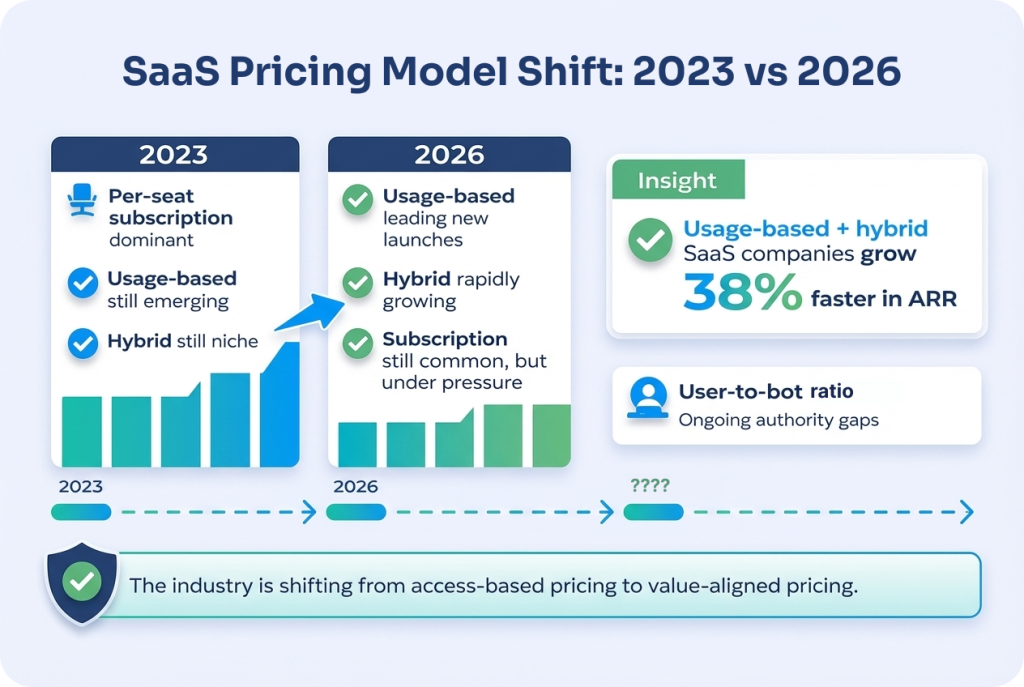
On the supply side, SaaS companies are finding that per-seat pricing does not capture the full value they deliver, particularly when AI features provide exponential value that scales with usage rather than user count.
Smart SaaS companies are adapting by tiering subscriptions based on feature access, usage caps, and AI capability levels rather than raw seat counts, allowing them to maintain subscription predictability while better aligning price with value.
Usage-Based and Consumption Models
Usage-based pricing charges customers based on actual consumption, whether that is measured in API calls, data processed, storage consumed, compute hours used, or AI queries executed.
This model has grown from 34 percent adoption among new SaaS launches in 2023 to 61 percent in 2026, making it the most popular choice for new products even though existing products predominantly remain on subscription models.
The growth of AI-powered SaaS has been a primary driver of usage-based pricing adoption.
When the marginal cost of serving a customer varies significantly based on their AI usage, with compute costs for AI inference representing a substantial portion of cost of goods sold, per-seat pricing becomes economically impractical.
Companies must charge based on consumption to maintain margins.
For the latest market data on SaaS pricing model trends and adoption rates, see our comprehensive SaaS statistics page.
CAC payback improvement: The 2025 High Alpha SaaS Benchmarks report found that companies pairing high NRR with low CAC payback nearly double their growth rates and Rule of 40 scores versus peers, and early-stage companies that switched to hybrid pricing (subscription plus usage) reported NRR in the 104–107% range, compared to seat-based peers trending below 100%.
The challenge with pure usage-based pricing is revenue unpredictability.
Monthly revenue can fluctuate 20 to 40 percent based on customer usage patterns, making financial planning difficult and creating investor uncertainty.
Companies also face the risk of customers dramatically reducing usage during economic downturns, creating revenue cliffs that subscription models are largely insulated from.
Hybrid Models and AI Credits
The fastest-growing pricing approach in 2026 is the hybrid model, which combines a base subscription fee that covers core platform access with usage-based charges for premium features, typically AI capabilities.
This structure gives customers cost predictability for foundational features while allowing the SaaS company to capture the full value of AI usage that generates returns far above the per-unit cost.
AI credit systems have emerged as a specific and increasingly popular variant of hybrid pricing.
Customers receive a monthly allocation of AI credits included in their subscription tier, with additional credits available for purchase on demand.
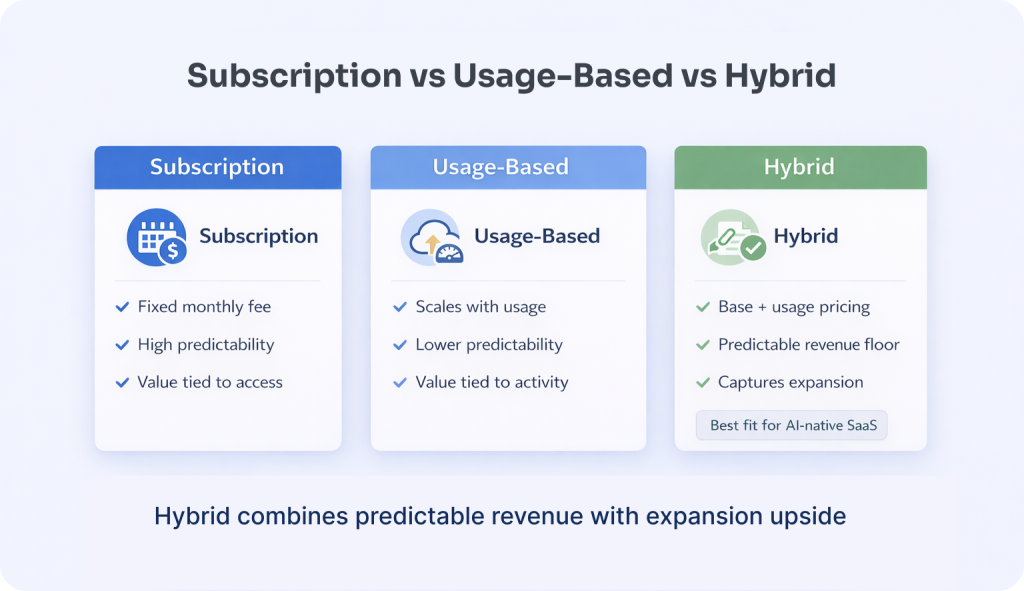
This model works effectively because it encourages AI feature adoption by giving every customer a starting allocation, creates natural expansion revenue as users consume more credits than their base allocation, maintains predictable minimum revenue through the subscription floor, and provides a clear mechanism for pricing different AI features at different credit costs based on their compute requirements and value delivered.
Freemium versus trial conversion: According to Kyle Poyar’s analysis of 1,000+ SaaS products and First Page Sage’s benchmark data from 86 companies, freemium models convert 2–5% of free users to paid, while opt-in free trials average 15–25% conversion for top performers, making trial-based acquisition significantly more efficient for products where the experience sells itself within a defined window.
Blue Tree Digital’s analysis of SaaS clients across subscription, hybrid, and usage-based models shows a clear pattern: hybrid-priced SaaS products require more sophisticated content marketing to explain pricing clearly to buyers, but convert organic traffic to trials at 28 percent higher rates when that content is supported by strong topical authority. The investment in domain authority pays outsized dividends for hybrid-model companies.
The most sophisticated hybrid models in 2026 use dynamic credit pricing that adjusts based on usage patterns, compute costs, and competitive positioning.
For example, routine AI features might cost one credit while advanced generative or analytical features cost five or ten credits, aligning pricing with both the cost to serve and the value delivered.
| Model | Revenue Predictability | NRR Potential | Best Fit |
|---|---|---|---|
| Per-Seat Subscription | High | Moderate (manual upsell) | Collaboration, CRM, project management tools |
| Usage-Based | Low-Moderate | High (automatic expansion) | API services, data platforms, AI-heavy products |
| Hybrid | Medium-High | High (floor + expansion) | Most AI-native SaaS products in 2026 |
| Outcome-Based | Low | Very High (tied to customer success) | Vertical SaaS with measurable ROI |
| Platform Fee | Low-Medium | High (scales with customer GMV) | Fintech, marketplace, e-commerce SaaS |
Emerging Models Like Outcome-Based and Platform Fees
Two newer pricing models are gaining traction in specialised segments of the SaaS market.
Outcome-based pricing ties the subscription cost to measurable business outcomes that the software helps achieve.
For example, an AI-powered sales tool might charge based on pipeline generated or deals closed rather than seats used.
This model is most common in vertical SaaS where outcomes are clearly measurable and directly attributable to the software.
Platform fee models charge a percentage of transactions processed through the platform, common in fintech SaaS, marketplace software, and e-commerce tools.
These models align vendor incentives directly with customer success because revenue only grows when the customer’s business grows, creating powerful retention dynamics.
When evaluating which pricing model to adopt for a new SaaS product, ask: does my product’s value scale linearly with usage or with business outcomes? If usage scales value, usage-based or hybrid models are the most defensible choice. If measurable business outcomes are directly attributable to the software, outcome-based models command premium pricing and generate exceptional NPS. Start simple and evolve toward complexity as product maturity and customer data justify it.
Choosing the Right Model for Growth
The best pricing model depends on your product’s value delivery pattern, competitive landscape, and growth stage.
Products where value scales linearly with usage, like data platforms, API services, and AI-powered tools, are natural fits for consumption or hybrid pricing.
Products where value is derived from access to a collaborative platform, like project management, CRM, or communication tools, often work better with subscription or tiered subscription models.
Early-stage SaaS companies should prioritise simplicity and revenue predictability, typically starting with a straightforward subscription model that can evolve toward hybrid pricing as the product matures and AI features are added.
Complex pricing models create friction in the sales process and can confuse customers who are evaluating your product against simpler-priced alternatives.
Regardless of pricing model, SaaS growth requires organic visibility.
Building a strong backlink profile remains one of the most effective long-term growth strategies for SaaS companies, driving qualified organic traffic that converts at rates two to three times higher than paid channels.
Our guide on link building for startups explains how early-stage SaaS companies can begin building domain authority efficiently even with limited marketing budgets.
How to Choose the Right SaaS Business Model for Your Stage and Market
The choice of business model is one of the highest-leverage decisions a SaaS founder makes.
It shapes not just revenue mechanics but product development priorities, go-to-market strategy, customer success requirements, and the content and SEO strategy needed to acquire the right buyers.
The most common mistake in business model selection is optimising for simplicity and early revenue predictability at the expense of long-term NRR potential.
Per-seat subscription models are easy to explain, easy to forecast, and administratively simple to manage.
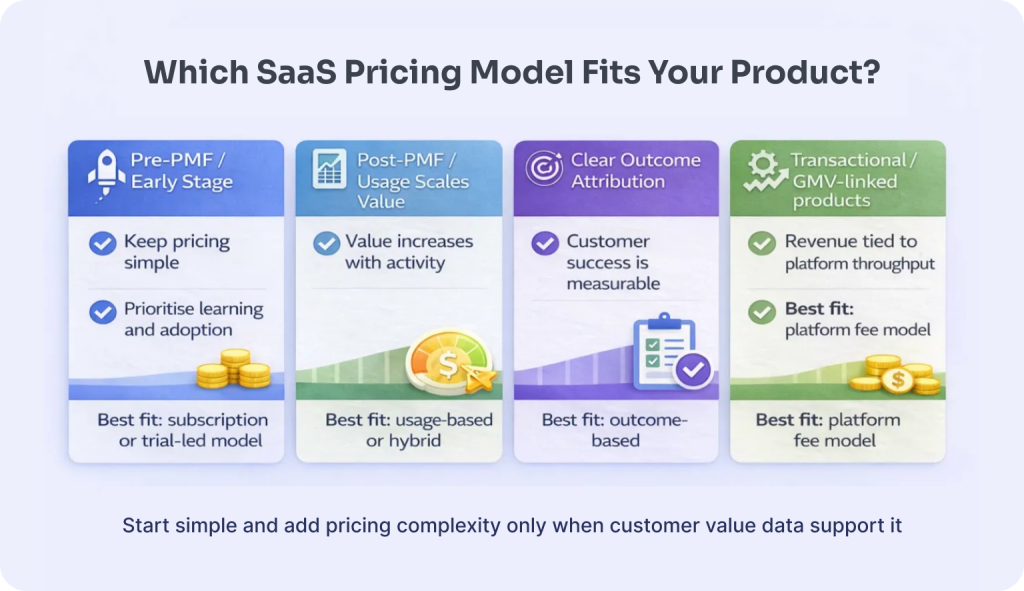
They are also structurally limited in their ability to capture full product value as usage deepens.
That structural ceiling is why NRR for pure per-seat SaaS averages 8 to 12 percentage points lower than equivalently performing products on usage-based or hybrid models.
The right starting point for model selection is the unit economics of your value delivery. Ask: does the value my customer receives scale with usage, seat count, or outcomes?
If a customer using your product more intensively derives proportionally more value, usage-based pricing aligns price with delivery and captures expansion revenue naturally.
Where value is relatively uniform across users, per-seat or per-account pricing is the more appropriate model.
If value is tied to measurable business outcomes (revenue generated, costs reduced, conversions improved), outcome-based pricing may be achievable but requires robust attribution infrastructure to implement credibly.
Pre-product-market-fit startups should generally default to the simplest pricing model their market will accept, not the most sophisticated one.
Freemium and simple subscription models accelerate user acquisition and product learning in the early stage, where understanding customer behaviour matters more than optimising margin.
Variable revenue and customer-facing credit systems add operational overhead that can distract from the core product development work needed to find PMF.
Post-PMF, the business model evolution playbook is well established: start simple, then layer in usage-based components as you identify the product activities most correlated with customer value and retention.
Slack started with per-seat pricing and added usage-based billing for enterprise features over time.
HubSpot began with subscription tiers and progressively introduced contact-count-based pricing as its value proposition became clearer. In both cases, the model evolution followed a deepening understanding of how customers derive value, not a theoretical preference for one model over another.
The marketing implications of business model choice are underappreciated by most SaaS operators.
Usage-based products require different top-of-funnel content than subscription products: buyers need to understand not just what the product does but how their usage patterns will translate into costs.
That makes clear, specific educational content and comparison guides essential for usage-based products.
Those content assets require strong topical authority, built through SaaS link acquisition and domain expertise, to rank in competitive search environments where buyers are actively researching pricing before making contact.
Contextual links embedded in high-authority editorial content are particularly effective for usage-based SaaS. They intercept buyers at the exact moment they are evaluating pricing models and competitive alternatives.
A single well-placed editorial mention on a relevant publication can deliver both referral intent and compounding domain authority.
Pure subscription products can often achieve this with simpler content strategies, but usage-based and hybrid products need to engineer it deliberately.
Hybrid models (combining a subscription base with usage-based premium features) represent the best of both structures for most mid-market SaaS companies in 2026.
They provide the revenue predictability that investors and finance teams require while capturing the expansion revenue opportunity that pure subscription models leave on the table.
Modern billing infrastructure platforms have significantly reduced the operational complexity of hybrid billing, making this model accessible to companies well below the enterprise threshold where it was previously practical.
SEO strategy follows the same logic. Hybrid products need content that serves two distinct buyer intents: the subscription buyer evaluating tier value, and the power user or enterprise buyer assessing usage costs at scale.
Building topical authority across both content clusters, and earning links that signal relevance to both, is the content infrastructure challenge that separates SaaS companies with compounding organic growth from those stuck on a content treadmill.





 Start the conversation