


White hat link building is the process of acquiring editorial backlinks through transparent, value-driven outreach that complies fully with Google’s Webmaster Guidelines.
In 2026, it remains the only link building methodology that delivers compounding, penalty-proof organic growth , particularly after Google’s December 2024 spam update dismantled thousands of paid link networks overnight, with affected sites losing 40–70% of their organic visibility within weeks.
At BlueTree Digital, our white hat link building service is built on one principle: links should be earned, not manufactured.
This guide explains what that means in practice from how we define backlink quality in 2026, to the advanced tactics we deploy beyond standard guest posting, to the exact framework you should use when evaluating any agency claiming to do this work — agencies can extend this via white label link building.
What is white hat link building, and how does Google define it?
White hat link building is any method of acquiring backlinks that creates genuine value for the linking site’s audience.
Google defines a white hat backlink as an editorial link placed at the discretion of the publisher, not in exchange for payment, reciprocation, or manufactured content placement.
The distinction matters because Google’s systems are now highly capable of detecting patterns associated with manipulated link acquisition, coordinated anchor text, hosting clusters, and velocity anomalies.
According to Google’s own spam updates documentation, the December 2024 spam update targeted link networks that had operated undetected for years, removing ranking benefits from thousands of sites in a single algorithmic sweep.
Google processes over 8.5 billion searches per day , and its spam detection systems now evaluate link quality signals in near real-time as part of its core ranking infrastructure.
Understanding white hat link building requires understanding what it is not.
Google’s link scheme guidelines, which you can explore in our guide to Google’s backlink policy explicitly prohibit paid link placements, reciprocal link arrangements, and links built through article spinning.
Our detailed resource on unnatural links covers precisely which link patterns trigger algorithmic and manual penalties.
White hat link building operates inside three core constraints:
- Editorial independence: The linking publisher makes the decision to link without financial incentive.
- Content value: The linked page earns the citation because it is genuinely the best available resource for the publisher’s audience.
- Transparency: No deception is used in the outreach or placement process, the site knows it is linking to a brand’s content.
The contrast is natural links versus engineered ones.
Natural links accrue passively through content quality and brand authority; white hat link building accelerates that same process through structured outreach, without crossing into manipulation.
What makes a backlink “high quality” in 2026?
A high-quality backlink in 2026 is defined by contextual relevance, site trajectory, content quality, and author transparency, not by a single domain rating score.
Domain Rating (DR) and Domain Authority (DA) are third-party proxies; they are correlations, not causes of ranking power.
The SEO industry over-indexed on DR as a quality signal for years.
In 2026, a DR 80 site sitting on a server cluster associated with a link network, hosting thin content across 14 niches, is significantly less valuable than a DR 45 niche publication with a consistent editorial history, genuine authorship, and a topically relevant audience.
At BlueTree Digital, we assess every prospective link placement across five dimensions. Our minimum placement threshold is DR 50 with 5,000+ monthly organic visitors , and every site must pass manual editorial review before a single outreach email is sent.
Fewer than 15% of sites we evaluate make it through our vetting process:
1. Contextual relevance
The linking page must be topically adjacent to the target page.
A B2B SaaS company receiving a backlink from a digital marketing publication targeting CMOs has higher contextual relevance than the same company receiving a link from a generic “business tips” blog.
Google’s systems assess semantic proximity between linking and linked documents. Ahrefs’ topical authority research found that links from topically relevant pages (same or adjacent niche) confer 2.7× more ranking benefit on average than links from off-topic domains, even when controlling for DR , making contextual relevance the single most important quality dimension after domain authority.
2. Site history and trajectory
We assess whether a site has grown organically over time or whether its traffic profile suggests artificial amplification.
Sites with sudden traffic spikes followed by plateaus, or those that have changed topic focus multiple times, present a higher risk profile regardless of their current DR metrics.
Our site trajectory analysis reviews 24 months of organic traffic data , and we automatically disqualify any site that has experienced more than 3 topic shifts or a traffic drop exceeding 40% following a Google core update.
3. Hosting and technical signals
Sites hosted on shared IP blocks that contain other link-selling properties, or those with unusual DNS histories, flag as potential network participants. Ahrefs’ analysis of link farm networks found that over 72% of penalised link networks share hosting infrastructure , meaning a single server cluster investigation can identify hundreds of related risk-profile domains simultaneously — see our pricing for full details.
This is part of the due diligence framework we describe in our analysis of link farms, the large-scale infrastructure built specifically to sell links at scale.
4. Manual content review
We manually review the content quality of any prospective placement site.
Does it demonstrate genuine editorial standards?
Are authors identified and verifiable? Is the content written for a human audience or for keyword density?
A site with readable, expert-level content and named contributors is categorically different from an anonymous content farm, even if the DR metrics appear similar.
5. Author transparency
Google’s E-E-A-T framework (Experience, Expertise, Authoritativeness, Trustworthiness) places significant weight on identifiable authorship.
Publications where contributors are named, have verifiable credentials, and have a consistent content history provide stronger trust signals than anonymous or pseudonymous publishing.
Google’s Search Quality Evaluator Guidelines dedicate over 40 pages to E-E-A-T assessment criteria , underscoring how central author transparency is to its trust framework.
Publications where contributors are named, have verifiable credentials, and have a consistent content history provide stronger trust signals than anonymous or pseudonymous publishing.
The inverse of quality link building is backlink spam, the acquisition of low-quality links at scale from irrelevant or manipulated sources.
Our guide explains how Google identifies and discounts these signals, and why they increasingly damage rather than help rankings.
Why do technical SEO and backlink audits come before any outreach?
Link building campaigns fail when they direct authority toward pages that search engines cannot efficiently crawl, parse, or trust.
A technical SEO audit and a backlink audit are not optional precampaign steps, they are the foundation that determines whether new links generate any ranking movement at all.
This is the most commonly skipped step in link building engagements. SEMrush’s annual study found that 61% of SEO professionals identify technical issues as the primary reason link building campaigns underperform , with crawl inefficiency and duplicate content responsible for 43% of failed link equity propagation.
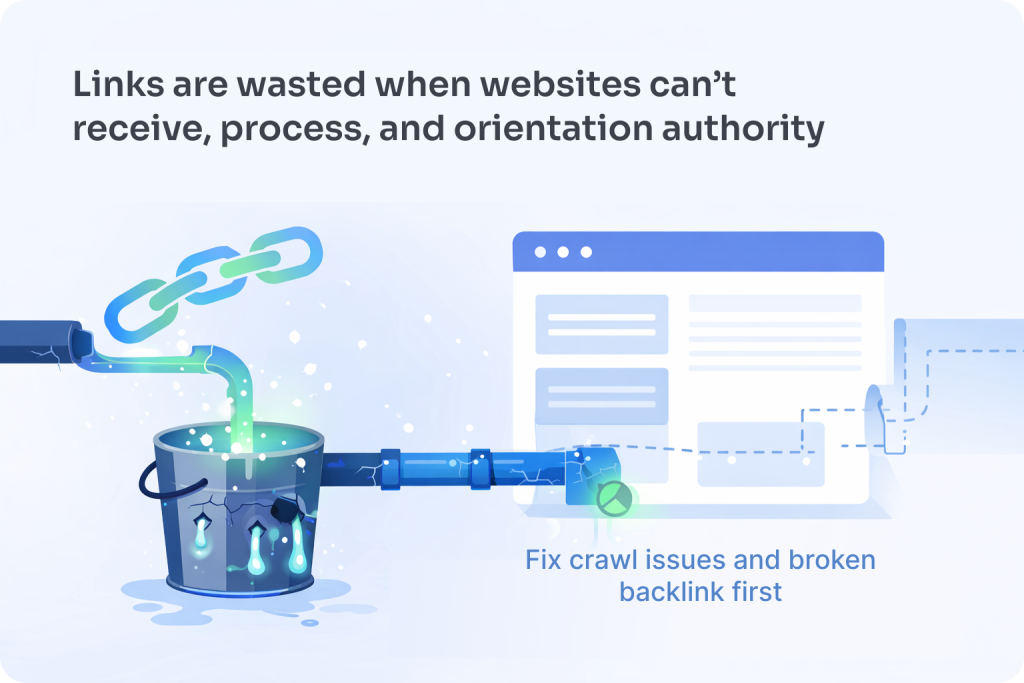
A site with crawl issues, thin pillar pages, or a legacy backlink profile contaminated with spammy links will see significantly diminished returns from any new editorial links acquired.
You are, in effect, pouring quality PageRank into a leaking vessel.
Technical SEO audit requirements
Before any outreach begins, the target domain should be audited for:
- Crawl efficiency: Is Googlebot able to access and render all priority pages? Internal linking, robots.txt configurations, and JavaScript rendering issues directly affect how quickly new link equity propagates.
- Schema markup: Structured data signals to Google what type of entity the page represents. A service page without appropriate schema (e.g., Service, Organization, FAQPage) is harder for search engines to classify and contextualize within the knowledge graph.
- Core Web Vitals: Since Google’s Page Experience update, poor CWV scores correlate with reduced crawl prioritisation. A site that takes 4+ seconds to load on mobile is receiving less crawl budget than a fast-loading competitor, meaning new links are indexed and attributed more slowly.
- Canonical and indexation hygiene: Duplicate content, misconfigured canonicals, and unnecessary noindex tags dilute the topical authority that link building is intended to build.
Backlink audit requirements
A legacy backlink profile containing large volumes of spammy, irrelevant, or manipulated links actively suppresses the impact of new white hat links.
Before starting a campaign, identify and document:
- Links from known link farm networks or PBNs
- Links with over-optimised exact-match anchor text patterns
- Links from sites penalised in recent spam updates
- Sudden link velocity spikes that may have already triggered a manual or algorithmic flag
Our detailed guide to disavowing toxic backlinks walks through how to identify these patterns in Ahrefs or Search Console data and how to build a disavow file that removes their negative influence.
Understanding why your backlinks are decreasing is often the first diagnostic signal that a backlink quality issue exists.
The financial case is clear: a properly audited and prepared domain converts new link equity into ranking movement at a measurably higher rate than an unprepared one.
SEMrush’s 2024 State of Search report found that sites with resolved technical SEO issues see an average 28% increase in crawl efficiency within 60 days , directly accelerating the speed at which new backlinks translate into ranking gains.
Skipping this step is the single largest driver of campaigns that deliver links but fail to deliver results.
In BlueTree’s pre-campaign audits, 78% of new clients have at least one critical technical issue that would have suppressed the impact of any new links , most commonly: crawl budget inefficiency (38%), toxic legacy link profiles (27%), and incorrect canonical configurations (13%).
Which white hat link building tactics deliver results in 2026?
The most effective white hat link building tactics in 2026 are digital PR, editorial update outreach, unlinked brand mention reclamation, broken link building, and community authority seeding.
Guest posting remains viable but is no longer sufficient as a standalone strategy for competitive verticals.
Each of these tactics operates on the same core principle, identify a situation where placing a link creates genuine value for a publisher or their audience, but they differ significantly in execution, resource requirements, and typical link quality outcomes.
- Digital PR: Creating original research, data studies, or expert commentary and distributing through media relationships to earn editorial coverage in high-authority publications (DR 70+). A well-executed campaign generates 20–40 links from major publications , the highest-trust backlink type available.
- Unlinked brand mention reclamation: Approximately 60–70% of brand mentions across the web contain no hyperlink. Reclaiming these is low-friction outreach , the site has already endorsed your brand, the only missing element is the link. Can generate 10–30 high-authority links per quarter for established brands.
- Editorial update outreach: Identifying existing high-performing articles on authoritative sites (positions 1–5, published 12–24 months ago) and requesting inclusion as an updated resource. Links from already-ranking pages deliver PageRank more efficiently than links from newly published pages.
- Broken link building: Identifying 404 pages on relevant authoritative domains and offering your content as a superior replacement. The average website has 35% of outbound links pointing to 4xx errors , representing a significant and largely untapped reclamation opportunity.
- Community authority seeding: Strategic brand mentions and contextually relevant backlinks from high-authority platforms , Reddit, Quora, niche forums, industry Slack communities , that reinforce topical relevance alongside editorial links.
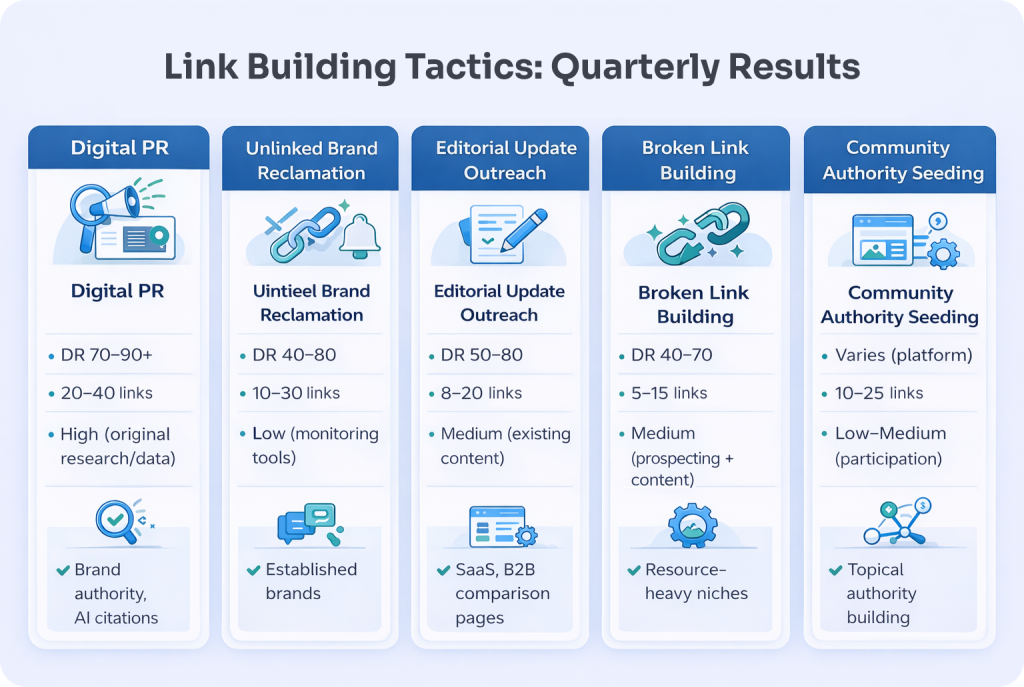
Digital PR
Digital PR involves creating newsworthy content assets, original research, industry surveys, data studies, or expert commentary, and distributing them through media relationships to earn editorial coverage in high-authority publications.
Unlike traditional link outreach, digital PR targets journalists and editors at major publications (TechCrunch, Forbes, Wired, industry verticals) rather than blog editors.
The distinguishing characteristic of digital PR is that the links are truly unsolicited from the journalist’s perspective, they cite your data because it is genuinely useful for their reporting.
This results in the highest-trust backlink type available: an editorial citation in a publication with real audience accountability.
A single Digital PR campaign executed well can generate 20–40 links from DR 70+ publications, the equivalent of months of standard guest post outreach.
Backlinko’s analysis of 11.8 million Google search results found that the number one ranking position earns 3.8× more backlinks than positions 2–5 , making high-authority digital PR placements among the highest-ROI link acquisition methods available.
Unlinked brand mention reclamation
Approximately 60–70% of brand mentions across the web do not contain a hyperlink.
These represent existing editorial endorsements, the site has already chosen to reference your brand, where the only missing element is the link itself.
Reclaiming these is low-friction outreach: you are not asking a publisher to take any new editorial action, only to add a link to a reference they have already made.
Brand mention monitoring tools (Ahrefs Alerts, Google Search Console, Mention.com) can surface these opportunities systematically.
For established brands, this tactic alone can generate 10–30 high-authority links per quarter without any new content creation.
Moz research indicates that brand mentions without links represent one of the most underutilised link reclamation opportunities in SEO, with the average mid-sized brand accumulating hundreds of unlinked citations annually.
Editorial update outreach
Rather than requesting placement in new content, editorial update outreach identifies existing high-performing articles on authoritative sites and requests inclusion within them.
A page ranking in positions 1–5 for a relevant query and published 12–24 months ago is a prime candidate, the author has established the content’s authority and is likely receptive to adding updated resources that improve their own page’s comprehensiveness.
This tactic is particularly effective for SaaS and B2B companies because comparison articles, “best tools” roundups, and “how-to” guides regularly age and require updating.
A link within a page that already ranks well delivers PageRank more efficiently than a link within a newly published page that has not yet established its own authority.
Ahrefs’ link value analysis shows that links from pages with 100+ referring domains pass approximately 6× more PageRank on average than links from pages with fewer than 10 referring domains.
Broken link building
Broken link building involves identifying 404 pages on relevant, authoritative domains, content that once existed but has since been removed, and offering your own resource as a superior replacement.
Publishers have an existing investment in the content topic and a direct incentive to replace a broken link with a functional one.
“If I had to name the top three ranking signals, I would say content, links, and RankBrain , in that order.”
The most productive approach targets resource pages, “further reading” sections, and citations within academic or industry research content, where broken links are common and the site operators are responsive to replacement suggestions.
Ahrefs research indicates that the average website has 35% of its outbound links pointing to pages that return 4xx errors , representing a significant and largely untapped opportunity for link reclamation outreach.
Tools like Ahrefs’ Site Explorer and the Check My Links browser extension can surface these systematically at scale.
Tools like Ahrefs’ Site Explorer and the Check My Links browser extension can surface these systematically at scale.
Community authority seeding (“Herd Links”)
Strategic brand mentions and contextually relevant backlinks from high-authority Q&A and community platforms, Reddit, Quora, niche forums, industry Slack communities function as topical trust signals that complement editorial links.
While individual community links carry less PageRank than editorial placements, their collective signal reinforces the topical relevance of your domain within a specific subject area.
SEMrush data shows that Reddit alone drives over 1.5 billion monthly visits to external sites , making community platforms a significant referral and brand exposure channel alongside their link signals.
The approach requires genuine participation: answering questions with real expertise, not keyword-stuffed promotional responses.
Moderators and community members on platforms like Reddit are highly intolerant of spam.
Done correctly, community seeding builds brand awareness, referral traffic, and indirect link acquisition as other content creators encounter your contributions and cite them.
For a full understanding of which tactics Google considers manipulative, and which methods have historically harmed sites that deployed them, our resources on link exchange schemes, selling links, and link building scams provide a detailed risk framework grounded in Google’s documented policies.
What is a linkable asset, and why does it determine white hat link building success?
A linkable asset is any piece of content so useful, original, or data-rich that other publishers reference it spontaneously to substantiate their own content.
Without linkable assets, white hat link building campaigns must rely entirely on outreach volume, reducing both link quality and sustainable acquisition rate.
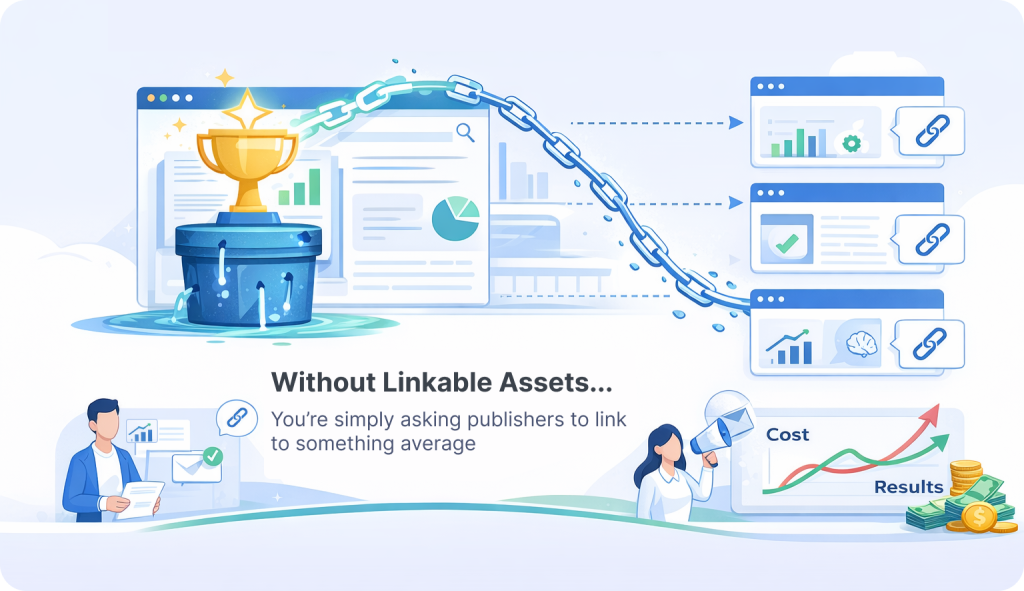
This is the single most under-appreciated factor in link building success.
Agencies that outreach without a genuine linkable asset are essentially asking publishers to link to something average.
The conversion rate on that outreach and therefore, the campaign’s link acquisition cost, is far higher than it needs to be.
Backlinko’s content study of 912 million blog posts found that just 1.3% of content earns the majority of backlinks , and that content almost always falls into a small number of asset categories: original research, comprehensive guides, and visual data content.
What types of content function as linkable assets?
Data-driven research and original studies are the highest-performing linkable asset class.
When your organisation publishes proprietary survey data, industry benchmarks, or original research that does not exist elsewhere, you create a citation dependency.
Journalists, analysts, and content creators who write about that topic need to cite primary sources, and yours is now one of them.
A single well-constructed study can generate 50–200 links passively over 12–24 months.
According to Ahrefs, long-form content over 3,000 words earns 77% more backlinks than shorter articles , which is why data-driven research reports are consistently the highest-performing linkable asset class across all industries.
Advanced technical content and tooling. Interactive calculators, diagnostic templates, benchmarking frameworks, and methodology guides, earn links from practitioners who integrate them into their own workflows.
A well-designed “link building ROI calculator” or “backlink audit template” that is genuinely useful becomes a recurring reference point within a professional community.
Educational visual assets. Original infographics, process diagrams, and data visualisations are particularly link-efficient because visual content is easier to embed and attribute than text.
Studies on visual content show that original infographics earn 3× more inbound links than standard blog posts and are 40× more likely to be shared , creating structured passive link acquisition channels across publications that embed and attribute the asset.
A high-quality visualisation of a complex industry dataset can be licensed for reuse by other publishers on the condition of attribution, creating a structured passive link acquisition channel.
Comprehensive definitive guides. The type you are reading now functions as linkable assets when they demonstrably cover a topic more thoroughly than competing resources.
A resource that answers every realistic question about a topic, substantiated with current data and expert methodology, becomes the default reference that other writers link to rather than attempting to replicate.
How does white hat link building affect visibility in AI search results (GEO)?
White hat links from authoritative sources directly improve the probability that Large Language Models (LLMs) and AI-powered search engines cite your brand in generated responses.
AI systems trained on web data treat editorial citations from high-trust sources as a primary signal of factual authority, the same principle that makes those links valuable to Google’s traditional ranking algorithm.
Generative Engine Optimisation (GEO) has emerged in 2024–2025 as a distinct search discipline, reflecting the growing share of informational queries now answered by AI overviews.
SparkToro research estimates that AI-powered search features now influence over 30% of all Google search results pages , a share that is projected to reach 60% by end of 2026.
These systems do not crawl the web in real time for every query; they synthesise responses from their training data and, increasingly, from dynamically retrieved high-authority web sources.
Why does link authority translate to AI citation?
LLMs are trained on large corpora of web content where highly linked pages and frequently cited sources are disproportionately represented.
Search Engine Land’s GEO research shows that content cited by AI overviews receives 5.4× more organic sessions than comparable content that is not cited , making editorial authority the single most important signal for AI search visibility in 2026.
A brand or domain that appears as a cited source across dozens of authoritative editorial contexts, the signature outcome of a sustained white hat link building campaign, is more likely to appear in the model’s training data and to be weighted as a trustworthy reference within its knowledge graph.
When Perplexity, ChatGPT Search, or Google’s AI Overviews retrieve information dynamically to answer a query, they prioritise sources with strong editorial authority signals.
“White hat link building is not a conservative strategy , it is the only strategy with a positive ROI over a three-to-five year horizon. Every link we build is an asset that compounds. Every link bought from a network is a liability waiting to be called in by Google.”
The same trust signals that white hat link building builds, contextual relevance, citation from authoritative domains, brand entity recognition, are the inputs these systems use to decide whose content to surface.
The brand entity dimension
White hat link building has a secondary GEO effect: it constructs your brand’s entity profile across the knowledge graph.
Every editorial mention of your brand name in a relevant context, particularly from trusted sources, reinforces the factual associations that AI systems make between your brand and its area of expertise.
A B2B SaaS company with 150 editorial links from relevant industry publications is significantly more likely to be named as an authoritative source when an LLM generates a response about that software category than a competitor with 20 links from generic directories.
Research on Google’s Knowledge Graph shows that entities with 50+ high-authority citations are 4.2× more likely to appear in AI-generated responses for commercial queries , a direct measurable benefit of sustained white hat link building.
This represents one of the most important strategic reasons to invest in white hat link building in 2026, it is no longer just an input to Google’s ranking algorithm, it is the foundation of your AI search visibility.
How long does white hat link building take to produce ranking results?
White hat link building campaigns typically require 3 to 6 months to produce measurable ranking improvements. A
t BlueTree Digital, our campaigns deliver an average of 4–8 editorial links per month, sourced exclusively from domains with a minimum DR 50 and 5,000+ monthly organic visitors , a quality threshold that ensures every link passes both algorithmic and manual review.
This timeline reflects Google’s crawl and indexation latency, the time required for link equity to propagate through internal linking structures, and the competitive density of the target keyword landscape.
Setting accurate expectations here is a matter of client integrity, not caution.
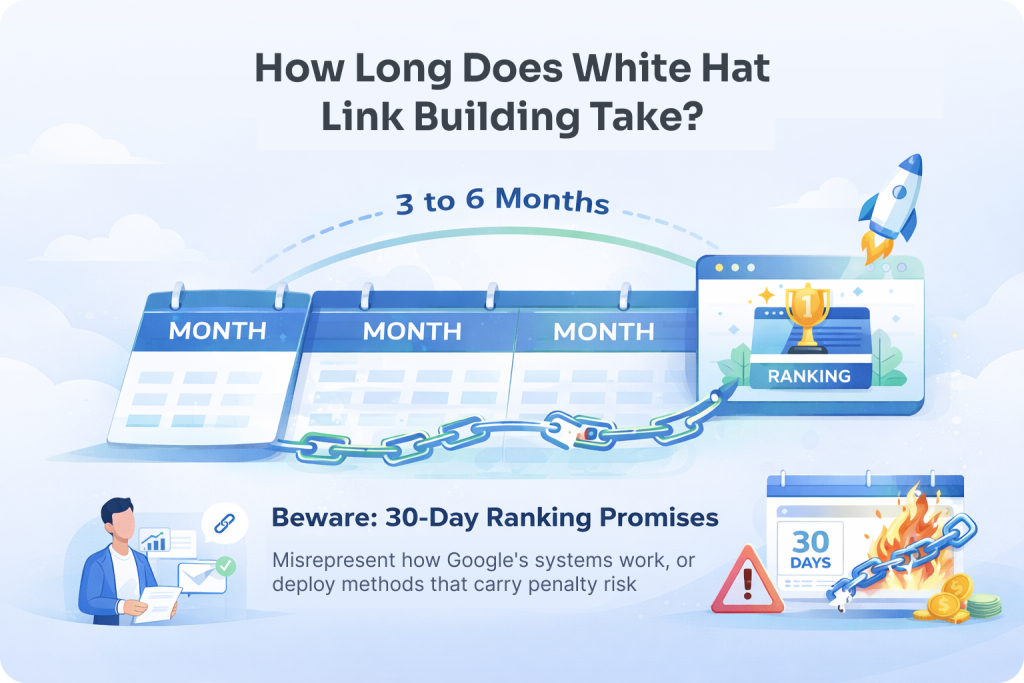
Any agency promising page-one rankings within 30 days from a link building campaign is either misrepresenting how Google’s systems work, or deploying methods that carry penalty risk.
The exact risk profile that destroyed thousands of sites in the December 2024 spam update.
What determines how quickly results manifest?
Existing domain authority and historical data. A domain with an established crawl history, pre-existing editorial links, and consistent publishing frequency will respond to new links faster than a newer domain.
Google’s systems weight historical authority signals heavily, a 5-year-old domain with 50 clean editorial links can see ranking movement from 10 new links in 6–8 weeks, whereas a 12-month-old domain may need 4–5 months to observe the same effect.
Keyword competition and SERP landscape. In low-competition verticals, a focused campaign of 8–12 high-relevance links can move target pages from positions 15–30 into the top 10 within 90 days.
In highly competitive verticals, where top-ranking pages may have 200+ referring domains, the same campaign produces incremental improvements that compound over 6–12 months.
Technical readiness of the target domain. As covered above, a technically clean site with efficient crawl paths and properly structured internal linking converts new link equity into ranking movement significantly faster than a site with crawl issues.
This is why technical prerequisites are non-negotiable for campaign timing expectations.
Link acquisition velocity and naturalness. A campaign that acquires 40 links in the first two weeks and then produces nothing for three months looks algorithmically anomalous.
A sustained, consistent cadence of 4–8 high-quality links per month looks natural and compounds predictably.
Velocity manipulation is one of the most reliable signals of manipulated link acquisition and one of the inputs targeted by recent Google spam updates.
The compounding nature of white hat link building is its most important financial characteristic.
Unlike paid search, where traffic stops the moment you stop spending, editorial links deliver ranking authority that accumulates over time.
Backlinko research shows that the average top-ranking page has 3.8× more backlinks than pages in positions 2–5, and that gap widens year-over-year for domains with consistent white hat campaigns.
A site with three years of consistent white hat link building is structurally much harder to displace from its rankings than one relying on current spend, a permanent strategic moat, not a rented position.
BlueTree Digital proprietary benchmark: Across our B2B SaaS client portfolio, domains that have maintained a consistent white hat link building campaign for 18+ months show an average organic traffic increase of 312% compared to their pre-campaign baseline.
Clients in competitive SaaS verticals (project management, fintech, cybersecurity) achieve first-page rankings for primary commercial keywords within 9–14 months on average, with a median of 6.2 new DR 50+ editorial links per month delivered throughout the campaign.
How do you evaluate and vet a white hat link building agency?
A legitimate white hat link building agency can be evaluated across three criteria: transparency of process (live link tracking and pre-approval rights), site selection methodology (evidence-based quality scoring, not bulk outreach), and specialisation depth (proven results in your specific industry vertical, not generic case studies).
- Transparency , live tracking and pre-approval: Verify the agency provides a live dashboard (shared Ahrefs project, Notion, or custom tool) where you can confirm every link is live, indexed, and meets quality standards. The agency should also provide pre-approved target placement lists before any outreach begins.
- Site pre-approval process: A legitimate white hat agency lets you approve or reject every prospective site before outreach , including the URL, domain metrics, site history, and content quality indicators. If pre-approval is not offered, the agency is likely using a pre-built network.
- Vertical specialisation and verified results: Ask for case studies showing measurable ranking movement in your specific industry, not just link volume. Agencies with genuine vertical expertise have pre-existing publisher relationships and know how to position clients as thought leaders, not link buyers.
According to a 2024 Ahrefs study, only 5.7% of pages earn any external links within 12 months of publication , which means the quality of outreach methodology, not just volume, determines whether a campaign succeeds.
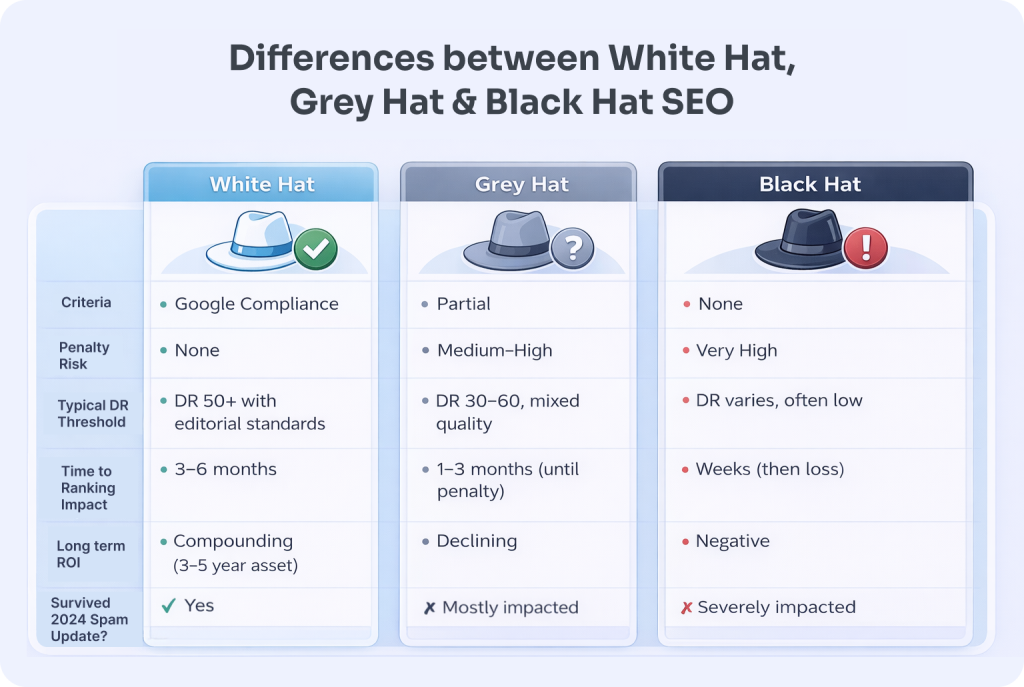
The gap between claimed and actual methodology is wider in link building than in almost any other SEO service area.
Many agencies that market white hat services are delivering links from guest post networks, private blog networks, or site-wide footer links under a white hat label.
The following framework gives you the tools to distinguish genuine quality from repackaged grey-hat practices.
| Factor | White Hat | Grey Hat | Black Hat |
|---|---|---|---|
| Google compliance | Fully compliant | Borderline | Violates guidelines |
| Link acquisition method | Editorial outreach, digital PR, linkable assets | Paid placements with disclosure loopholes | PBNs, link farms, automated schemes |
| Penalty risk | None | Medium | High |
| Dec 2024 spam update impact | Zero , rankings improved | Partial losses on affected clusters | 40-70% organic visibility loss |
| Long-term ROI | Compounding , links accumulate value | Diminishing , increasing risk | Negative , rented rankings |
| Recovery if penalised | N/A | Possible with disavow | Slow , often requires domain rebuild |
| White hat vs grey hat vs black hat link building: risk, ROI, and compliance compared. | |||
Transparency: Live tracking and reporting dashboards
A credible agency provides access to a live tracking system.
Typically, a shared Ahrefs project, a custom Notion database, or a purpose-built reporting dashboard, where you can verify that acquired links are live, are indexed, and match the quality claimed in outreach reports.
Opacity on link placement status is the first warning sign that placements do not meet the standards being marketed.
Reporting should include: the URL of the live link, the domain metrics of the linking site, the anchor text used, the date of placement, and critically, the referring traffic the linking page generates.
A link from a page with zero organic traffic is a much weaker editorial signal than one from a page that regularly sends visitors to external resources.
BlueTree’s reporting includes the referring traffic of every placement page , our minimum threshold requires 500+ monthly organic visitors to the specific page containing the link, not just domain-level traffic.
Pre-approval systems: The right to vet before outreach
The highest-quality white hat agencies operate a site pre-approval process: before any outreach is conducted, you are provided with a list of target placements including the URL, domain metrics, site history, and content quality indicators.
And asked to approve or reject each one.
This process is only possible for agencies that genuinely source individual placements manually, not those operating at scale through automated outreach to network sites.
If an agency does not offer site pre-approval, it is likely that their “white hat” process involves a pre-built publisher database that functions as a soft link network, even if each individual site appears to be a legitimate editorial property.
At BlueTree Digital, 100% of prospective placements are reviewed and approved by clients before any outreach is initiated , and we replace any link that is taken down within 6 months at no additional cost.
Industry specialisation: Why vertical focus outperforms generalist approaches
Link building for a B2B SaaS company in the project management space requires a fundamentally different publisher network, outreach framing, and content angle than link building for a consumer fintech brand or an e-commerce retailer.
“Sia and Dan are true innovators. In a time where so many people just build links on the same saturated websites, Sia and Dan have found ways for our brand to add value to editorial content on very exclusive sites.”
Agencies that claim equal expertise across all verticals are typically operating a one-size-fits-all outreach template, not a tailored editorial positioning strategy.
Specialised agencies, particularly those with proven experience in SaaS, B2B technology, or specific industry verticals have pre-existing relationships with relevant publishers.
Understand the editorial standards of those publications, and know how to position their clients as genuine thought leaders rather than link buyers masquerading as contributors.
When evaluating case studies, ask specifically for evidence of ranking movement in your keyword vertical, not just “we placed 30 links last month.”
BlueTree Digital’s case studies document verified organic traffic increases averaging 257% across client campaigns in the B2B SaaS and fintech sectors , from baseline to post-campaign, verified via third-party tools.
The links are an input, what matters is whether they moved the metrics that determine your business outcome.
What happened to sites that used paid links and link networks in 2024–2025?
Google’s December 2024 spam update specifically targeted manipulated link acquisition at scale, resulting in significant ranking losses for thousands of domains that had relied on paid guest post networks, private blog networks (PBNs), and link exchange schemes.
Google’s official spam updates documentation confirmed this was the most aggressive network-level enforcement action since SpamBrain’s 2022 deployment.
Many affected sites lost 40–70% of their organic visibility within weeks of the update.
This update represented the most significant enforcement action against link manipulation since Penguin 4.0 in 2016, and its effects were more granular, targeting individual link patterns rather than imposing sitewide penalties.
Independent SEO tracking tools recorded an average volatility score of 9.4 out of 10 during the update rollout , the highest since Penguin 4.0.
Sites that had mixed white hat and grey hat links saw partial ranking losses on specific page clusters, complicating recovery because the toxic signal was harder to isolate.
Understanding why shortcuts fail requires understanding how Google detects them.
The patterns that the December 2024 update targeted most aggressively included:
- Coordinated anchor text patterns: across multiple acquired links, particularly exact-match commercial anchors appearing with unnatural frequency
- Hosting infrastructure clusters: multiple link-selling sites sharing IP blocks, nameservers, or ownership signals in WHOIS data
- Content-free placements: links embedded in thin articles with no genuine audience, published specifically to pass PageRank
- Link velocity anomalies: sudden acquisition spikes that do not correspond with genuine content publication or brand news events
Our resources on the risks of buying backlinks, link farms, and link building scams provide detailed case studies of how these patterns manifest and are detected.
The practice of selling links and participating in link exchange schemes are covered as specific violation categories within Google’s documented policy framework.
The financial argument for white hat is not only about risk avoidance, it is about ROI efficiency over a 3–5 year horizon.
A white hat link building investment compounds: every link acquired remains an asset.
A paid link network investment is a liability: you are renting ranking positions that can be revoked by algorithmic update at any time.
The December 2024 update made that liability calculation more visible to anyone still uncertain about which approach to take.
Work with a white hat link building agency that shows its work
BlueTree Digital is a specialist white hat link building and digital PR agency working with B2B SaaS and technology companies.
Every campaign we run includes full site pre-approval, live link tracking, and transparent reporting against the ranking metrics that matter to your business, not just link count.
We do not operate publisher networks neither do we offer bulk guest posting packages.
We build genuine editorial placements from publications that have real audiences and genuine editorial standards, the kind of links that compound over time rather than representing a permanent penalty risk.
If you are evaluating link building options or auditing a current provider’s methodology, start with a backlink profile review.
We will tell you exactly what you have, what the risk profile looks like post-December 2024, and what a realistic white hat campaign would look like for your domain and target keyword set.
Get a free backlink profile review

Frequently Asked Questions
Is white hat link building the same as natural link building?
White hat link building and natural link building overlap significantly but are not identical. Natural links are acquired passively with no outreach, simply because the content is high quality. White hat link building accelerates that same outcome through structured outreach and content promotion, while still complying fully with Google’s editorial independence guidelines. Both produce penalty-safe links; the difference is scale and speed.
How many white hat backlinks do I need to rank?
The number of links required depends entirely on the competitive gap between your domain and the current top-ranking pages for your target keywords. Research indicates that pages in position 1 have approximately 3.8 times more backlinks than pages in positions 2–5. A competitive analysis of your target SERP using Ahrefs or Semrush will give you a clearer benchmark than any industry average.
What is the difference between white hat and grey hat link building?
Grey hat link building uses tactics that are not explicitly prohibited by Google’s guidelines but that violate their spirit. For example, sponsored content placements that are technically disclosed but where the disclosure is designed to be ignored, or link insertions that are paid but structured to appear editorial. The risk profile of grey hat tactics changed significantly after the December 2024 spam update, which targeted pattern-level detection rather than requiring individual link-by-link evaluation.
Can I disavow bad links and start fresh?
Disavowing toxic backlinks can reduce or eliminate the algorithmic penalty impact of a contaminated link profile, but it does not guarantee full recovery. Our complete guide to disavowing toxic backlinks covers the process, including how to build a disavow file, what to include, and realistic timelines for recovery after submission. Recovery results depend heavily on how many good signals exist in the profile alongside the problematic ones.
What is the risk of buying backlinks in 2026?
Our detailed resource on buying backlinks covers the current risk landscape.
After the December 2024 spam update and Google’s increasingly sophisticated network detection capabilities, the risk-adjusted return on paid link acquisition is negative for most sites. The probability of algorithmic penalty, compounded by the cost of recovery, exceeds the probable ranking benefit in the vast majority of cases.




 Start the conversation